Staircase Width Calculator
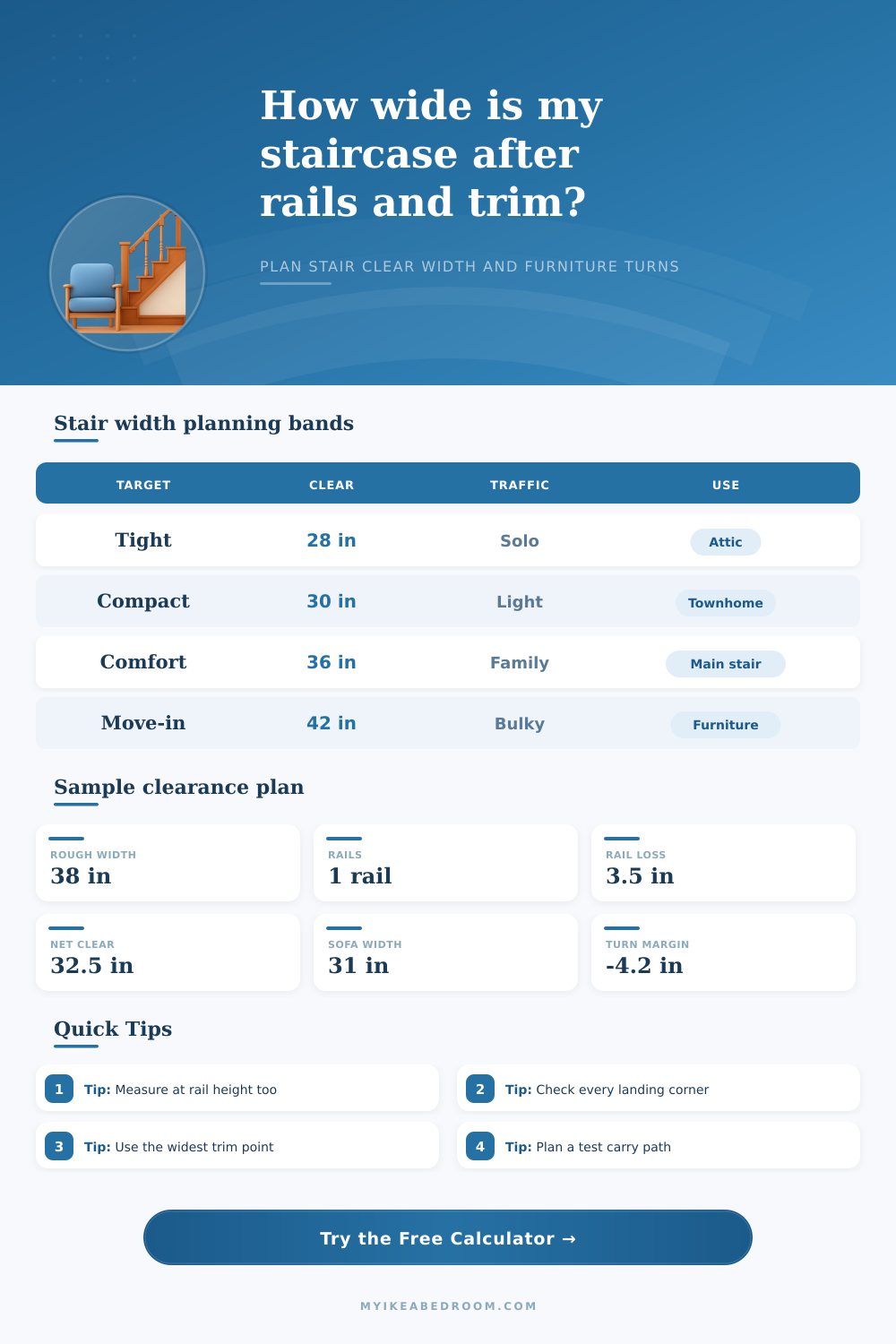
Estimate stair clear width after finish layers, skirt boards, and handrails, then compare it with furniture passage, landing turn room, traffic level, and a selected planning target.
Load a common stair condition, then adjust the dimensions from your own tape measurements. These are planning estimates, not legal or permit guidance.
| Band | Finished clear width | Best planning use | Watch point |
|---|---|---|---|
| Tight utility path | 28 to 30 in | Attic, loft, storage, occasional solo use | Bulky furniture and two-way passing are usually difficult. |
| Compact household stair | 30 to 34 in | Townhouses, older rowhomes, basement access | Rails, skirt boards, and trim can quickly erase carrying room. |
| Comfortable main stair | 34 to 38 in | Daily family traffic and normal laundry baskets | Large dressers may still need drawers and feet removed. |
| Move-in friendly route | 38 to 44 in | Sofas, mattresses, wardrobes, and multi-person carries | Landing size can become the real limit even when the run is wide. |
| Element | Typical deduction | Where to measure | Why it matters |
|---|---|---|---|
| Drywall or wall finish | 1/2 to 5/8 in per side | From framing or rough opening to finished wall face | Small finish layers affect every inch of stair run. |
| Skirt board and base trim | 1/4 to 3/4 in per side | At stair nose height and along the wall face | Trim often sticks farther out than the plain wall surface. |
| Round or oval handrail | 2 1/2 to 4 in per rail | From finished wall to outside face of rail | The rail face is often the tightest shoulder and furniture contact point. |
| Bracket or return detail | 1/4 to 1 in per rail | At brackets, volutes, rail ends, or posts | One protruding return can set the practical clearance for the whole path. |
| Item type | Typical carried width | Depth concern | Planning note |
|---|---|---|---|
| Flat-pack wardrobe box | 20 to 28 in | Long panels swing wide on turns | Usually passes narrow stairs if the landing lets the long side rotate. |
| Queen mattress | 30 to 36 in when bent or stood | Corner compression varies by mattress type | Soft items need less rail clearance but more landing control. |
| Small sofa or loveseat | 30 to 34 in after legs removed | Arm depth drives turn envelope | Check the diagonal against the landing, not only the stair run. |
| Tall dresser or chest | 28 to 36 in | Drawers and feet may add protrusions | Remove drawers and hardware before measuring the final carry width. |
| Turn type | Planning factor | Typical route | What usually limits it |
|---|---|---|---|
| Straight-through | 0.35 x small side added | Open stair to hall or no major corner | Rail face and shoulder width matter most. |
| Quarter turn landing | 0.50 x small side added | L-shaped stair with one pivot | Furniture depth competes with landing width. |
| Switchback landing | 0.65 x small side added | U-shaped stair with a 180 degree carry | Diagonal sweep and carrier positions become important. |
| Winder or angled turn | 0.75 x small side added | Older homes with tapered steps or tight bends | Narrow inside corners and rails can stop bulky items. |
When you are moving large furnitures into a home, you must measure your stairs and hallways to ensure the furniture will fit. Many people make the mistake of only measuring the widest part of they halls and stairs. However, many people fail to account for the narrowest part of the hallway or stairs.
This narrow part of the hallway or stairs is referred to as a pinch point. These pinch point will be crucial when moving the furniture because if you dont account for all of the pinch points, your furniture may not be able to move through that part of the hallway or stairs. One of the first error that a person might make is only measuring from wall to wall in the hallway or staircase.
Measure Stairs, Hallways, and Landings Before Moving Big Furniture
However, the staircase might have rough framing, drywall, and trim that take up space. Each of these elements will take up space so that when you measure the hallway or staircase from wall to wall, you must account for each of these elements to get the correct measurement of how wide the staircase or hallway are. Furthermore, people also must account for the handrail of the staircase.
A handrail take up space. When moving a large object, you need space for your hand and shoulder for other individuals to move with you. By deducting the handrail from the total measurements of the staircase, you will get a more accurate measurement of the available space.
Additionally, people must also account for the physical space that the individuals will take up when moving the furniture. If you are the only individual moving the furniture, you will need some space around the furniture. However, if other individuals is moving the furniture, those individuals will need more space to pivot and not hit the walls with their elbows.
Therefore, you will need to account for this space, known as a traffic buffer, when measuring the space that furniture will need to move through the home. The other issue that is likely to prevent your furniture from moving through your staircase is the landing. The landing is the spot where you will pivot your furniture to turn the corner.
When pivoting furniture, furniture will create a swept envelope. This swept envelope is the area that the furniture will take up while it is being pivoted on a corner. If the landing is too small for your furniture to pivot, your furniture will become a challenge to move through this spot in your home.
For this reason, the diagonal of the furniture is more important than the width of the furniture when dealing with a landing in your home. The width of the stairs and hallways that your furniture must travel will differ from home to home. For instance, the attic stairs might only need to be wide enough for one individual to pass.
However, the main stairs of the house should be wide enough for two individuals to pass each other. If you are remodeling your home, make sure the staircase is wide enough so that you wont have to dismantle any furniture to move it through the house. Planning for the most difficult move that you will make when moving into the home will ensure that you do not have to make any change once you are in your new home.
Finally, if you are unsure whether or not your furniture will fit in your home, create a mockup of the furniture using cardboard or painters tape. Using this mockup, you can get a better idea of the footprint of the furniture in the house and on the landings in your staircase. A mockup will allow you to see any potential contact points of the furniture that a tape measure might not be able to account for.
While the measurements of the furniture can only provide an estimate of the space that the furniture will take up in your new home, a mockup provides a physical representation of the space that your furniture will take up. Therefore, your goal is to find the narrowest point of the hallway from the entrance of the home to the spot where the furniture will be placed. Many individuals may think that their stairs are wide enough for their furniture.
However, when they enter their homes, they may find that the landing is a challenge for their furniture. Make sure to account for both the net clear width and the turn margin of each spot that the furniture will travel through your home. By taking the time to account for the different aspects of the space within your home, you can ensure that your furniture will indeed fit your reality of your home.