Stair Runner Width Calculator
Choose a runner width that keeps the exposed tread balanced on both sides, includes binding, and estimates runner length, carpet area, and waste for straight stairs, landings, and different wrap methods.
Pick a common staircase scenario, then adjust the stair width, reveal, runner width, binding, wrap style, landing length, and waste allowance.
Fit summary
The selected runner covers 75% of the stair width and leaves a classic reveal.
Usable center field: 25.5 in between bindings
Nearest standard alternative: 30 in runner leaves 3.0 in per side
Fit rating: Balanced
| Runner width | Typical stair width | Reveal per side | Best use |
|---|---|---|---|
| 22 in | 28 to 32 in | 3 to 5 in | Very narrow stairs or compact service stairs |
| 24 in | 30 to 34 in | 3 to 5 in | Older narrow stairs and attic stairs |
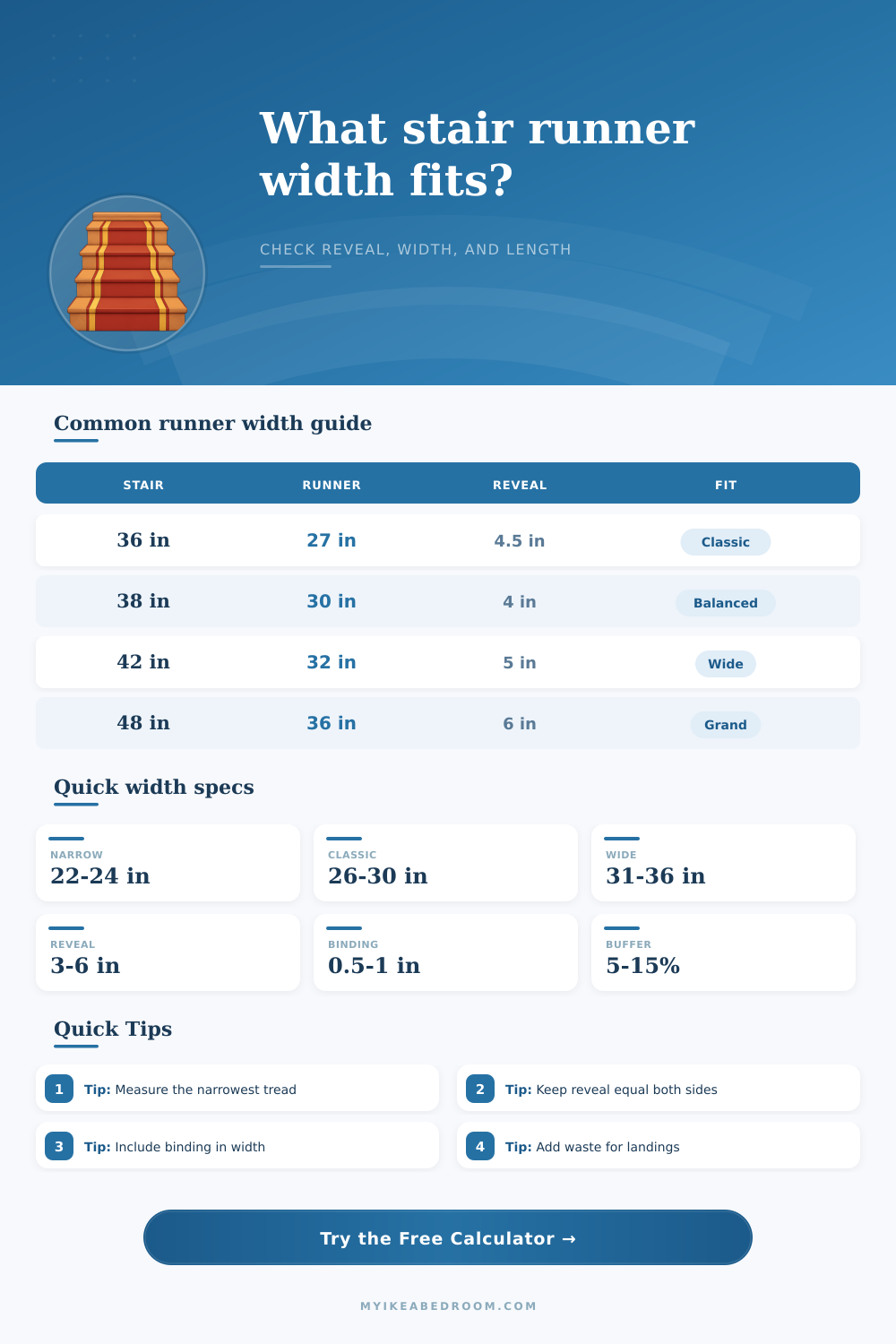
| 26 to 28 in | 34 to 38 in | 3 to 6 in | Classic residential runner proportions |
| 30 to 32 in | 38 to 44 in | 3 to 7 in | Wider hall stairs and larger entries |
| 36 to 39 in | 44 to 54 in | 4 to 8 in | Grand stairs and very wide staircases |
| Reveal per side | Visual effect | Watch for | Fit note |
|---|---|---|---|
| Under 2 in | Almost full carpet coverage | Edges may look cramped near skirts | Use only when a broad runner is intended |
| 2 to 3 in | Wide runner look | Small measuring errors show quickly | Good for open or grand stairs |
| 3 to 6 in | Balanced classic reveal | Keep both sides equal | Most common target range |
| 6 to 8 in | Narrower center runner | Runner may feel undersized on wide stairs | Works when wood tread is featured |
| Over 8 in | Accent strip effect | Less foot coverage on broad stairs | Usually choose a wider runner |
| Wrap style | Added length per tread | Visual result | Calculation use |
|---|---|---|---|
| Flat treads only | 0 in | Runner stops on treads or uses separate pieces | Shortest length estimate |
| Waterfall | 1 in | Smooth drop over each nosing | Common straight-run estimate |
| Hollywood wrap | 2 in | Follows the nose tightly | Adds tuck around each tread edge |
| Cap and band | 3 in | More wrapped and tailored | Use for higher trimming allowance |
| Stair scenario | Clear width | Runner width | Reveal each side |
|---|---|---|---|
| Compact cottage stair | 32 in | 24 in | 4 in |
| Standard closed stair | 36 in | 27 in | 4.5 in |
| Wide entry stair | 42 in | 32 in | 5 in |
| Grand center stair | 48 in | 36 in | 6 in |
Width tip: Use the narrowest tread width, especially when skirt boards, old plaster, or winders make the staircase slightly uneven. A runner that fits the tightest point will read straighter down the full stair.
Length tip: Count every tread and riser the runner touches, then add the landing length and the wrap allowance before waste. Patterned runners usually need more trimming room than plain runners.
A stair runner softens the visual impact of a staircase, but it’s all about width: Too narrow (a.k.a. Shoelaces) and it doesn’t make sense on a broad landing; too wide and it’s cumbersome, interrupting flow of the steps’ natural line. Enter your dimensions into the calculator above and it’ll do the math for you; no more guessing if a standard roll will fit your particular layout. You don’t want it to be accidental, you want the runner to seem intentional.
First, there’s a single critical measurement in this: the smallest clear width of your stair. It’s distance from wall to wall or skirt board to skirt board at its narrowest. In older homes, baseboards bow out and plaster bulges; they’re never straight. Cut to the top and it may or may not matches at the bottom. People makes this mistake. They plan for average width but need to plan for the minimum. Use the tool; it allows you to enter the narrow dimension first; the critical one, and it will calculate amount of tread revealed on each side (the wood showing through). That’s what we call the reveal.
How to Choose the Right Size Stair Runner
A typical balanced reveal is three to six inches on each side. Less than two inches, and the runner appears to be suffocating within its own territory; no longer does the carpet visually provide a separation from step to step. More than eight inches (on a wide stair) and the carpet transitions from being a functional floor to an ornamental one. Instead of appearing as a pathway, it take on the appearance of a stripe. Before reaching for a tape measure, use the calculator to see what the reveal would look like based off your exact dimensions. Use the runner width slider to adjust accordingly until numbers seem satisfactory.
Binding also counts. You see 27-inch runners that look great on paper but actualy have lots of binding on either side. So the effective width of the carpet itself isn’t as wide. The binding width inputs accounts for this fact. For most pro installs, they’ll do a waterfall wrap over the nosing. This adds about an inch of length per step because the material must drape smoothly over edge without bunching. Other wrapping types, like Hollywood wraps or cap and band methods, use more fabric at each corner. Failing to specify which type of wrap in your estimate could of meant being short when the installer shows up.
Complicating matters are landings. Calculating a simple straight run is easy, but a turn requires more trim and pivot material. If your stairs has winders or angles, add an extra ten to fifteen percent for waste. Even more important is whether you have a patterned runner, where each cut must match the others, so add in some additional buffer.
The page has a table that lays out typical situations so you can see how a large stair such as a grand staircase calls for a thirty-six inch wide runner different than a cottage stair which does just fine at twenty-four inches. It’s all about proportion. The runner, then, is like the belt on your outfit: It ties everything together, and when it’s not the right size, the whole thing doesn’t work. But you don’t have to memorize the ratios. You only have to know where to look. Measure carefully, factor in the binding, and leave the arithmetic to the tool. A well-fitted runner looks like part of the staircase rather than something just laid over it. Begin at the narrowest point, locate your reveal, and leave it to the math.