Straight rail sizing
Stair Handrail Length Calculator
Estimate the sloped rail length, total developed cut length, bracket count, and stair angle for wall-mounted handrails on interior and exterior stair flights.
Use finished stair dimensions. This tool assumes one straight sloped rail with level extensions added at the ends.
Different handrail materials change the feel in your hand, the finish options, and the bracket span you can comfortably support.
To properly installs a handrail on stairs, one must calculate the develop length of the handrail. The develop length of the handrail is the total length that the handrail will follow from one end of the stairs to another. People often makes mistakes when measuring for a handrail as they only measure for the sloped portion of the handrail.
However, the handrail must also account for the length of the handrail that will be required for the top and bottom of the stairs. Furthermore, the handrail will need to account for any return in the walls. The handrail will be too short for the stairs if the length needed for the returns in the walls isnt accounted for in the calculated length of the handrail.
How to Measure Handrail Length for Stairs
Stairs has a total rise and total run. The total rise of the stairs is the vertical distance from one finished floor to an other finished floor. The total run of the stairs is the horizontal distance from one stair to another stair.
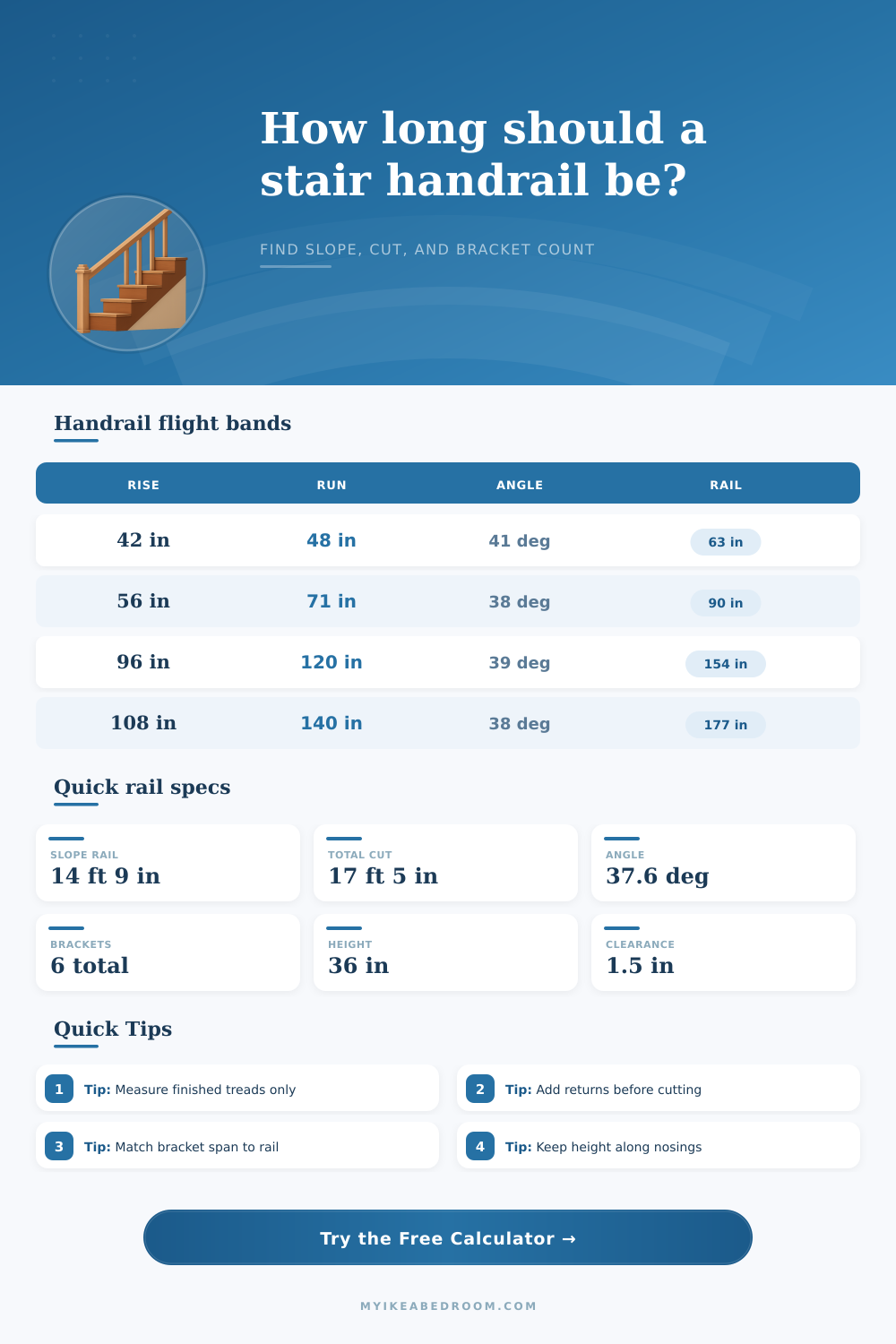
Using these two measurements, one can calculate the length of the sloped portion of the handrail as the hypotenuse of a triangle with the rise and run. This measurement must be take from the nosing of the stairs. Measuring from the nosing will result in the handrail being installed at an incorrect height.
The measurements for handrails should be taken from the finished stairs. Drywall may add to the thickness of the riser of the stairs. Additionally, carpet and tile may add to the depth of the treads of the stairs.
To properly calculate the length of the handrail, a person must use a tape measure to measure the number of risers and the distance from one stair to the next once the stairs are finished. These measurements will determine the angle of the handrail. A comfortable angle of a stair handrail is between 35 and 45 degree.
If the stairs are steeper than 45 degrees, it may be difficult for the user to grip the handrail as they must fight the force of gravity to grip the railing. Handrail extension are necessary for stairs at the top and bottom of the stairs. The length of the handrail should extend horizontally along the landing at the top of the stairs for at least the length of one tread of the stairs.
This extension will allow individual to find the handrail as they ascend the stairs. The handrail should extend at the bottom of the stairs to allow individuals to easily transition from the stairs to the floor or to an other wall return. Allowances should also be made for any returns in the walls.
Four inch of allowance for each end of the stairs for wall returns is standard as it is easier to trim a handrail than to add to it. Brackets will be placed along the length of the handrail. Brackets should be placed every 36 to 48 inch along the handrail.
However, the exact distance between the brackets will depend on the material of the handrail. For instance, if the handrail is wooden, brackets can be set more far apart as wood is more flexible and can take up more distance between the brackets. For metal handrails, you should place brackets at regular intervals as metal does not allow for as much flex as wood.
Additionally, the handrail should have at least a 1.5-inch clearance from the walls of the staircase as it is necessary for the individual’s fingers to be able to grip the railing without hitting the wall. The material of the handrail will impact how the handrail will perform on the stairs. For instance, aluminum is a good material for outdoor stairs as it resist water.
However, wood handrails such as oak may swell or crack if exposed to the rain. The height of the handrail should be between 34 and 38 inches from the stair nosing. The height of the handrail must be measured from the nosings of the stairs as measuring the height of the handrail from the wall will give incorrect measurement for the height.
Finally, before cutting the handrail to the length of the stairs, determine the length of the handrail stock necessary for the project. If the handrail length required for the stairs are longer than the standard length of handrail stock, such as 12 or 16 feet, a scarf joint will be necessary for the handrail stock. Additionally, you should test the height and flow of the handrail before installing the handrail in the staircase.
Testing the handrail will ensure that the handrail is to the correct height and follows the path of the stairs correctly.