Stair Guard Layout Pre-Check
Banister Calculator
Estimate sloped banister length, baluster spacing, piece count, bracket count, and order weight from real stair geometry. Inputs stay in one full row section and results render on a separate row below.
Each preset is a real stair or deck condition so spacing and count begin with practical jobsite geometry.
Core method: stair rise and run set slope length. Usable banister length then drives baluster count from opening cap, visual density, and service condition factors.
Full breakdown
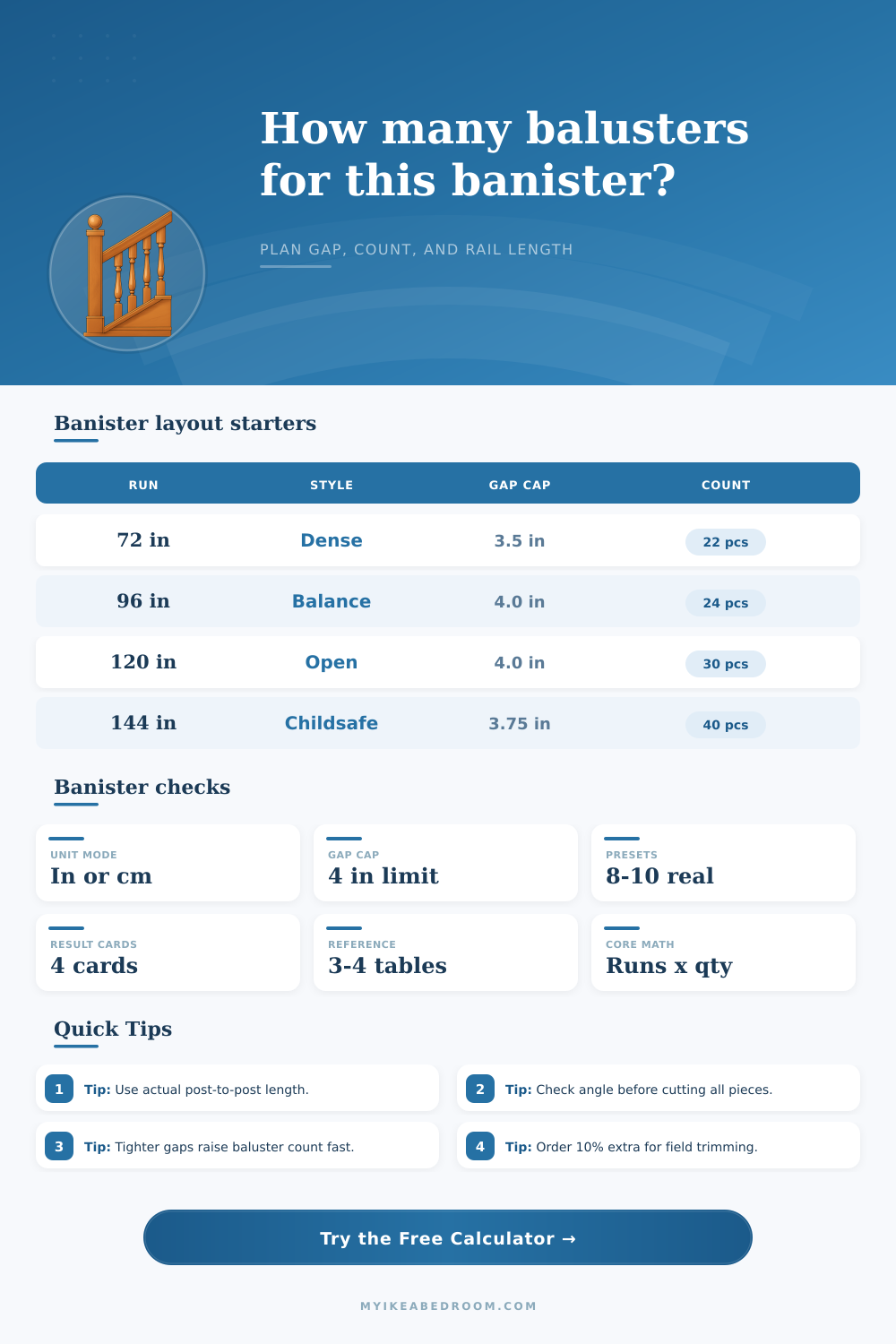
These tables compare spacing density, baluster profile effects, bracket spacing choices, and opening-cap bands using the current stair geometry.
| Density mode | Target gap | Balusters per run | Actual opening | Read on it |
|---|
| Profile | Nominal width | Balusters per run | Order weight | Comment |
|---|
| Bracket spacing | Brackets per run | Total brackets | Rail stock (8 ft) | Read on it |
|---|
| Band | Cap opening | Required count | Actual opening | Verdict |
|---|
Compare code-first, balanced, open-look, and heavy-duty banister directions under the same stair dimensions.
When you are planning your staircase, you must calculate the number of balusters that are required for a handrail. Many people will attempt to estimate the number of baluster that will be needed. However, using estimations often leads to ordering too few balusters for the staircase handrail, or placing the balusters in such a way that the staircase dont comply with building codes regarding handrail balusters.
The geometry of the stairs must be accounted for in the calculation of the number of balusters. The stairs is sloped, which means that the length of the handrail will be longer than horizontal distance of the stairs. Thus, if you do not calculate the slope of the handrail, you will end up with an incorrect number of balusters.
How to Measure and Buy Balusters for Stairs
To calculate the length of the handrail, you must measure the total rise and total run of the stairs. For instance, you could determine that the total rise of the staircase is 108 inches and the total run is 150 inches. The length of the handrail will be longer than 150 inches, due to the slope of the stairs.
You must also take into account the space that the newel posts will take up. Newel posts of a staircase have a certain width. Additionally, there is an inset distance from the newel post to the first baluster of the staircase.
Thus, the length of the handrail is determined by calculating the total rise and total run of the stairs, and then subtracting the width of the newel posts and the inset distance from the newel posts to the first baluster. If you do not take into account the width of the newel posts and the inset distances from those posts to the first balusters, you will order too many baluster for the staircase. Another factor that affect the number of balusters that will be needed for the staircase is the width of the balusters themselves.
Balusters that are of a wider width will require fewer balusters than balusters of a thin width. Thus, you must consider the width of the balusters when calculating the total number of balusters that will be needed. Furthermore, building codes require that the gap between balusters should not allow a four-inch sphere to pass through the staircase.
Thus, you must ensure that the spacing between balusters will be under four inches. Another consideration for the balusters is the density of the balusters. Dense baluster designs provide the look of a staircase that is private in relation to the space surrounding the staircase.
In contrast, stairs with sparse balusters will appear open and allow light to pass through to the area surrounding the staircase. You must decide on the density of the balusters because the weight of the balusters will change with the density. For instance, using balusters of a material like oak will create a much more heavy staircase than balusters of a material like aluminum.
Finally, you must consider the environment of the staircase when selecting the type of balusters. If the staircase is to be used in a coastal area, for instance, the balusters will be exposed to moisture. In this case, using materials like stainless steel will prevent the staircase from corroding.
It is also recommended that you order additional balusters beyond the calculated number of balusters that will be needed. For example, you may order an extra 10 percent of the total balusters that will be needed. Balusters may need to be trimmed to allow for the angle of the handrail.
Additionally, some baluster may be damaged and need to be replaced. Thus, you should of order extra balusters in case you need to replace any of the balusters. Finally, when you are installing the balusters, ensure they are plumb.
Balusters need to be vertical. The handrail will be sloped, but the balusters will remain vertical. Before installing the balusters to the handrail, dry-fit the balusters.
This allows you to ensure that the spacing between the balusters will comply with building codes. You should also check the spacing of the brackets that are to support the handrail. These brackets will provide a necessary support for the handrail.