Sprinkler Coverage Calculator
Estimate sprinkler spray area, zone coverage, head-to-head spacing, overlap allowance, head count, runtime depth, and precipitation rate for lawn or garden watering zones.
▶Lawn And Zone Presets
Pick a common lawn layout, then adjust zone shape, radius, arc, head spacing, overlap, flow, and runtime for the actual sprinkler heads.
⚙Zone And Sprinkler Inputs
Your sprinkler coverage estimate
Coverage breakdown
📐Formulas Used
spray area per head = pi x radius^2 x arc angle / 360
effective pattern area = spray area per head x head count x (1 - overlap percent)
head-to-head ratio = average head spacing / spray radius
precipitation rate in/hr = 96.3 x total GPM / zone area sq ft
💧Quick Sprinkler Specs
📋Coverage Reference Tables
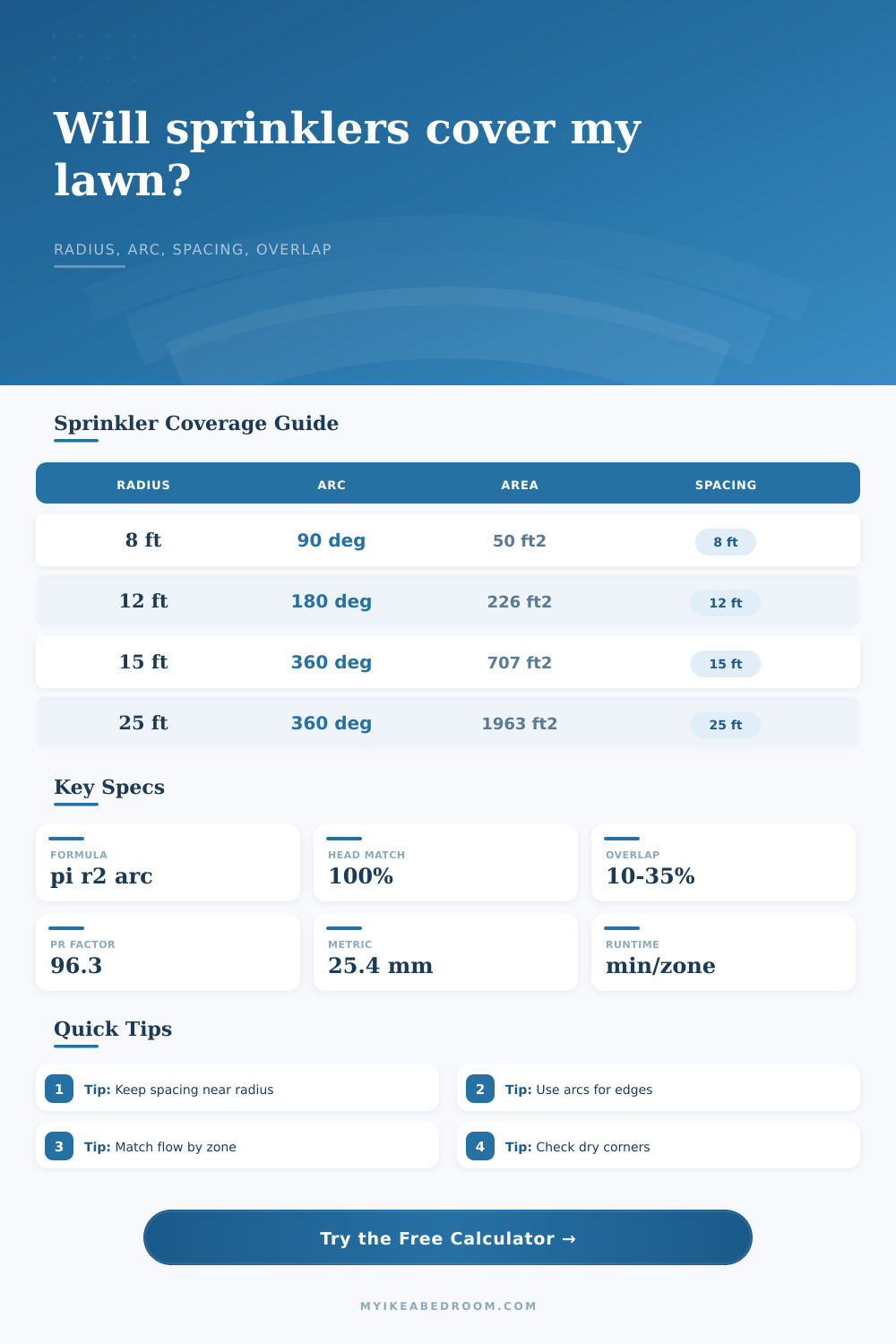
| Spray radius | Arc angle | Area per head | Head-to-head spacing |
|---|---|---|---|
| 8 ft / 2.4 m | 90 degrees | 50 sq ft / 4.7 sq m | About 8 ft / 2.4 m |
| 10 ft / 3.0 m | 180 degrees | 157 sq ft / 14.6 sq m | About 10 ft / 3.0 m |
| 12 ft / 3.7 m | 180 degrees | 226 sq ft / 21.0 sq m | About 12 ft / 3.7 m |
| 15 ft / 4.6 m | 360 degrees | 707 sq ft / 65.7 sq m | About 15 ft / 4.6 m |
| 25 ft / 7.6 m | 360 degrees | 1,963 sq ft / 182.4 sq m | About 25 ft / 7.6 m |
| Spacing ratio | Coverage signal | What it means | Adjustment cue |
|---|---|---|---|
| Under 80% | Heavy overlap | Heads are closer than radius | Check runoff and reduce runtime |
| 80% to 100% | Head-to-head | Spacing supports even coverage | Good starting range |
| 100% to 115% | Light gap risk | Spray edges may not meet well | Increase radius or add heads |
| Over 115% | Dry gap likely | Spacing exceeds throw by a lot | Reduce spacing or redesign zone |
| Zone area | Total flow | Precipitation rate | 20 min depth |
|---|---|---|---|
| 400 sq ft / 37 sq m | 4 GPM / 15 L/min | 0.96 in/hr / 24 mm/hr | 0.32 in / 8 mm |
| 600 sq ft / 56 sq m | 6 GPM / 23 L/min | 0.96 in/hr / 24 mm/hr | 0.32 in / 8 mm |
| 800 sq ft / 74 sq m | 8 GPM / 30 L/min | 0.96 in/hr / 24 mm/hr | 0.32 in / 8 mm |
| 1,200 sq ft / 111 sq m | 10 GPM / 38 L/min | 0.80 in/hr / 20 mm/hr | 0.27 in / 7 mm |
| Common zone | Typical arcs | Overlap target | Coverage note |
|---|---|---|---|
| Long strip | 90 to 180 degrees | 15% to 30% | Side edges need tighter spacing |
| Rectangle lawn | 90, 180, 360 degrees | 20% to 35% | Mix corners, edges, and centers |
| Round island | 360 degrees | 10% to 20% | Center head may cover most area |
| Corner bed | 45 to 120 degrees | 20% to 35% | Use arcs to avoid hardscape spray |
💡Sprinkler Coverage Tips
Ever wonder why that patch of brown, crunchy grass always happens right outside your driveway? Don’t blame it on soil (or even the sun). Most likely, it’s a matter of geometry. Sprinkler installation is part-plumbing, part-math, and it’s the latter that count most for irrigation design.
Placing sprinkler heads incorrectly won’t be helped by increasing runtime. Just feed in your head specs and zone dimensions, and let the calculator crunch all those hard numbers for you. No need to guess at coefficients.
How to Space Your Sprinklers
The spray radius is distance that water sprays from the nozzle out to where the water falls off the edge of the pattern. You need the radius to be the guide for how far apart you space heads. People make a mistake by trying to save money on fittings so they space their head farther apart then necessary. Heads should be no farther apart than their own radius.
When they’re closer together than that, you get the next head getting hit with spray from previous head. That’s called head-to-head coverage. If you spread them farther apart, what happens? Dry bands forms between patterns. You gotta have some overlap in the math.
Most lawns aren’t perfect circles; that’s why the tool request the arc angle. If your head is on a corner, use a ninety-degree arc. If it’s along the street, do a hundred-eighty-degree half-circle. Don’t waste water on sidewalk by using a full three-hundred-sixty-degree nozzle on an edge (it will create runoff instead). As you can see in the reference table, those arcs makes a difference in area covered. Even though radius of a quarter-circle is the same as a full circle, it doesn’t cover as much ground. The calculator automaticly accounts for this.
Another is precipitation rate: That’s the speed at which water hits the ground. A high precipitation rate, meaning that water is dropping on ground more quickly then it can soak in, causing it to run off or puddle, happens when water is delivered too fast. Sprays has a higher precipitation rate; rotors have a lower one (they’re throwing water slowly across a wide space). It calculates the rate from your area and flow, and then tells you what that rate is. Too high for your kind of soil? You’ll want to use shorter cycle, more often.
Overlapping presents another variable. Real world conditions makes things less perfect: nozzles get old, pressure fluctuates and spray is drifted by wind. To compensate, I add a ten to twenty percent buffer when calculating my overlap amount. Better to water slightly overlapping some of your lawn twice, than to miss part of it entirely. But too much overlap will waste water, so again you must strike a balance between evenly covering an area without being redundant.
Sprinkler systems are generally considered lights by most homeowners, so they just lay them out in an even pattern and assume that’s it. But lawns are not the same as lights… Shaded areas, slopes, soil compaction all impact water behavior. What the tool will do is give you a starting point, whether or not your setup make sense on paper.
Then you have to pay attention to water. Run it through, check for dry spots, and tweak the heads. It’s a repeating process. Begin with what you can calculate: start with inputs, then add the heads to fit those zones. And let the arithmetic determine the spacing; don’t make it force-fit your plan if it won’t work in the math.
A greening lawn is the prize, not a head-spinning puzzle. The lawn shape works out, and the gap next to the driveway dissapears, if physics allow it. Let the water do what it does best and go away.