Speaker Room Size Calculator
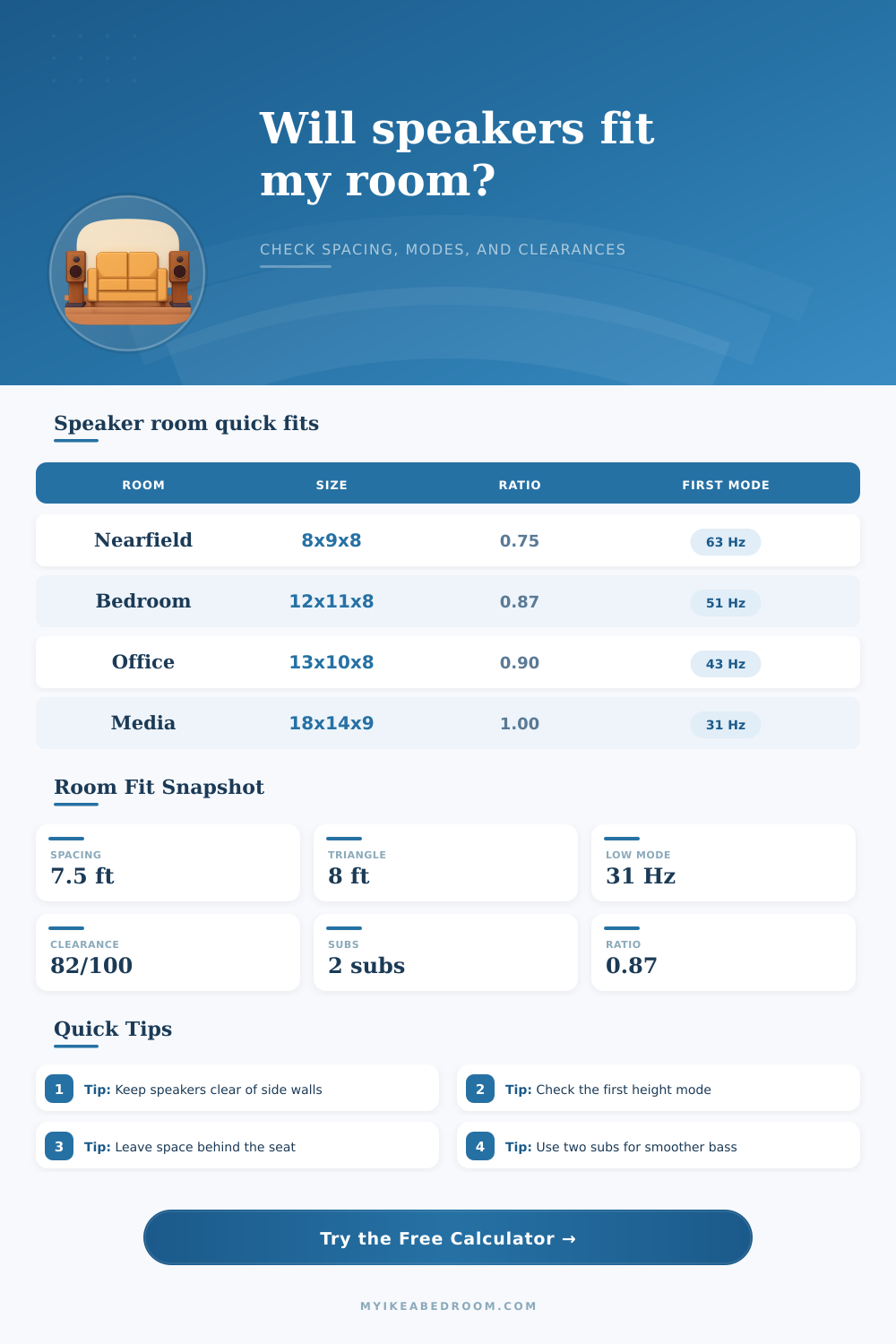
Check whether a room can support your stereo layout by estimating speaker spacing, listening triangle geometry, axial room modes, boundary clearance, and subwoofer fit.
Load a realistic starting point, then tune the dimensions and clearances to match your room.
Fit breakdown
Adjust the room values to calculate a fit.
| Layout target | Spacing divided by listening distance | Best fit | Tradeoff |
|---|---|---|---|
| Nearfield desk | 0.70 to 0.80 | Short desk or monitor bridge | Stable center image, narrower stage |
| Narrow stereo | 0.80 to 0.86 | Small bedroom or office | Works when side walls are close |
| Balanced stereo | 0.86 to 0.92 | Bookshelf speakers on stands | Good image width without crowding |
| Equilateral | 0.96 to 1.04 | Dedicated listening position | Needs enough width and side clearance |
| Wide image | 1.05 to 1.18 | Larger rooms with towers | Can thin the center if overdone |
| Mode formula | What it checks | Useful range | Planning note |
|---|---|---|---|
| 565 divided by room dimension in ft | First axial mode | 20 to 90 Hz | Lowest pressure buildup along one room axis |
| 1130 divided by room dimension in ft | Second axial mode | 40 to 180 Hz | Can stack with desk or wall reflections |
| 1695 divided by room dimension in ft | Third axial mode | 60 to 270 Hz | Often overlaps lower vocal warmth |
| Close modes within 5 Hz | Cluster risk | Any room size | Use seat shifts and sub placement to smooth |
| Speaker type | Front wall target | Side wall target | Fit behavior |
|---|---|---|---|
| Nearfield monitors | 1.0 to 2.0 ft | 1.0 to 1.5 ft | Short triangle controls early reflections |
| Compact bookshelf | 1.5 to 2.5 ft | 1.5 to 2.0 ft | Forgiving in bedrooms and offices |
| Bookshelf on stands | 2.0 to 3.0 ft | 2.0 to 3.0 ft | Benefits from symmetry and toe-in |
| Floorstanding towers | 2.5 to 4.0 ft | 2.5 to 3.5 ft | Needs breathing room for bass balance |
| On-wall speakers | 0.2 to 0.8 ft | 1.0 to 2.0 ft | Designed for shallow front clearance |
| Subwoofer count | Placement starting point | Expected smoothing | Room-size note |
|---|---|---|---|
| 0 subs | Main speakers only | Depends on speaker bass | Watch tower boundary buildup |
| 1 sub | Front wall quarter point | Moderate | Best with seat away from rear wall |
| 2 subs | Midpoints of front and back walls | Strong | Often best balance for small rooms |
| 3 subs | Front pair plus rear midpoint | Very strong | Useful for longer media rooms |
| 4 subs | Wall midpoints or corners | Highest | Needs careful level and delay matching |
Best when the listener sits close, speaker spacing stays under the desk width, and the rear wall clearance is limited.
Works well in bedrooms and offices because stands can set tweeter height, toe-in, and distance from boundaries.
Needs more front and side clearance because stronger low-frequency output interacts with room modes earlier.
Lets the main speakers stay compact while one or more subs handle the lowest modes and seat-to-seat variation.
In addition to the speaker itself, the room in which that speaker is playing into another listening device have an effect on the speaker. Speakers are not just devices that move air; they also interact with every flat surface, corner, and ceiling in the room in which they is deployed. If a person ignores the geometry of the room in which they place there speaker, they will hear the walls of the room instead of the speaker themself.
One way of establishing the speakers within a listening area is to form a listening triangle. Two speakers and the listener’s head form an imaginary equilateral triangle. Calculations of the listening triangle can inform a listener of the ideal spacing of the speakers, given the distance of the listener from the listening area.
How to Set Up Speakers in Your Room
An ideal listening triangle will result in a precise speaker setup that allows the singer to seem as if they are standing in front of the listener. An unbalanced listening triangle, however, will result in a vague soundscape, as if the listener is hearing a wall of sound emanating from the speakers. Ratios for placement of the speakers are necessary due to the fact that a listening triangle may not be able to be formed within each listening area.
For example, a listening area may be a narrow hallway, or may be occupied by a large sectional sofa that prevents the formation of a perfect listening triangle. Additionally, some individuals prefer a wide sonic image to immerse the listeners into the music, while others require the placement of the speakers in a narrow fashion to prevent the speakers from becoming physical obstacle within the listening area. By shifting the listener’s distance from the speakers, it is possible to increase the spatial awareness of the listener by changing how sound interacts with the listeners ears.
Boundary reinforcement, or the phenomenon in which speakers are placed too close to a wall, cause issues in the bass frequencies emanating from those speakers. This phenomenon occurs because the speaker reflects low frequencies off the wall very quick, causing the bass to become bloated and boomy. The calculator will allow the listener to determine if the speakers are at risk of creating this phenomenon by measuring the clearance score.
Floorstanding speakers may require more clearance from the walls than nearfield monitor speaker. Room modes are frequencies that the dimensions of the listening area create. The specific note within that room will resonate regardless of the music that is played.
For instance, if the length of the room reinforces a certain frequency, such as 40 Hz, that frequency will be loud in one part of the room while dissapears in another part of the same room. These axial modes in the room can create issues with the bass within a bedroom, thus allowing individuals to understand the reason for a subwoofers incorrect behavior. It is common for the addition of a subwoofer to each listening area.
Each subwoofer can introduce a peak of bass to a certain corner of the room. Additional subwoofers can help to even out these high peaks of bass. Thus, the addition of more subwoofers will help to fill in the gap in the bass that may disappear in certain area of the room.
The reference tables will help to determine the number of subwoofers that is necessary for the room based off its size. In addition to the ceiling and floor, the ceiling also reflects the sound from the speakers. If the height from the speakers to the ceiling is too low, the reflected sound will bounce off of the ceiling and into the listener’s ears.
This reflected sound can potentially cause cognitive confusion for the listener, and can reduce the clarity with which the listener hears the high frequencies of certain instrument. To combat this reflection of sound, some individuals utilize acoustic cloud, or adjust the angle of the speakers. The listener can use the placement maps from the calculator as a map, but not as laws that must be followed.
For example, if the clearance score is low, the listener may shift one of the speakers away from a side wall. Additionally, if the modes indicate certain frequencies, that listener may move their seat forward or backward from the speakers. While the calculations will help to even out the sounds in each listening area, a person must utilize their ears to perfect the sound that are created in their listening area.
Thus, by following the guide provided on this page, a listener can transform their listening area into a listening area that is calibrated for each individual listener.