Room isolation, absorption, gap control, and panel sizing
🎧 Soundproofing Calculator
Size treated area, panel count, core volume, and assembly mass for bedrooms, offices, practice rooms, and shared walls while keeping metric and imperial modes aligned.
📌Preset soundproofing scenarios
🔧Soundproofing inputs
📊Calculation results
📋Reference tables
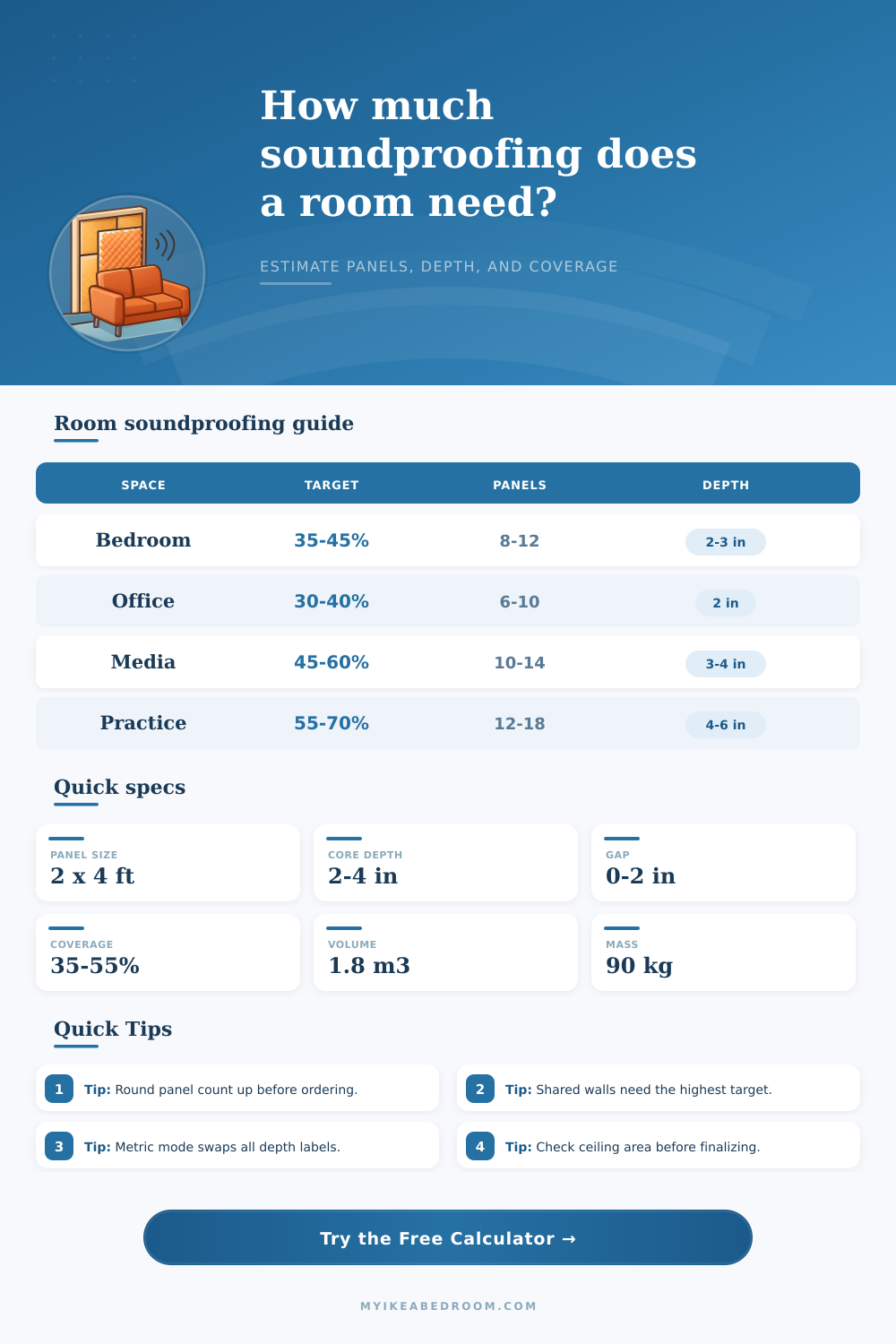
| Use | Target share | Depth | Gap | Focus |
|---|---|---|---|---|
| Bedroom | 34% | 2 in | 1 in | Sleep wall |
| Office | 31% | 2 in | 0.5 in | Speech control |
| Media | 42% | 3 in | 1 in | Front wall |
| Practice | 56% | 4 in | 1.5 in | Music room |
| Nursery | 28% | 2 in | 0.5 in | Quiet corner |
| Shared wall | 50% | 4 in | 2 in | Isolation wall |
| Panel | Area | Per 100 sf | Metric note | Best fit |
|---|---|---|---|---|
| 2 x 2 ft | 4 sf | 25 panels | 0.37 m2 | Closets |
| 2 x 3 ft | 6 sf | 17 panels | 0.56 m2 | Desk walls |
| 2 x 4 ft | 8 sf | 13 panels | 0.74 m2 | Bedrooms |
| 4 x 4 ft | 16 sf | 7 panels | 1.49 m2 | Large walls |
| Material | Density | Face wt | Area factor | Use |
|---|---|---|---|---|
| Mineral wool | 2.8 lb/cf | 0.30 psf | 1.00x | Broadband core |
| Fiberglass | 1.8 lb/cf | 0.18 psf | 1.02x | Light absorption |
| PET felt | 1.5 lb/cf | 0.20 psf | 1.05x | Neat wall finish |
| Acoustic foam | 1.2 lb/cf | 0.10 psf | 1.08x | Compact control |
| MLV composite | 11.0 lb/cf | 1.00 psf | 1.15x | Barrier layer |
| Double gypsum | 18.0 lb/cf | 2.20 psf | 1.18x | Heavy shell |
| Shape | Area formula | Perimeter | Input pair | Best use |
|---|---|---|---|---|
| Rectangle | L x W | 2(L+W) | Length and width | Most rooms |
| Circle | pi r2 | pi d | Diameter only | Round nooks |
| Triangle | 0.5 b h | b+2s | Base and height | Corner fills |
| Custom | Entered area | Entered perimeter | Area and perimeter | Odd layouts |
📦Material and spec comparison
💡Tip boxes
Soundproofing is the process of reducing the amount of sounds that enters or leaves a room. Soundproofing require an understanding of how sound move through a space. Sound moves through a space in the form of vibrations that travel through the walls, studs in the walls, and the gaps under doors.
Sound also reflect off of hard surfaces in the room. When sound reflects off of hard surfaces, those reflected sounds create echo in the room. Many people attempt to solve sound problem by simply sticking foam squares to the walls.
How to Soundproof a Room
However, foam squares are designed to absorb sound waves, not block sound waves from moving from one room to the next. Absorption is the process of stopping the echo of sound within a given room. Blocking sound, on the other hand, is the process of stopping sound from traveling from one room to another.
To block sound from a room, an understanding of the relationship between mass and air are required. The mass of a material refers to the weight and density of that material. Mass is a requirement for stopping a sound wave from moving through a material.
When a sound wave move, it creates vibrations. The use of a material that has a significant amount of mass must counteract the vibrations. Using a light foam panel may stop a high-pitched sound from a radio, for example.
However, the same light foam panel will not stop a low-frequency sound, such as the sound of a bass guitar. Blocking low-frequency sound require a material that has a high amount of mass. In soundproofing, the total mass of the materials must be calculated.
The total mass of the soundproofing materials will determine whether or not that material will act as a barrier to sound, or if it will simply be used as a decorative layer in the walls of a structure. When soundproofing a wall, another factor to consider is how much of the wall’s surface area will be covered by the soundproofing panels. The amount of wall area that must be covered with soundproofing depend on the purpose of the room.
A bedroom will require less soundproofing coverage than a music practice room. This is because a bedroom only needs to dampen the sounds of specific noises that enters the sleeping persons room. A music practice room, however, create more energy than a sleeping person.
If too much of the soundproofing panels are added to a small room, the room may start to feel unnatural when in use. An unnatural environment can lead to an unpleasant sound experience for those who are in that area. There are different type of soundproofing materials out there.
Each material has a specific purpose within soundproofing. Mineral wool is a dense material used for absorbing sound waves with a broadband frequency. Fiberglass is a lighter material used to absorb speech and high-frequency sounds.
Finally, mass loaded vinyl and gypsum wall panels are the two heaviest materials for soundproofing; they are used in the process of sound isolation. Sound isolation is the process of adding bulk to a material to stop the vibration of sound from moving from one room to another. If an individual desires to stop their voice from traveling down the hallway to the next room, fiberglass is the preferred material.
However, if the individual desires to block sound from a neighbor’s room from entering there own, mass loaded vinyl is the material of choice. Another factor in soundproofing is the depth of the soundproofing panel and the presence of air gap. If a soundproofing panel is too shallow, it may be able to stop the vibrations of mid-range sound waves.
However, to stop low-frequency sound waves, such as sound from a subwoofer, a deep soundproofing panel is required. An air gap is introduced between the soundproofing panel and the wall. This air gap can increase the performance of the soundproofing panel.
When a soundwave hits the panel, the soundwave will pass through the panel into the wall. The soundwave will reflect off of the wall and the soundproofing panel will catch it as it travels back out of the wall. The geometry of a room can have an impact on how sound move in that specific room.
Most rooms are in the shape of rectangles. However, sound often collects in the corners of those rectangles. Placing soundproofing panels on only the walls of the room will allow sound to remain loudly in the corners of the room.
Additionally, sound will seek out the path of least resistance. This path of least resistance could be the floor or the ceiling of the room. If soundproofing panels are only placed on only one wall of a room, it is likely that sound will be traveling through the rest of the room.
It would be unnatural for one wall of a room to be soundproofed while the other walls are not. Another consideration when purchasing soundproofing panels is that more soundproofing panels should be ordered than the math suggest will be necessary for the job. Ten percent more soundproofing panels should be ordered than the total number that is calculated.
This is because some soundproofing panels may need to be cut to fit around the doors, windows, and other fixtures in the walls. When a person cuts a soundproofing panel, the offcuts are often of no use to soundproofing the walls of a room. By understanding the factors discussed in this article, such as mass, depth, and coverage, an individual is able to manage any soundproofing project that they might encounter for their home or commercial structure.
You’ll find that mass is actualy the most importent thing to consider. You should of looked at the thickness of the walls too. Most people thinks that foam is enough, but it isnt.
It would of been better to use mass loaded vinyl. It is much more effective than a light foam panel. Doing it right will make the room feel more comfortabley.
If you dont follow these steps, you might recieve a noisy room.