Loose fill, foam crumb, fiber, and cushion refill planner
Sofa Cushion Fill Weight Calculator
Estimate cushion volume, compression-adjusted fill weight, per-cushion portions, chamber portions, refill quantity, bag count, and firmness band for sofa seats, back pillows, chaise cushions, loveseats, floor sofas, and modular sectionals.
The calculator treats the cushion as a soft rectangular chamber. For sewn cushions, measure the cover after it has relaxed and use seam allowance to avoid overfilling the corners.
| Cushion type | Typical size | Fill approach | Firmness target |
|---|---|---|---|
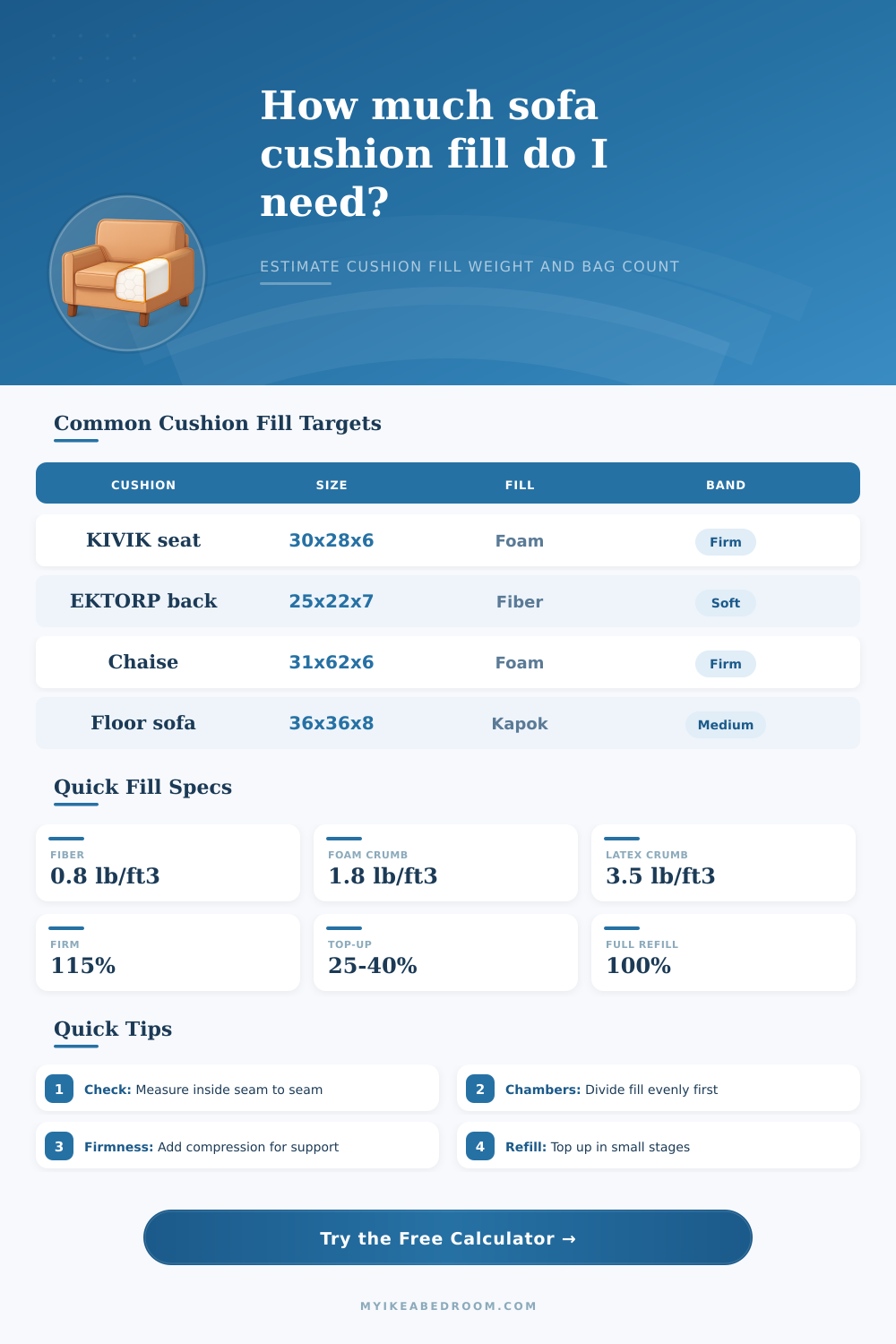
| KIVIK-style seat cushion | 30 x 28 x 6 in | Foam crumb or foam-fiber blend with two chambers. | Firm seat, 15% to 25% compression. |
| EKTORP-style back cushion | 25 x 22 x 7 in | Polyester fiber or down-feather blend with gentle loft. | Soft to medium, 5% to 15% compression. |
| Sectional chaise cushion | 31 x 62 x 6 in | Shredded foam in three or four lengthwise chambers. | Firm, 18% to 28% compression. |
| Floor sofa cushion | 36 x 36 x 8 in | Kapok, fiber, or foam crumb in large baffled chambers. | Medium lounge, 10% to 22% compression. |
| Outdoor bench cushion | 48 x 18 x 4 in | Poly fill or quick-dry fiber with modest compression. | Medium, 8% to 18% compression. |
| Fill material | Planning density | Best use | Adjustment note |
|---|---|---|---|
| Polyester fiber fill | 0.6 to 1.0 lb/ft³ | Back cushions, pillows, soft toppers. | Fluff first, then pack in handfuls. |
| Shredded foam crumb | 1.5 to 2.2 lb/ft³ | Loose seat refills and modular cushions. | Overfill slightly for firmer seats. |
| Memory foam blend | 2.0 to 3.0 lb/ft³ | Deep lounge cushions needing slower rebound. | Rest foam before judging fullness. |
| Latex foam crumb | 3.0 to 4.0 lb/ft³ | Supportive seats and resilient floor cushions. | Weigh portions because it is dense. |
| Kapok fiber | 0.45 to 0.7 lb/ft³ | Soft natural pillows and low-pressure backs. | Needs periodic redistribution. |
| Firmness band | Multiplier | Compression target | What it feels like |
|---|---|---|---|
| Soft lounge | 0.85x fill weight | 5% to 12% | Relaxed, squeezable backs and pillows. |
| Medium support | 1.00x fill weight | 10% to 18% | Everyday sofa seat with moderate loft. |
| Firm seat | 1.15x fill weight | 18% to 28% | Structured cushion that resists sagging. |
| Extra firm | 1.30x fill weight | 28% to 40% | Dense support for floor sofa blocks or firm seats. |
| Refill task | Refill percent | Chamber strategy | Bag planning |
|---|---|---|---|
| Light loft top-up | 15% to 25% | Add evenly to corners and upper edge first. | Usually one small bag covers multiple backs. |
| Noticeable sag repair | 30% to 50% | Split fill by chamber and rest before closing. | Round up because opened bags settle. |
| Full loose-fill replacement | 100% | Weigh each chamber portion before stuffing. | Use total calculator result plus one small spare bag. |
| Firmness conversion | 110% to 130% | Use baffling or seams to prevent clumping. | Choose denser material instead of endless fiber. |
When your couch pillows start to flatten out you know it’s time. What started off as a nice rectangular shape turns into a disc. You attempt to plump up the cushion but it never bounces back; rather the fill bunch up or falls apart. Why? Well loose fill is intended to compress. People generaly estimate what size replacement cushion they will require. They end up with either too much or too little stuffing in their cover, leaving their bottom all saggy or their cover skin-tight.
By entering in the size of your item, the calculator figures out math for you so you don’t distort the fabric or overfill the space in the compartment. The first thing to do is actualy measure the space within the cover itself. Don’t look at outer width of the pillow. Look at the seam-to-seam measurement. Why? Because when a fabric is folded over, that takes up space in the seam allowance. So if your pillow has sides tucked under then you want to measure without tucks on either side. That’s going to account for the space you’re not planning for and it make a difference in the finished product.
How to Measure and Refill Your Cushions
So what makes a cushion feel hard versus soft? soft? That’s all about density. We use two different type of fill. Shredded foam crumb is heavier and provides good support. Polyester fiber, like what is used in back pillows, is light and airy so you can really sink into it. For the type of material you purchase, use this tool to adjust accordingly. Latex crumb will be heavier because its denseness require more mass. The tool converts that into pounds so you know exactly how much to add.
But there’s another thing people get wrong about compression. They buy it based off only on the volume they are filling. Loose fill compresses under pressure. This explains the multiplier in the band selector which adjust the base weight upward. So if you want a firm seat (that means the material compresses when you sit), then you’ll require more fill than what was shown by the empty volume. Conversely, less of this buffer is needed for a softer back cushion. And this is where the reference table comes into play by linking compression levels with comfort types.
Many new sofas has their cushions internally divided into 2-3 sections. That’s good for preventing filling from moving to only half the cushion. Before beginning a pour, calculate what % of the total weight is in each chamber and then begin with that amount. Otherwise, if you guess that it’s even on both sides, you’ll find out later the hard way that one side will be significantly firmer then the other. If you weigh out the amount in each section first, they’ll match up perfectly. This will make topping them off later a snap because you’ll know exactly how much goes into each.
Photo via: Design Sponge
It’s not typically a complete refilling. Just topping off is usually sufficient. You can program the refill level on the tool. If your cushion looks good but doesn’t feel as cushy, a 25% refill will often make it good as new and maintain same feel the couch had. Topping off is also much cleaner than having to remove all the existing fill, so for full replacements, you’ll plan out how many bags you think you might need (so you don’t run out halfway through the process!). You might also end up with half a bag of foam crumbs.
The time cushion will also settle into your shape over time. It is not like solid foam but loose fill. That’s where some care is needed. Fluffing out the fibers reset the compression. This redistributes the fibers. Now you can weigh down what’s in there and know how much is there. How do you reset it? Pack it all back up evenly by measuring the cover, weighing parts of it, and then packing it in. Voila! You get a brand-new-feeling couch and cushion that stay shaped the way you like them.