Soap Mold Volume Calculator
Estimate rectangular, cylinder, or oval soap mold volume, target fill percentage, fluid ounces, milliliters, rough oil weight, and user-ratio lye and water amounts.
■Mold presets
■Soap mold inputs
Measure the inside mold cavity. Oil weight uses the rough cold process planning rule: 0.4 oz oil per cubic inch of filled mold volume.
Soap mold volume results
■Formula cards
■Soap mold reference tables
| Mold shape | Volume formula | Best measurement | Planning note |
|---|---|---|---|
| Rectangular loaf or slab | Length × width × height | Inside dimensions at the soap batter line | Works for loaf molds, slab trays, square bars, and divider cavities. |
| Cylinder or round tube | pi × radius² × height | Inside diameter and pour length or height | Use the filled length for horizontal tubes and the filled height for vertical tubes. |
| Oval bar or loaf | Length × width × 0.785 × height | Long and short inside diameters | Oval math avoids overestimating curved molds with rectangle volume. |
| Multiple cavities | Single cavity volume × cavity count | One cavity measured inside the walls | Use the matching molds input for identical cavities or duplicate loaf molds. |
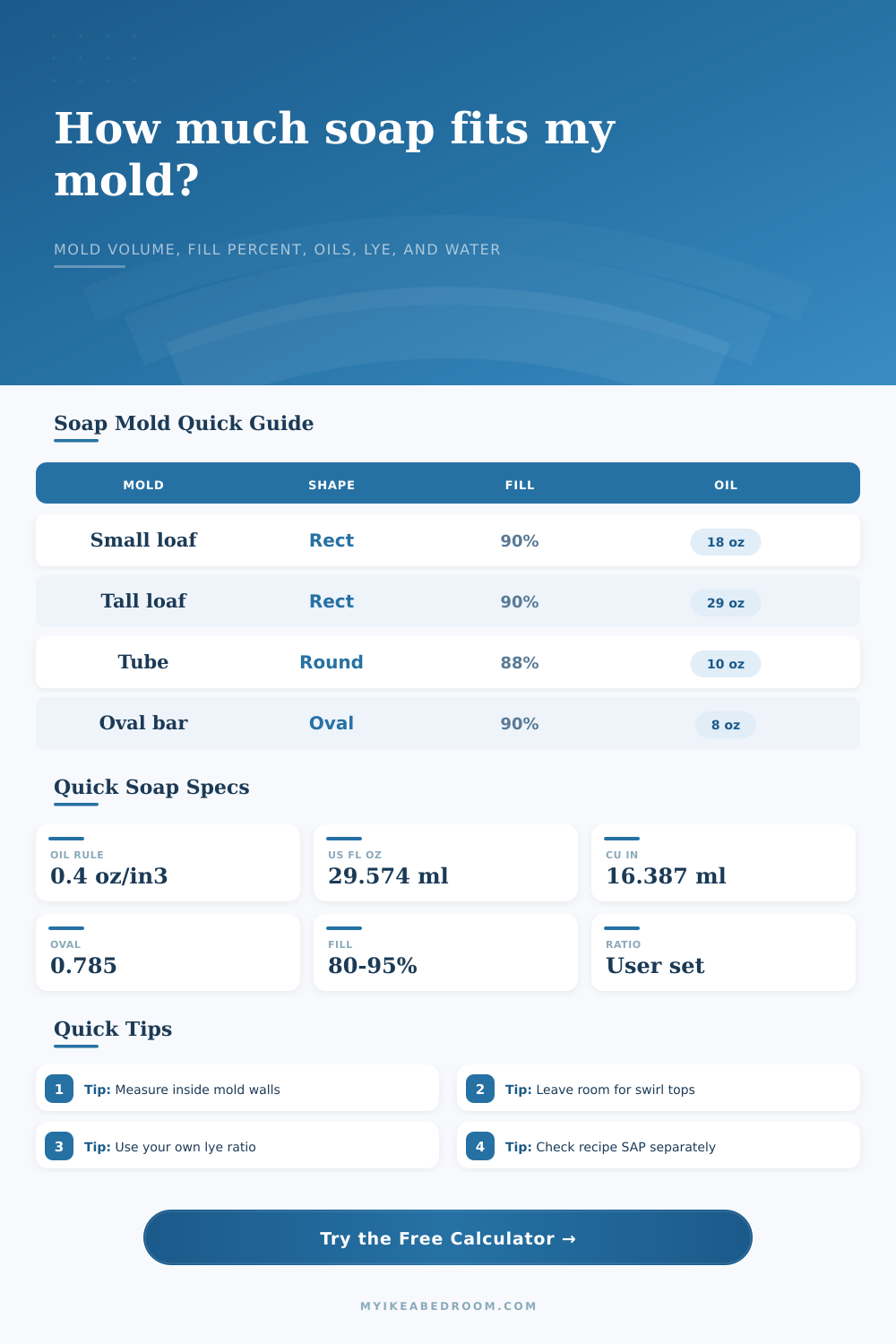
| Fill percentage | Full capacity × fill percent | Usable batter line below rim | Use 80 to 95 percent to leave room for texture, dividers, and movement. |
| Preset | Inside size | Filled volume | Rough oil estimate |
|---|---|---|---|
| Small loaf mold | 8 in × 2.75 in × 2.25 in rectangle at 90% | 44.6 in³ / 731 ml / 24.7 fl oz | 17.8 oz / 506 g oils |
| Standard loaf mold | 10 in × 3.5 in × 2.5 in rectangle at 90% | 78.8 in³ / 1290 ml / 43.6 fl oz | 31.5 oz / 893 g oils |
| Tall skinny loaf | 10 in × 2.5 in × 3.0 in rectangle at 88% | 66.0 in³ / 1082 ml / 36.6 fl oz | 26.4 oz / 748 g oils |
| Small slab tray | 9 in × 9 in × 1.25 in rectangle at 85% | 86.1 in³ / 1411 ml / 47.7 fl oz | 34.4 oz / 976 g oils |
| Mini bar cavity tray | 12 cavities, each 3 in × 2 in × 1 in at 90% | 64.8 in³ / 1062 ml / 35.9 fl oz | 25.9 oz / 735 g oils |
| Round tube mold | 3 in diameter × 4 in length cylinder at 88% | 24.9 in³ / 407 ml / 13.8 fl oz | 10.0 oz / 282 g oils |
| Large cylinder loaf | 3.5 in diameter × 10 in length cylinder at 90% | 86.6 in³ / 1419 ml / 48.0 fl oz | 34.6 oz / 982 g oils |
| Oval silicone bar | 6 cavities, each 3.25 in × 2.25 in × 1.1 in oval at 90% | 34.1 in³ / 559 ml / 18.9 fl oz | 13.6 oz / 387 g oils |
| Metric loaf mold | 25 cm × 7 cm × 6 cm rectangle at 90% | 57.7 in³ / 945 ml / 32.0 fl oz | 23.1 oz / 654 g oils |
| Filled mold volume | Fluid ounces | Milliliters | Oil estimate at 0.4 oz per cu in |
|---|---|---|---|
| 25 in³ | 13.9 fl oz | 410 ml | 10.0 oz / 283 g oils |
| 50 in³ | 27.7 fl oz | 819 ml | 20.0 oz / 567 g oils |
| 75 in³ | 41.6 fl oz | 1229 ml | 30.0 oz / 850 g oils |
| 100 in³ | 55.4 fl oz | 1639 ml | 40.0 oz / 1134 g oils |
| 125 in³ | 69.3 fl oz | 2048 ml | 50.0 oz / 1417 g oils |
| Oil weight | Lye at 13.8% of oils | Water at 30% of oils | Important recipe note |
|---|---|---|---|
| 16 oz / 454 g oils | 2.21 oz / 63 g | 4.80 oz / 136 g | Calculator scales your entered ratio only; recipe SAP still controls safe lye. |
| 24 oz / 680 g oils | 3.31 oz / 94 g | 7.20 oz / 204 g | Use your soap recipe or a dedicated lye calculator for the true NaOH amount. |
| 32 oz / 907 g oils | 4.42 oz / 125 g | 9.60 oz / 272 g | Water can be adjusted by maker preference, technique, and fragrance behavior. |
| 40 oz / 1134 g oils | 5.52 oz / 157 g | 12.00 oz / 340 g | The mold volume estimate is for batch sizing, not formula safety validation. |
| 48 oz / 1361 g oils | 6.62 oz / 188 g | 14.40 oz / 408 g | Always weigh ingredients accurately and confirm all recipe ratios before mixing. |
■Soap mold measuring tips
You measure out some cold process soap batter and pour it into a soap mold. When the soap reaches the edge of the mold, it creep up over the top. It can comes out of the mold and cool on your countertop. You end up with a hot mess where your soap should be.
Here’s the thing, the math isn’t usually wrong. What is wrong is the difference between the soap mold cavity and the soap mold. What you are measuring from the outside isn’t realy how much room there is for soap. It’s mostly wood, silicone, or plastic.
How to Use the Soap Mold Calculator
That’s where the calculator comes in (above); it makes you think about how much usable interior space is inside your wall. It ask for height, width, and depth, and uses those figures to calculate how many true cubic inches will fit inside the wall.
And why does this matter? Because soap batter grows when it reaches trace, then shrinks a little bit while curing. Filling a mold to its full volume leave zero wiggle-room for things like texturing, swirls, or just plain old pouring mishaps. By using a fill percentage (typically about 90%) you build-in an error cushion with this tool, a safety zone for whatever happens next. Just a tiny tweak in the math, yet one that saves time and mess from a post-pour clean-up.
Precision also matters in selecting the proper shape setting. If it’s a rectangle, it’s straightforward and easy peasy. If it’s an oval or a cylindrical tube (like bar molds), those aren’t rectangles and need some math attention. That round corner of a cylinder isn’t the same as rounding a square. You are using the radius plus pi. This has a major impact on surface area and volume compared to a similarly sized rectangular block of the same maximum width.
Don’t worry. The calculator does that for you automatically and knows what to apply to get the area calculation right. There is no need to memorize those high school geometry equations. And it even can converts fluid ounces to cubic inches, handy when your recipes are scaled by liquid volume instead of by weight.
With this volume, it calculates how much oil would of been required to fill up that space. It does so based off a standard rule of thumb: about four tenths of an ounce of oil per cubic inch of mold. (Remember this isn’t set in stone; this is a rough guess.) Depending on which oils you use in your recipe, how watery your lye solution was, and if you added things like micas or clays to your batter, the weight will change. A higher-water recipe may need just a bit more oil to come to the same level. Certain additives, especially heavier ones like clays, will displaces more.
The calculator provides a ballpark figure, but always double check the final calculations against a true soap formulation program using saponification values. This will make certain that your lye and water levels is appropriate for the types of fat you’re working with, and that they won’t burn the soap.
For example, the page has some handy reference tables to compare common mold sizes side-by-side. This lets you see at-a-glance how much more a large cylinder will hold than a small loaf, what the approximate yield is for each, etc. It’s good for seeing trends (e.g., what effect does doubling the diameter have on a cylinder vs. What happens if you double its height? The volume grows exponentially with diameter but only linearly with height, which helps you design your own molds to suit both your desired batch size and your space.
You’ll often get used to always making either too-large or too-small of a batch, adjusting even by half an inch can dramatically affect the yield of the final loaves. There’s no magic bullet to batch planning. It’s half experience and half science. No general formula you find here will stop you from learning something new about how your batter behaves in YOUR kitchen. The speed with which you mix it, the temperature, the humidity (they all affects the final size).
The beauty of the calculator is that it takes all this guesswork out of figuring out what your initial size should be, so you can build up from there. When you are ready to pour that batter, you will know you have enough to fill the mold without waste, and enough room to let the soap breathe as it sets. It may add another half-minute of measuring the interior of your mold, but avoids hours spent scrubbing hardened soap from your countertop.