Smart Lock Battery Life Calculator
Estimate smart lock battery life in days and months from battery capacity, lock and unlock cycles, standby current, wireless wakeups, cold weather derating, and low-battery reserve.
▶Lock And Use Presets
Pick a realistic access pattern, then fine-tune the battery, current, wakeup, weather, and reserve fields below.
⚙Battery And Drain Inputs
Your Smart Lock Battery Estimate
Calculation Breakdown
🔋Current And Capacity Factors
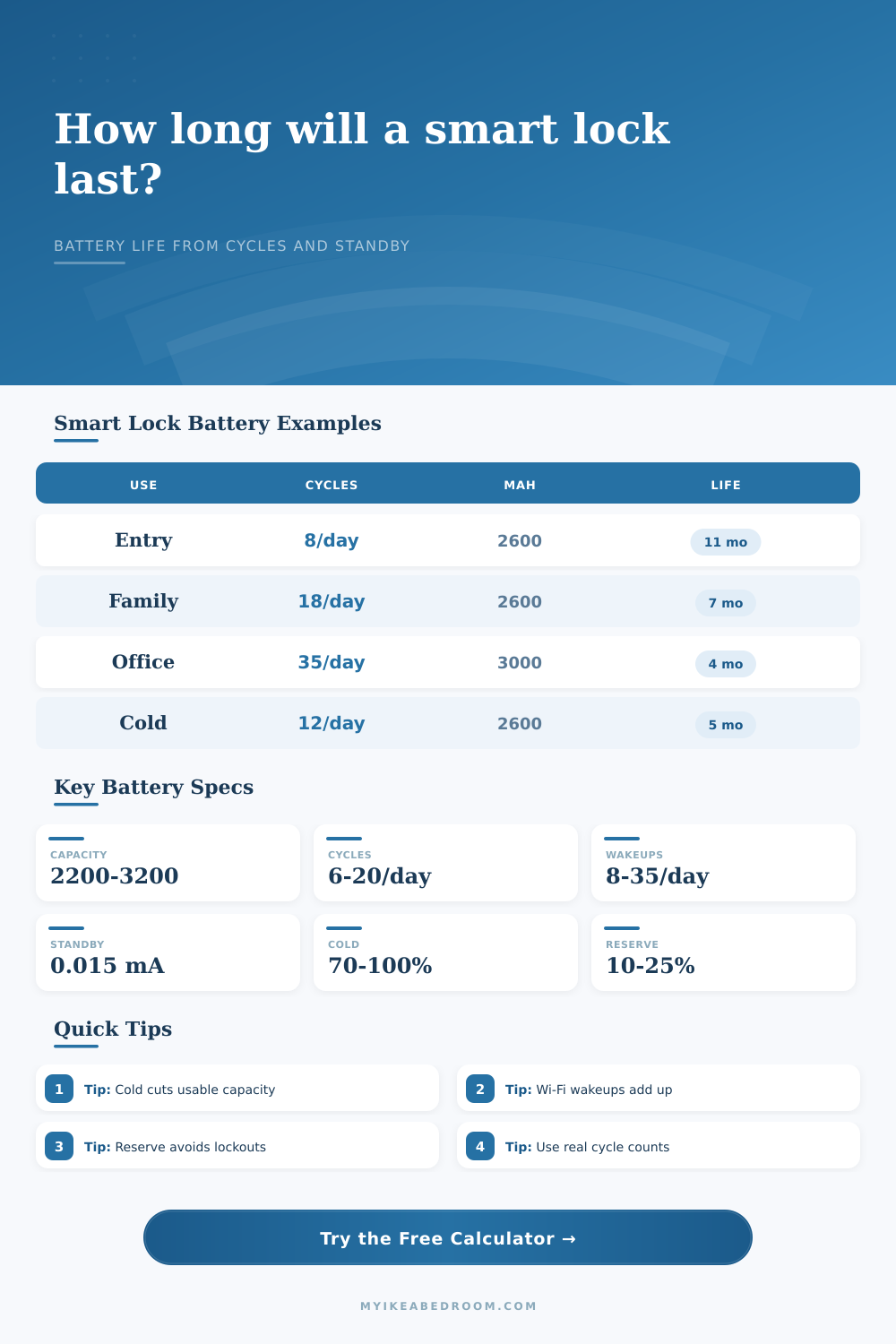
📊Preset Battery Life Reference
| Smart Lock Scenario | Cycles Per Day | Wireless Wakeups | Useful Planning Note |
|---|---|---|---|
| Apartment entry | 6 to 10 | 8 to 20 per day | Often standby and wakeups matter more than motor use. |
| Family front door | 14 to 24 | 18 to 40 per day | Frequent lock/unlock cycles noticeably shorten runtime. |
| Rental keypad lock | 8 to 18 | 25 to 70 per day | Code entry and remote status checks can dominate drain. |
| Small office lock | 28 to 55 | 30 to 90 per day | High-traffic doors need a shorter battery check interval. |
| Vacation home | 0 to 3 | 10 to 45 per day | Remote monitoring can use more energy than the latch. |
📐Battery Capacity Table
| Battery Pack | Typical Capacity | Usable Setting | Best Calculator Use |
|---|---|---|---|
| 4 alkaline AA cells | 2200 to 3000 mAh | 65% to 80% | Common smart deadbolt pack with voltage cutoff. |
| 4 lithium AA cells | 3000 to 3500 mAh | 80% to 95% | Useful for cold areas and long reserve intervals. |
| 8 alkaline AA cells | 4400 to 6000 mAh | 65% to 80% | Use pack mAh at the lock voltage, not summed watt-hours. |
| Rechargeable NiMH AA cells | 1900 to 2500 mAh | 55% to 70% | Lower voltage may trigger warnings before fully drained. |
| Rechargeable lock pack | 1500 to 5000 mAh | 75% to 90% | Use the printed pack rating and expected reserve. |
📋Daily Drain Source Table
| Drain Source | Input Field | Daily Formula | What Raises It |
|---|---|---|---|
| Standby current | Standby current (mA) | mA × 24 hours | Always-on radios, sensors, or bright status LEDs. |
| Motor action | Cycles and mAh per cycle | Cycles × cycle mAh | Misaligned bolts, tight weatherstripping, and retries. |
| Wireless wakeups | Wakeups and mAh per wakeup | Wakeups × wake mAh | Wi-Fi checks, automations, alerts, and hub polling. |
| Keypad or LED use | Events and mAh per event | Events × event mAh | Long code entry, beeps, light rings, and night use. |
| Reserve and derating | Usable, cold, reserve, age | Capacity × factors | Cold cells, older batteries, and early warning cutoff. |
❄Cold Weather And Reserve Table
| Condition | Cold Factor | Reserve Setting | Battery Life Effect |
|---|---|---|---|
| Indoor conditioned door | 95% to 100% | 10% to 15% | Longest predictable runtime and fewer false warnings. |
| Covered exterior door | 80% to 95% | 15% to 20% | Moderate derating covers cool nights and warm days. |
| Freezing entry door | 55% to 75% | 20% to 30% | Plan shorter replacement intervals in winter months. |
| Infrequent vacation lock | 70% to 100% | 20% to 35% | Extra reserve helps when visits are far apart. |
| High-traffic work door | 80% to 100% | 15% to 25% | Reserve matters because daily drain is less forgiving. |
ℹBattery Life Tips
Battery life isn’t just about basic math. Smart locks is notorious for dying at bad moments.
The power draw are determined by factors like battery chemistry, temperature, wireless signals, and motor mechanics. You might grab the door handle only to discover that screen is blank. Power outage. The majority of consumers purchase a smart lock, install new batteries, then await dreaded low-battery alert. Too late: They’re stuck outside (or forgot their backup code).
Why Your Smart Lock Battery Dies Fast
The calculator convert electrical measurements into a time frame. But to believe its answer, one has to know what’s killing it.
Because they’re always listening, they’re still consuming energy. These days they’re listening for Bluetooth signals. They’re pinging WiFi hubs and checking for app connections. This standby current, aka background activity, frequently burns more power than motor itself. And an inefficient wireless setting can cause a quiet apartment with low traffic to drain batteries even faster then a busy home. You pay for this connectivity in terms of battery life: the lock remain connected to your network all the time.
Each time the bolt opens, it draws quite a bit of current as well from motor. So you have to consider physical work of opening the door too. The bigger the door, the more the motor has to struggle with it. The closer out of alignment the strike plate is, the more the motor have to struggle. All this additional resistance will add to power draw each day. You’ll hear when the motor struggles because of how loud the lock sounds. That will cut into the run time overall. More than just changing batteries, lubing the bolt and adjusting strike plate on the door will lengthen battery life.
Battery performance is heavily influenced by temperature. In the cold, chemical reaction in alkaline batteries will slow down and reduce usable capacity by half or more. A six-month life outside on a locked-up porch in the summertime would of been reduced to two months in the winter. Lithium batteries works better in colder temperatures, making them a better option for outdoor use. There’s also cold weather factor in this tool, where you can model what it will do based off your local conditions.
Another good idea: save some juice. Smart locks has a low-voltage cutoff to avoid losing motor engagement. Because of this, having zero power can cause the lock to fail to engage entirely. That means it won’t latch shut or may not respond to commands anymore. Saving ten to fifteen percent as a reserve will ensure that you swap out batteries before they’re completely dead and leave your lock in an unworkable state. Better safe than sorry, and you’ll want that door unlocked.
As the table of references shows, battery timeline depends on usage patterns. A standard door lasts years. Remote monitor in vacation home = Shorter if you are rarely there. How many times do you tap on the app? How often are people entering and leaving? What are the winter temps? Estimate those and then input them into the equation.
Now it’s not a guess anymore… It’s a maintenance schedule. Replace batteries before they fail. That ensures that lock works properly.