😴 Sleep Calculator
Find the perfect bedtime or wake-up time based on 90-minute sleep cycles
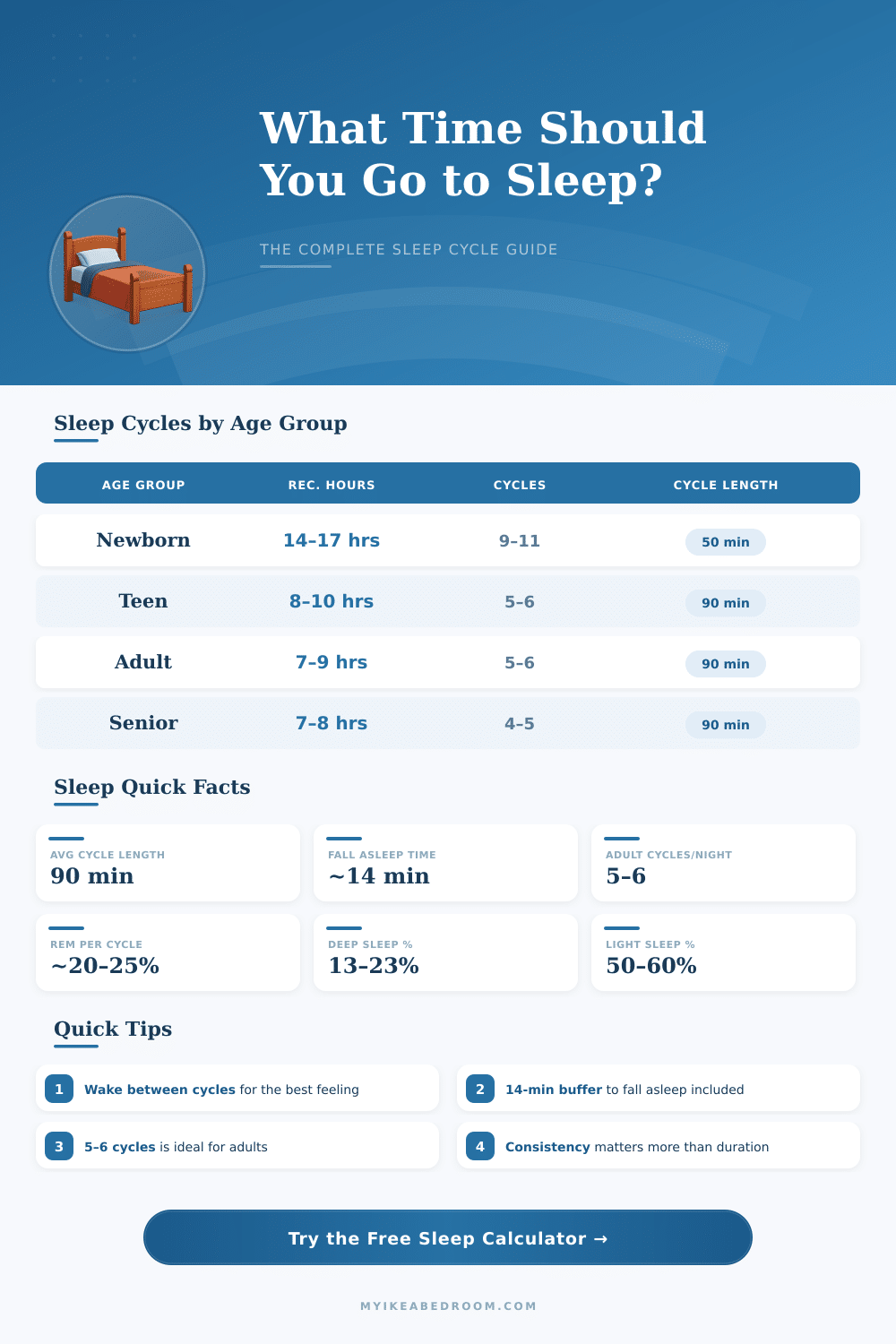
| Age Group | Recommended Hours | Min Acceptable | Sleep Cycles |
|---|---|---|---|
| Newborn (0–3 mo) | 14–17 hours | 11 hours | 9–11 cycles* |
| Infant (4–11 mo) | 12–15 hours | 10 hours | 8–10 cycles* |
| Toddler (1–2 yrs) | 11–14 hours | 9 hours | 7–9 cycles* |
| Preschool (3–5 yrs) | 10–13 hours | 8 hours | 6–8 cycles* |
| School Age (6–13 yrs) | 9–11 hours | 7 hours | 6–7 cycles |
| Teen (14–17 yrs) | 8–10 hours | 7 hours | 5–6 cycles |
| Adult (18–64 yrs) | 7–9 hours | 6 hours | 5–6 cycles |
| Senior (65+ yrs) | 7–8 hours | 5 hours | 4–5 cycles |
* Infant cycles are shorter (50–60 min) than adult cycles (90 min)
| Cycles | Total Sleep Time | Wake Feel | Best For |
|---|---|---|---|
| 1 cycle | 1 hr 30 min | Groggy | Emergency only |
| 2 cycles | 3 hours | Very tired | Short nap limit |
| 3 cycles | 4 hrs 30 min | Tired | Minimum viable |
| 4 cycles | 6 hours | Okay | Short nights |
| 5 cycles | 7 hrs 30 min | Good | Most adults |
| 6 cycles | 9 hours | Excellent | Full recovery |
| Nap Duration | Sleep Stage Reached | Benefits | Risk |
|---|---|---|---|
| 10–20 minutes | Stage 1–2 Light Sleep | Alertness boost, mood lift | None (power nap ideal) |
| 30 minutes | Stage 2 Light Sleep | Memory consolidation | Mild grogginess |
| 60 minutes | Stage 3 Deep Sleep | Declarative memory boost | Sleep inertia 30+ min |
| 90 minutes | Full cycle incl. REM | Full cognitive restoration | May affect night sleep |
Going to bed and waking at the same time every day — even on weekends — regulates your circadian rhythm more effectively than any other strategy. Aim for the same wake time within 30 minutes every day.
Blue light from phones and screens suppresses melatonin production by up to 50%. Stopping screen use 60–90 minutes before bed allows your body to naturally transition into sleep mode. Dim your lights too.
Sleep is a state in that the mental and physical activity lowers, awareness adjusts and a bit of feeling sticks. Muscular movement and connection with the surroundings clearly drops during that time. It differs from waking although first it seems a bit simple cause.
For many folks, sleep simply wants to say lie comfortably, close the eyes and remove all other thoughts.
How to Sleep Better
About a third part of human life passes in sleep. Good sleep at the right moments is this important for survival as food and drink. Getting enough sleep and ensuring its good quality both matter for staying healthy.
Most adults need around seven to eight hours each nihgt. When dealing about child health, adults suggest seven to nine hours, while babies and children need even more, based on their age.
Sleep happens in cycles. The first phase is non-REM sleep, that is made up of four levels. The first level is that middle zone between waking and sleep.
In the second level comes light sleep, when the heartbeat and breathing slow down and the body heat lowers. The third and fourth levels are deep sleeps. Dreaming also happens during sleep.
The memories last and lodge hear. Muscles and tissues fix themselves more quickly in sleep than in waking.
Based on how well one slept, like this one feels during the day. Daily habits and evening routines can greatly affect it. Keeping a fixed schedule for lying down and rising helps the internal body clock work more well.
Like this one trains the body to know when comes time for sleep and when for waking up.
The room setup plays a big role. Cool temperature in the room helps a lot. Also darkness in it is useful.
Home noise can bother, so use a fan or window device to cover sounds as cracking or dog barking commonly does a difference. Avoiding screens in bed is a good idea, because it does not leave the brain too excited. Having warm milk before sleep can also help calm the mind.
If one does not fall asleep in twenty minutes, just leave the bedroom and involve yourself with something relaxing, as reading or listening to gentle music, later return to bed when the tiredness comes. Yoga could be one of the best workout modes for improving sleep quality. Walking many steps daily and listening to soothing music overnight also helps falling asleep.
Getting sunshine daily can also improve the sleep quality. Arranging those factors that affect sleep commonlymakes it easier than one thinks.