Shutter Louver Spacing Calculator
Plan shutter blade count, center spacing, rail clearance, divider rail bays, panel layout, and total louver length from your window opening.
📌Real Shutter Presets
📏Shutter Measurements
🖼Louver Profile Comparison Grid
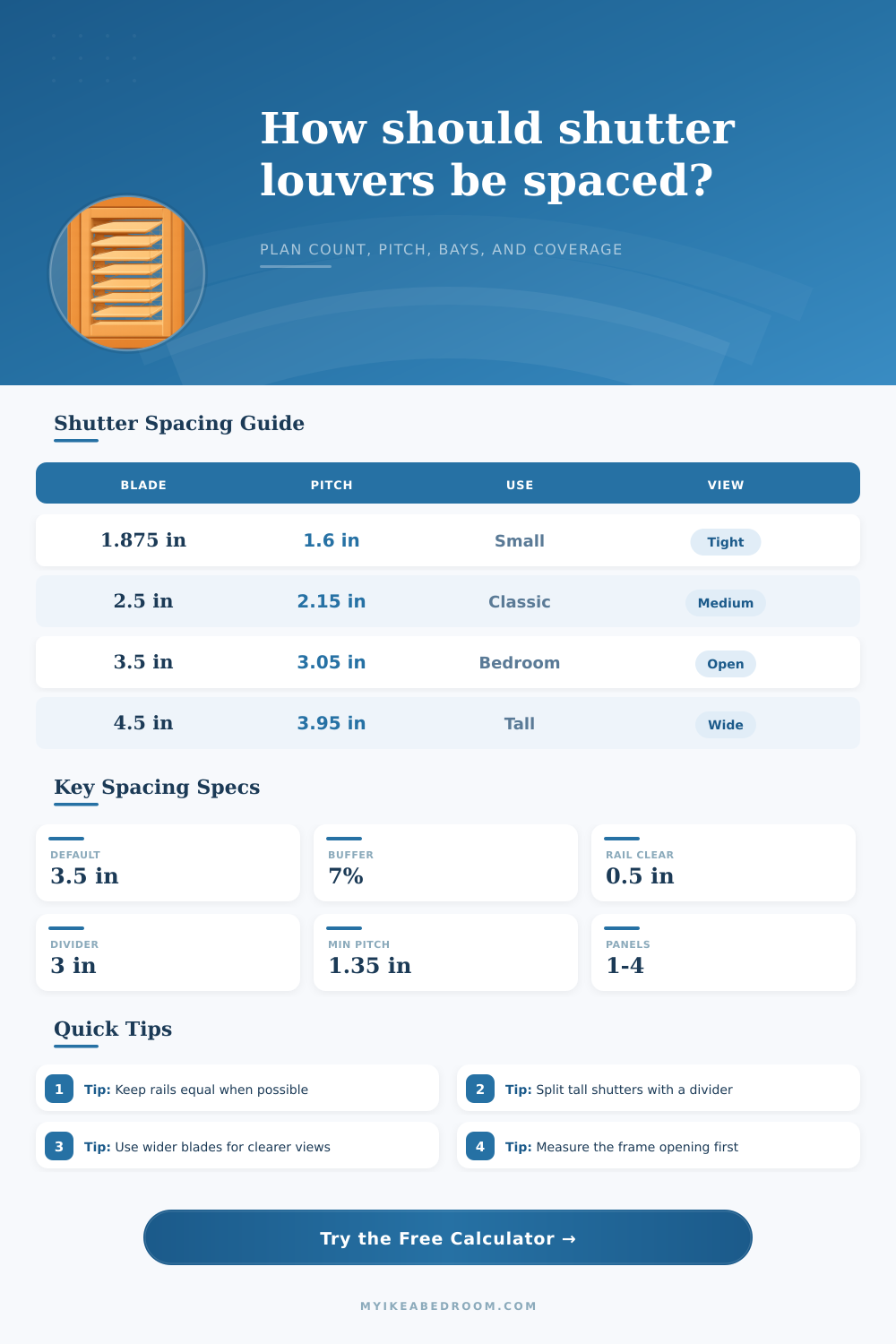
📊Blade Width and Pitch Reference
| Louver blade | Balanced pitch | Typical overlap | Best use |
|---|---|---|---|
| 1.875 in slim blade | 1.60 in / 4.1 cm | About 0.28 in | Small shutters and shallow frames |
| 2.5 in classic blade | 2.15 in / 5.5 cm | About 0.35 in | Bedroom windows and cafe shutters |
| 3.5 in plantation blade | 3.05 in / 7.7 cm | About 0.45 in | Most full height room shutters |
| 4.5 in wide-view blade | 3.95 in / 10.0 cm | About 0.55 in | Tall openings and clearer views |
🧮Panel Height Spacing Examples
| Clear bay height | 2.5 in blade count | 3.5 in blade count | 4.5 in blade count |
|---|---|---|---|
| 24 in / 61 cm | 11 louvers | 8 louvers | 6 louvers |
| 36 in / 91 cm | 17 louvers | 12 louvers | 9 louvers |
| 48 in / 122 cm | 23 louvers | 16 louvers | 12 louvers |
| 60 in / 152 cm | 28 louvers | 20 louvers | 15 louvers |
| 72 in / 183 cm | 34 louvers | 24 louvers | 18 louvers |
🛠Divider Rail and Panel Layout Table
| Opening style | Suggested panels | Divider rails | Spacing note |
|---|---|---|---|
| Small bath or vanity window | 1 panel | 0 divider rails | Keep one clean louver bay |
| Standard bedroom window | 2 panels | 0 or 1 divider rail | Use matching counts on both panels |
| Tall closet or wardrobe door | 2 panels | 1 divider rail | Split tall stacks for smoother tilt |
| Wide double window | 4 panels | 1 divider rail | Keep each leaf light enough to swing |
| Patio door height shutter | 4 panels | 1 or 2 divider rails | Limit each louver bay height |
📝Preset Output Comparison
| Preset | Opening size | Blade profile | Expected layout |
|---|---|---|---|
| Vanity single shutter | 24 x 36 in | 2.5 in classic | One panel, one bay |
| Bedroom pair | 36 x 54 in | 3.5 in plantation | Two panels, matching stacks |
| Tall closet shutter | 48 x 72 in | 3.5 in plantation | Two panels, center divider |
| Double window four panel | 60 x 64 in | 3.5 in plantation | Four panels, balanced pitch |
| Patio door shutters | 72 x 80 in | 4.5 in wide-view | Four panels, long view blades |
💡Spacing Tips
Shutter louver spacing is the calculation that determine the distance between each individual louver blade. The distance between each louver blade must be calculated because each of the shutter’s frame components, such as the rails and the stiles, take up some of the space that would otherwise be available for the louver blades. If the louver spacing isnt calculated correctly, there is a potential problem with either the distance between the individual louvers at the top of the window, or the blades will not tilt in coordination with one another.
Before cutting any louver blade, several decisions must be made regarding the construction of the shutters. You must make decisions regarding the number of shutter panels that will cover the window, and the width of each of the side stiles of the shutters. In some instances, a divider rail may be used to divide a tall panel of shutters into two smaller panels.
How to Calculate Louver Spacing for Shutters
The height of each of these components alter the available height for the louver panels to be constructed. A calculator can make these types of subtractions for the designer. The width of the louvers is a crucial dimension to decide upon in the construction of the shutters.
Using narrow louver blades, such as 1.875 inches in width, is beneficial for small windows or when privacy is an issue. Using wide louver blade, such as 4.5 inches in width, provides more clearance for light to enter the window when the shutters are opened. However, these wider blades require more space between the centers of each louver.
Thus, each panel of a specific height will be able to hold fewer of the wide louver blades than it would the narrow louver blades. The pitch of the louvers is the distance between the center of each louver. The pitch of the louvers will change the number of blades that is required for the shutters to cover each bay.
A tight pitch between each louver will block more light and sightlines than if each louver panel had a wide pitch. A wider pitch between each panel will allow more air to move through the open shutter panels. A target pitch can be entered into the software, or the software can automatically adjust the pitch based on the height of the remaining shutter panels.
Additionally, the height of the top and bottom rails, as well as any divider rails for tall panels, will impact the louver panel calculations. The top and bottom rails provide strength to the shutters, as well as allow for the mounting of hardware onto the shutter. If a divider is incorporated into the middle of a tall shutter panel, this will reduce the height of each of the stacks of shutters that are created.
Shorter stacks of shutters are easier to operate than tall panels of shutters. The calculator will subtract the height of the top and bottom (and any divider) rails from the total height of the panel, and the remaining height can be divided by the number of bay that are to be constructed. Additional clearance must be accounted for at the top and bottom of each of the shutter panels.
If you dont account for clearance at the top and bottom of the panels, the outermost louver blades may bind against the top and bottom shutter rails. A small amount of clearance, such as 0.5 inches, is all that is needed for each blade to tilt. The calculator for the shutters accounts for both the clearance and the tilt mechanism for each shutter.
The length of the louvers will be determined by the length of each panel of shutters as well as the width of each of the stiles. Once the designer determines the number of louver blades, the length of each blade can be calculated by multiplying the number of blades by the width of each blade, and adding in a buffer for any cutting error. The length of each louver blade should of been rounded to the nearest foot or three feet in length when purchasing the shutters.
Rounded lengths will ensure that there is enough of each louver blade to complete the construction of the shutters. Common mistakes include measuring the shutters in the wrong dimensions. For instance, many individuals will measure the dimensions of the outside frame of the window instead of the opening where the shutters will be placed.
Additionally, many individuals will not account for the width of the two stiles on each shutter panel. Each measurement should be taken twice to ensure accuracy in measuring the dimensions of the shutters. Additionally, the number of panels must match the way the shutters will hang.
Finally, the louver spacing will impact the quality of the installation of the shutters. If the pitch of the louvers is the same throughout each pair of shutters, the lines created by each louver blade will meet at the center of each bay. If the clearance is correct at the top and bottom of the panels, the tilt mechanism will work correctly each time that the shutters are opened and closed.
Correct louver spacing will ensure that each blade is in the proper position, and that each louver moves in the expected manner.