Shower Water Usage Calculator
Estimate shower gallons, liters, hot water share, and low-flow comparison using GPM x minutes x showers.
🚿Quick presets
💧Shower details
Your shower water estimate
Calculation breakdown
⚙Flow rate reference
📋Showerhead flow table
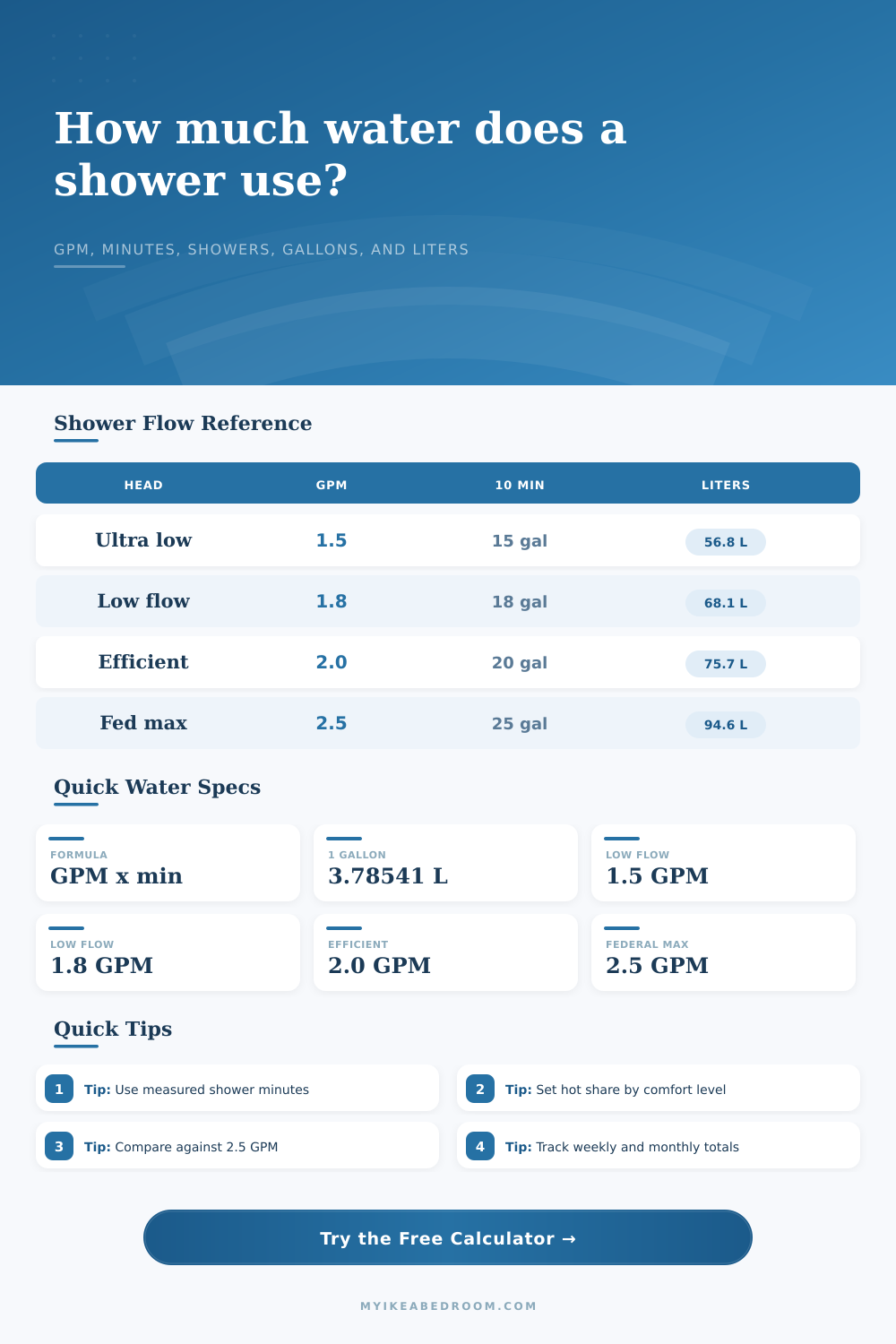
| Flow type | GPM | 8 minute shower | 10 minute shower | 10 minute liters |
|---|---|---|---|---|
| Ultra low-flow | 1.5 GPM | 12 gallons | 15 gallons | 56.8 liters |
| Low-flow | 1.8 GPM | 14.4 gallons | 18 gallons | 68.1 liters |
| Efficient | 2.0 GPM | 16 gallons | 20 gallons | 75.7 liters |
| Federal maximum | 2.5 GPM | 20 gallons | 25 gallons | 94.6 liters |
⏱Duration and frequency table
| Pattern | Flow | Minutes | Showers per day | Daily gallons |
|---|---|---|---|---|
| Quick rinse | 1.5 GPM | 5 minutes | 1 | 7.5 gallons |
| Typical efficient | 1.8 GPM | 8 minutes | 1 | 14.4 gallons |
| Long shower | 2.0 GPM | 15 minutes | 1 | 30 gallons |
| Two short showers | 2.5 GPM | 6 minutes | 2 | 30 gallons |
🌡Hot water fraction table
| Mix setting | Hot fraction | Hot gallons from 100 gal | Hot liters from 100 gal | Use case |
|---|---|---|---|---|
| Cool rinse | 40% | 40 gallons | 151.4 liters | Warm weather |
| Mild shower | 60% | 60 gallons | 227.1 liters | Everyday use |
| Warm shower | 70% | 70 gallons | 265.0 liters | Common estimate |
| Hot shower | 80% | 80 gallons | 302.8 liters | Cold mornings |
🏠Household example table
| Household | Flow | Minutes | Daily total | 30 day total |
|---|---|---|---|---|
| One person | 1.8 GPM | 8 minutes | 14.4 gallons | 432 gallons |
| Two people | 1.8 GPM | 8 minutes | 28.8 gallons | 864 gallons |
| Four people | 2.0 GPM | 10 minutes | 80 gallons | 2400 gallons |
| Guest week | 2.5 GPM | 9 minutes | 112.5 gallons | 787.5 gallons |
💡Calculation tips
Don’t make the mistake of thinking that all water savings come down to flipping a switch, opening a faucet… Closed. That mentality fail to account for movement of water within your plumbing system.
Combine that with the fact that showers involve both duration of the event and amount of water flowing per second and you’ll have something interesting to calculate. Why? Calculating the volume require more than one variable: how fast the water flows and how long you leave it running.
How to Save Water and Money in the Shower
While most people can estimate what number they put into this equation, we’ve done the multiplication for you. Simply enter your shower habits into the calculator above and let us take care of the rest. It removes the need for guessing at whether you’re using gallons or liters.
It also distinguishes between total volume and the portion of water that was actualy heated. And that’s important because while water may be cheap relative to fossil fuels, heating water isn’t. It burns energy, and energy ain’t free.
Gallons Per Minute (or GPM) refers to amount of water being pushed through your showerhead at any given moment. It’s an expression of simple volume. Federal guidelines mandate a max for newly installed fixtures which tends to be about two point five gallons per minute.
If you’re retrofitting an old home, your heads is likely well beyond that. Antique ones will spit out three or four gallon per minute with little effort. That old-school stat versus today’s ultra low flow standard is spelled out in the reference table on the page.
Replacing your head can save multiple gallons of water each day per person. It doesn’t seem like much until you multiply that by thirty and then again by how many people live in your house. If you save only two gallons per shower as a family of four, that’s more than a lot when you do the math. That adds up to a lot over time.
The second lever to pull is time. A typical adult shower last eight to ten minutes; some teens may spend even longer and guests may enjoy a lingering soak. The calculator lets you dial in your exact shower time.
Why? Because reducing your shower by just two minutes will save you more water then replacing an old 2.0 flow rate showerhead with a 1.8. We often underestimate how long we’re standing beneath the spray; and a timer will help us realize it.
Guess what? If you believe you shower for five minutes, but the clock reads nine, then you’re using nearly twice as much water as you thought. That’s when waste lurks: In the gap between what you think and what is real.
On the energy side of the equation, the hot water fraction input tell you what percentage of the water that goes into shower comes from the hot water tank. Because you combine cold water with hot, not everything going into the shower was heated up. Seventy percent is a good guess for most showers in cooler months when you want them warmer. You could go as low as forty percent in the summertime. This will give you a sense of just how much of the water you’re using has been heated up.
Inefficient heating of water is common in most houses and while insulating tanks can mitigate some standby losses, they don’t solve it completely. If you know what portion of your water is hot, then you also have a better idea of how much it’s contributing to your energy bill. It makes your water bill more real, something tangible instead of abstract.
The last step is comparing what you use now to something as a baseline. Maybe it’s the feds maximum, maybe it’s a good low flow number like 1.5 gpm (gallons per minute). Compare yourself to those and see if there are places to save without necessarily changing out any hardware yet. See what’s possible before buying anything.
Awareness is the goal here. If you don’t know how much you’re using, you can’t control it. Seeing your monthly gallons/liters lets you go from abstractions about what that means to “oh yeah, now I get it, this is a thing I’m spending all this money on”. It becomes something you want to preserve because you now know how many gallon of water you use every day in the shower.
Shower’s a daily routine and doesn’t need to be a resource suck. Change when you take one and change how much flow comes out and see the result. Get clean AND keep the bill down. Yeah the water still runs but you’ll pay less for the priviledge.