Shower Flow Rate Calculator
Calculate shower GPM from a bucket test or a rated showerhead, convert to L/min, then adjust for multiple heads and water pressure.
🚿Shower presets
⚙Flow rate inputs
Bucket test formula: GPM = gallons / seconds x 60. Metric bucket volume is converted to gallons, and every result also shows L/min.
Shower flow rate result
⚙Common shower flow cards
📊Shower flow reference tables
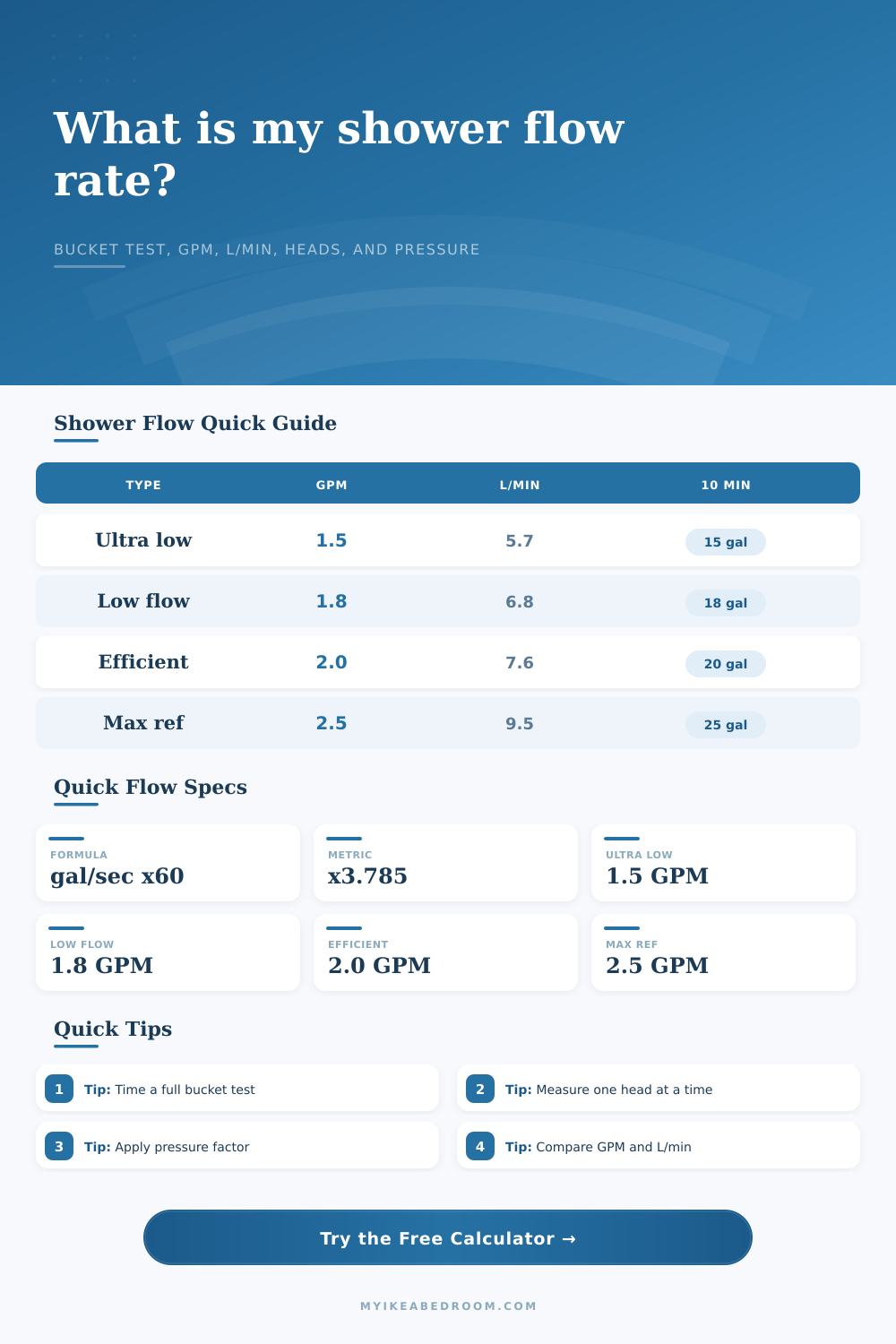
| Reference | GPM | L/min | 8 minute shower | 10 minute shower |
|---|---|---|---|---|
| Ultra low-flow showerhead | 1.5 GPM | 5.7 L/min | 12 gal / 45 L | 15 gal / 57 L |
| Low-flow showerhead | 1.8 GPM | 6.8 L/min | 14.4 gal / 55 L | 18 gal / 68 L |
| Efficient showerhead | 2.0 GPM | 7.6 L/min | 16 gal / 61 L | 20 gal / 76 L |
| Maximum reference showerhead | 2.5 GPM | 9.5 L/min | 20 gal / 76 L | 25 gal / 95 L |
| Older high-flow fixture check | 3.0 GPM | 11.4 L/min | 24 gal / 91 L | 30 gal / 114 L |
| Bucket volume | Fill time | Formula | Measured GPM | Metric flow |
|---|---|---|---|---|
| 1.0 gal | 40 sec | 1.0 / 40 x 60 | 1.5 GPM | 5.7 L/min |
| 1.5 gal | 50 sec | 1.5 / 50 x 60 | 1.8 GPM | 6.8 L/min |
| 2.0 gal | 60 sec | 2.0 / 60 x 60 | 2.0 GPM | 7.6 L/min |
| 2.0 gal | 48 sec | 2.0 / 48 x 60 | 2.5 GPM | 9.5 L/min |
| 5.0 L | 40 sec | 1.32 / 40 x 60 | 2.0 GPM | 7.5 L/min |
| Active heads | Per-head flow | Pressure factor | Total GPM | Total L/min |
|---|---|---|---|---|
| 1 head | 1.8 GPM | 100% | 1.8 GPM | 6.8 L/min |
| 1 head | 2.0 GPM | 110% | 2.2 GPM | 8.3 L/min |
| 2 heads | 1.5 GPM | 100% | 3.0 GPM | 11.4 L/min |
| 2 heads | 2.0 GPM | 95% | 3.8 GPM | 14.4 L/min |
| 3 heads | 1.8 GPM | 85% | 4.6 GPM | 17.4 L/min |
| Pressure condition | Factor | 2.0 GPM head result | When to choose it |
|---|---|---|---|
| Low pressure | 0.85 | 1.7 GPM / 6.4 L/min | Weak spray or shared supply line. |
| Slightly low pressure | 0.95 | 1.9 GPM / 7.2 L/min | Minor pressure drop during busy periods. |
| Normal pressure | 1.00 | 2.0 GPM / 7.6 L/min | Use for direct bucket-test conditions. |
| Strong pressure | 1.10 | 2.2 GPM / 8.3 L/min | Fixture tests higher than its label. |
| Very strong pressure | 1.20 | 2.4 GPM / 9.1 L/min | Use only when measured flow supports it. |
| Preset | Method | Base flow | Heads | Planning purpose |
|---|---|---|---|---|
| Bucket test low-flow | Bucket test | 1.5 GPM | 1 | Checks an ultra low-flow shower. |
| Bucket test standard | Bucket test | 2.0 GPM | 1 | Checks a common efficient shower. |
| 2.0 GPM efficient | Rated | 2.0 GPM | 1 | Compares against label flow. |
| Rain + hand shower | Rated | 1.8 GPM | 2 | Totals dual outlets in one shower. |
| Low-pressure check | Bucket test | 1.8 GPM | 1 | Applies an 85% pressure factor. |
💡Measurement tips
Measuring your shower flow help you know how well your plumbing perform. The first step is to notice when your water pressure immediately drops because someone turned on another tap. Ugh!
Here’s why it’s important to measure your real flow rate. The calculator convert the bucket test into liters per minute and gallons per minute, these are the numbers that allow you to know what’s going on behind the walls. For most people, the label on their showerhead is gospel. Nope. That number doesn’t apply to your plumbing condition. With a bucket test you get the truth.
How to Test Your Shower Water Flow
Pick up a container, mark off where full is on it and put it beneath your shower head. Time how long it takes. Collect one and a half gallons in forty five seconds? Do the math. Divide gallons by seconds and multiply by sixty. That are the gallons per minute. That’s a real world number.
Every filter, every elbow joint, every restriction in your pipes slow the water down. That math gives you a real-world number. A two gallon per minute rated fixture could be delivering just one and a half gallons per minute in your house due to low pressure or an old supply line.
Now you take that starting point and you look at the rest of the system. If you have more than one head (for example a handheld sprayer and a rain shower), then the multiple heads is accounted for by the tool. Having two heads mean double the demand on both your pump and your water heater. Turning on the second valve drop the pressure. There’s a way to apply a pressure factor with the calculator.
Why? Because this isn’t theoretical: Water flow isn’t linear. The more outlets you add, the greater the increase in pipe friction which causes the pressure to decrease at each individual outlet.
For some larger context: What’s the difference between liters per minute and gallons per minute? About three point seven liters equals one gallon per minute. If you want to calculate your water bill or how much water you’re using for the environment, you’re looking at total volume per shower. If you take a shower lasting eight minutes, with two gallons per minute of flow, that’s sixteen gallons of water. That is enough water to fill half a regular bathtub. A low-flow head, which has a flow rate of one point eight gallons per minute, saves almost five gallons per shower. Over a month, that add up to over a hundred gallons. It is not a huge saving, but it is consistent.
Until they purchase new fixture, many homeowners don’t even consider pressure. They’ll add that snazzy-looking rain head and find it’s more of a mist than anything else. This isn’t typically a fault off the head; it’s the supply pressure. You may be at the far end of a lengthy pipe run. Or perhaps you’re sharing a main line with another set of high-demand fixtures, in those scenarios, there simply isn’t much force behind the water. The tools’ reference tables shows how varying pressure conditions impact the effective flow. What was once a powerful spray could become nothing more than a lukewarm drizzle. Avoid the return trip to the hardware store by knowing this ahead of time.
This doesn’t require that you become a plumber. All it requires is measurement before changes. You measure your existing flow. You record any pressure condition at maximum demand. Then you determine whether you are seeking performance or conservation.
A luxurius rain shower is something your plumbing might support… Or it might not. The numbers will show that. They will also show that perhaps you should of use the more efficient (lower flow) alternative.
It is better to know beforehand. It is better than discovering halfway through a long, hot shower that nothing is coming out anymore.