🪜 Shelving Span Calculator
Find the safe span, deflection, and load capacity for any shelf material and thickness
| Span | Max Deflection (L/360) | Max Deflection (mm) | Load Limit (Uniform, lbs) | Typical Use |
|---|---|---|---|---|
| 12" (30 cm) | 0.033" | 0.84 mm | 80–120 | Spice rack, small display |
| 18" (46 cm) | 0.050" | 1.27 mm | 60–90 | Bathroom shelf, small kitchen |
| 24" (61 cm) | 0.067" | 1.69 mm | 40–70 | Bookcase bay, closet shelf |
| 30" (76 cm) | 0.083" | 2.12 mm | 30–50 | Standard bookshelf span |
| 36" (91 cm) | 0.100" | 2.54 mm | 20–40 | Wide bookcase, TV unit |
| 48" (122 cm) | 0.133" | 3.39 mm | 15–30 | Garage storage, wide span |
| 60" (152 cm) | 0.167" | 4.23 mm | 10–20 | Metal shelving, heavy bracing |
| Material | MOE (psi) | MOE (GPa) | Max Load (lb/ft) | Sag Risk |
|---|---|---|---|---|
| Plywood (Baltic Birch) | 1,800,000 | 12.4 | 40–60 | Low |
| MDF | 500,000 | 3.4 | 20–30 | High |
| Solid Pine | 1,600,000 | 11.0 | 35–50 | Medium |
| Solid Oak | 1,800,000 | 12.4 | 50–75 | Low |
| Tempered Glass (3/8") | 10,000,000 | 69.0 | 15–25 | Low (brittle) |
| Steel (1/16" channel) | 29,000,000 | 200.0 | 80–150 | Very Low |
| Particleboard | 350,000 | 2.4 | 15–20 | Very High |
| Melamine Board | 450,000 | 3.1 | 18–28 | High |
| Thickness | Thickness (mm) | Safe Span (Plywood) | Safe Span (MDF) | Safe Span (Solid Wood) |
|---|---|---|---|---|
| 1/2" | 12.7 mm | 18" | 14" | 22" |
| 5/8" | 15.9 mm | 22" | 16" | 26" |
| 3/4" | 19.1 mm | 28" | 20" | 32" |
| 1" | 25.4 mm | 36" | 26" | 42" |
| 1-1/4" | 31.8 mm | 44" | 32" | 52" |
| 1-1/2" | 38.1 mm | 52" | 38" | 60" |
| 2" | 50.8 mm | 72" | 48" | 84" |
| Project | Typical Span | Recommended Material | Min Thickness | Typical Load |
|---|---|---|---|---|
| Bookcase (paperbacks) | 24"–28" | Plywood or Solid Pine | 3/4" | 20–30 lb |
| Bookcase (hardcovers) | 20"–24" | Plywood or Hardwood | 3/4"–1" | 30–50 lb |
| Closet clothing shelf | 32"–42" | Melamine or Plywood | 3/4" | 20–40 lb |
| Kitchen pantry shelf | 18"–24" | Plywood | 3/4" | 15–25 lb |
| Garage storage | 36"–48" | Plywood or Steel | 1"–1.5" | 50–100 lb |
| Display / decorative | 18"–36" | Glass or Solid Wood | 3/8" (glass) | 5–15 lb |
| Wine rack shelf | 24"–36" | Solid Pine or Oak | 3/4" | 20–40 lb |
| Laundry room shelf | 24"–30" | Plywood | 3/4" | 20–60 lb |
The length of the shelf determines how far apart the supports are. Those limits depend on the strength of the material; the stronger it is, the bigger space you can leave between the wall supports This is very important to understand before you start to build any shelf.
The general knowledge about unsupported lengths does not come from magic or lab tests. It grew through decades of successes and mistakes, becoming standard for building. This knowledge is so common that free calculators exist on the net.
How Far to Space Shelf Supports
With such programs, you can count the load, the bend or the thickness, simply choosing the material and filling the necessary data.
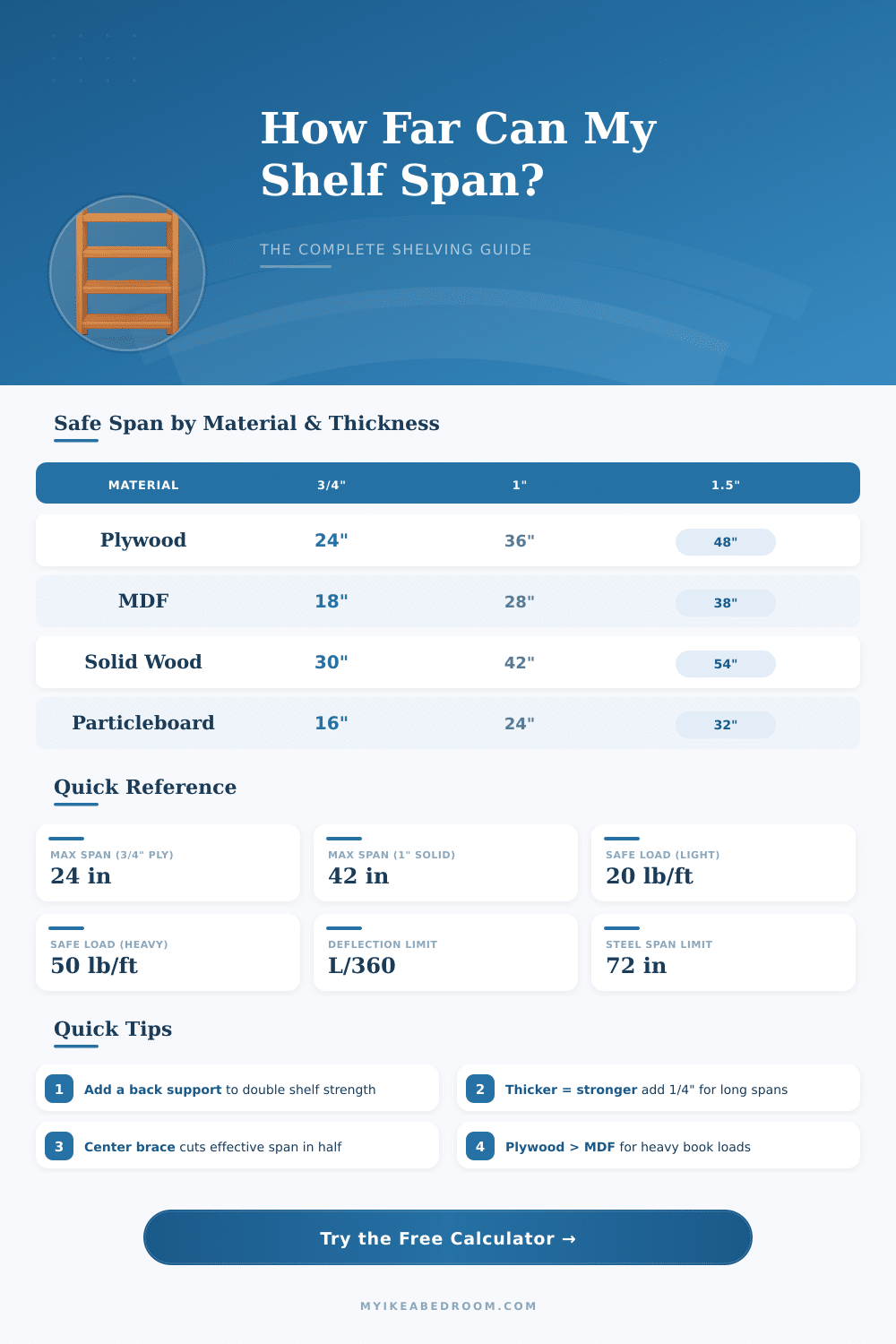
For 3/4″ plywood, a good limit is 32 inches, but that already is the maximum for heavy objects. One solution is to put a colmun in the center of the length and install supports on the column and the back, like this effectively splitting the shelf in two parts. 32 inches are almost the maximum.
You can use fixed shelves, pin the back and use a face frame for help. Sticking a piece of hardwood (around 1.5 to 2 inches wide) on the front also improves the strength.
The maximum length for 3/4″ plywood is around 3 feet, while for solid hardwood it is about 4 feet. If you use 3/4″ plywood for garage shelving, it can bear moderate or heavy loads with a gap of 24 inches between centers, if it is backed by blocks or full sides. Particleboard barely can bear its own weight without a bend.
It is better to reduce the distance to 16 inches or use proper boards.
Narrow shelves are not as strong. Even so, because narrow shelves less commonly bear heavy loads, that is not always a problem. For instance, a shelf with a depth of 6 inches probably will not bear more than 20 pounds each foot, so a 30-inch length would still be good.
The standards for particleboard and MDF say that a bend of more than 1/8 inch at 36-inch length already is visible. For plywood, the base is 3/16 inch at 36 inches, which is indeed 25 percent higher.
If you need longer shelves, add vertical supports. For instance, a 1×4 board bent in its strong direction is much more rigid and strong than a 1×12 board bent in its weak direction. Sticking a front edge of 1-1/4 inch and leaving a little space where the shelf meets the edge creates a tiny ledge, that stops the bend.
If the shelves will have equal load and two supports, lay the supports at one quarter of the distance from every end. This way the free ends balance the rotation that otherwise would cause a bend in thecentre.