📚 Shelving Calculator
Plan shelf spacing, count shelves, and check load capacity for any room
(25–30 cm)
(41–61 cm)
(15–20 cm)
(2.5–5 cm)
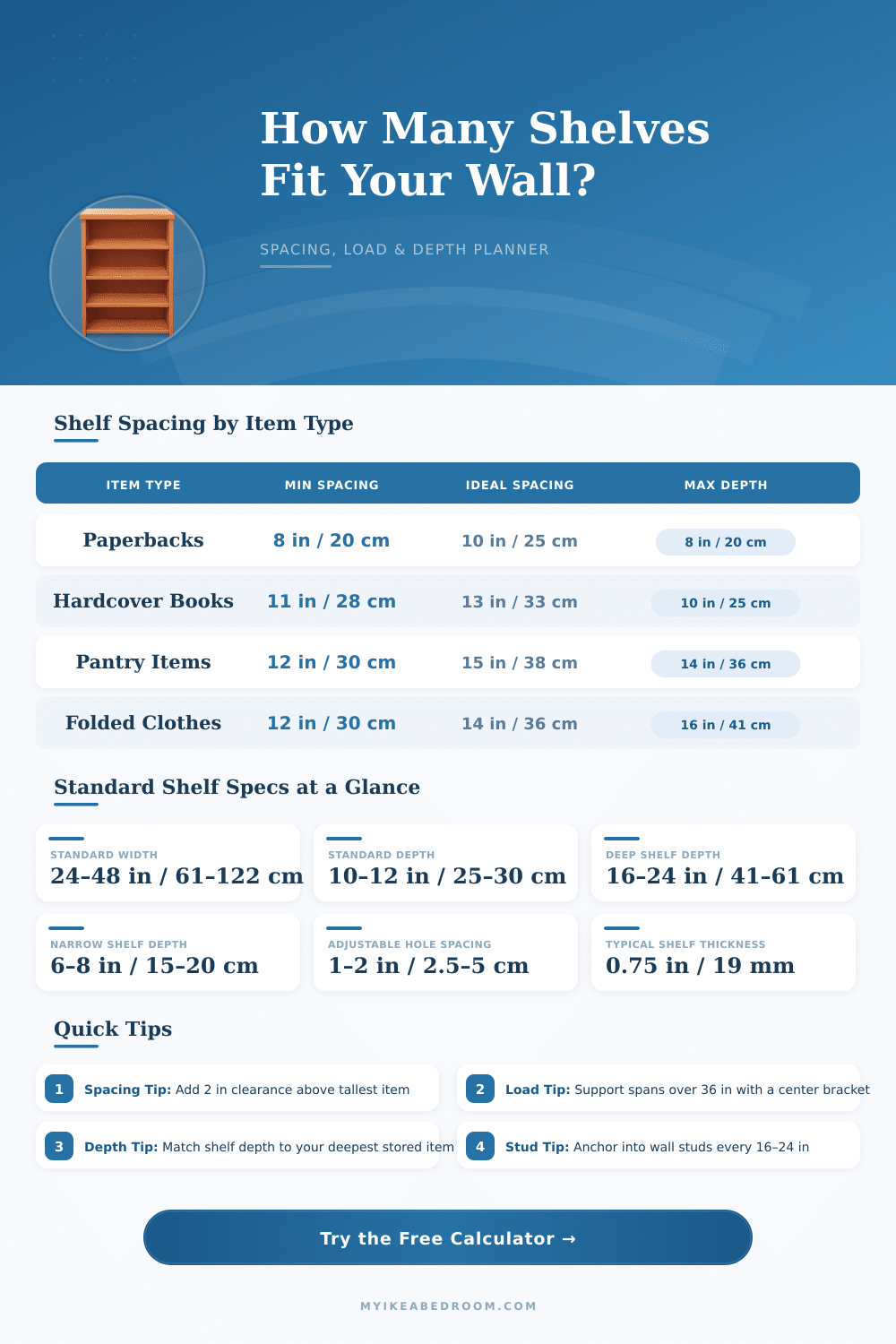
| Item Type | Min Spacing | Ideal Spacing | Notes |
|---|---|---|---|
| Paperback Books | 8 in / 20 cm | 10 in / 25 cm | Add 1 in above tallest |
| Hardcover Books | 11 in / 28 cm | 13 in / 33 cm | Extra clearance for art books |
| Folded Clothes | 12 in / 30 cm | 14 in / 36 cm | Allow room to grab items |
| Shoes (flat) | 6 in / 15 cm | 8 in / 20 cm | Boots need 14+ in |
| Pantry Cans / Jars | 8 in / 20 cm | 12 in / 30 cm | Double-stack if possible |
| Cereal Boxes | 12 in / 30 cm | 14 in / 36 cm | Tall items at eye level |
| Kids Toys | 12 in / 30 cm | 18 in / 46 cm | Lower shelves reachable |
| Garage Items / Bins | 16 in / 41 cm | 24 in / 61 cm | Use deep shelves (>16 in) |
| Office Binders / Files | 12 in / 30 cm | 14 in / 36 cm | Label at front edge |
| Plants / Decor | 14 in / 36 cm | 20 in / 51 cm | Allow for growth + watering |
| Shelf Span | Wood Board (lbs) | Wire Shelving (lbs) | Floating / Bracket (lbs) |
|---|---|---|---|
| Under 24 in / 61 cm | 80–100 | 50–70 | 40–60 |
| 24–36 in / 61–91 cm | 60–80 | 40–60 | 30–50 |
| 36–48 in / 91–122 cm | 40–60 | 30–45 | 20–35 |
| Over 48 in / 122 cm | 25–40* | 20–30* | 15–25* |
* Center support bracket required for spans over 36 in / 91 cm. Values are guidelines; consult manufacturer specs for safety-critical loads.
| Room / Use | Recommended Depth | Typical Width | Common Material |
|---|---|---|---|
| Home Office / Books | 10–12 in / 25–30 cm | 24–36 in / 61–91 cm | Wood / Cube unit |
| Bedroom Closet | 12–16 in / 30–41 cm | 24–48 in / 61–122 cm | Wood / Wire |
| Pantry / Kitchen | 12–16 in / 30–41 cm | 18–36 in / 46–91 cm | Wire / Wood |
| Garage / Workshop | 18–24 in / 46–61 cm | 36–72 in / 91–183 cm | Heavy-duty wire / Metal |
| Kids Room | 10–12 in / 25–30 cm | 24–36 in / 61–91 cm | Wood / Cube unit |
| Laundry Room | 12–16 in / 30–41 cm | 24–48 in / 61–122 cm | Wire |
| Display / Decor | 6–10 in / 15–25 cm | 18–36 in / 46–91 cm | Floating shelf |
| Shoe Storage | 10–12 in / 25–30 cm | 24–36 in / 61–91 cm | Wire / Wood |
Shelving seems simple but becomes tricky when you start to think about it Shelf creates flat, horizontal surface for various objects. You can lay books, frames, home decor, paint or keep various bins. Open shelving removes stuff from the floor and keeps them easy to reach; whether shoes and clothes, records, care products, photos or decorative vases.
Because vertical space stays unused, wall shelves are very useful. Hanging shelves on wall, you free the floor and tables, which makes the room feel less narrow. You even can install them in various heights for different family members, which looks quite modern as a design touch.
How to Choose and Use Shelves
The choice of material is very important. For home shelving, quality plywood as white birch or solid hardwoods as oak and maple give the best combination of stiffness and stability. Depending on whether you need strength or beauty, you can use also steel, alumunim, glass or MDF.
For instance, heavy book collections can push shelf curve middle, if the material is not strong enough.
Industrial steel with triple reinforcement and no-sliding rails create heavy shelves, that work well in garages, workshops and warehouses. They are adjustable, resistant to rust and easy to install. Other popular choice for storage, especially with plastic bins, are wire metal shelves.
Although you can buy extra accessories and adjust the shelves, move them away for fix them no always are easy. Even so, wire shelves usually last longer than board shelves, that can quickly fall.
Doing own shelves is entirely possible. You can choose wooden boards in home improvement store and pay little amount so that they cut them to your size by means of their panel saw. For simple shelf, take rugged wood, drill holes, use glue and set everything with screws.
Ensure, that the wood is thick enough so that the screws well hold.
In the kitchen, shelves use most of the wall space and help to find everything quickly. Wooden or metallic kitchen shelves also can improve your decoration. For pantry, you can use adjustable handles set to the studs.
If you use shelves that involve only half of the width of the cabinet, you maximize the space. You could group the foods according to family members, recipes or even according to health goals for easy healthy choices. Lay some low shelves is also a clever move.
Use second-hand metallic wire shelves can be real bargain, if you search well. Some shelvings from closed stores can bear so much weight, that you indeed would fear about cracking thefloor of the house.