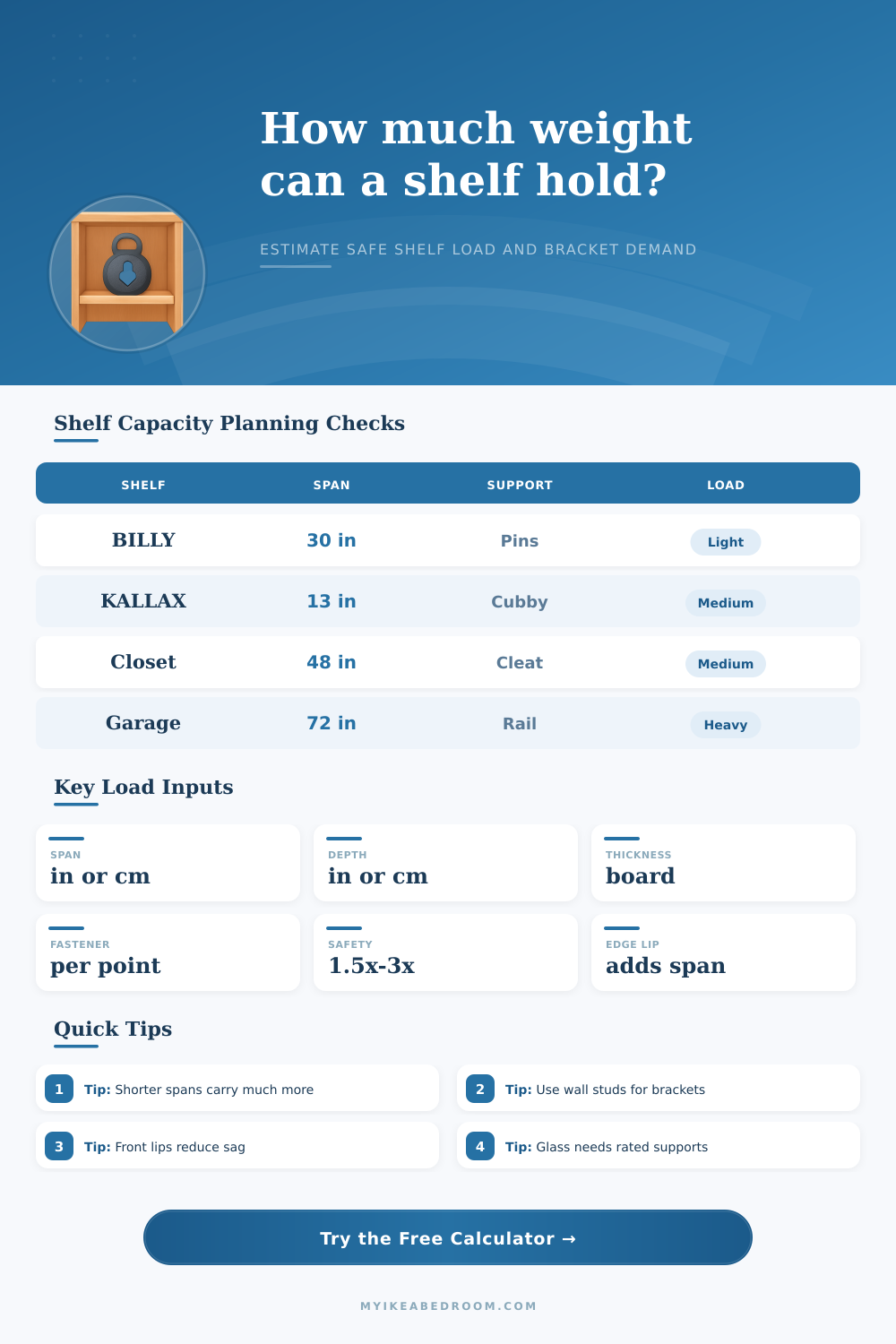
Shelf Weight Capacity Calculator
Estimate practical shelf load capacity from span, depth, thickness, material, support style, bracket spacing, fastener rating, load distribution, safety factor, and edge reinforcement.
Load a common shelf scenario, then adjust every field to match the board, support, and wall or cabinet connection you plan to use.
| Material | Relative stiffness | Best use | Planning caution |
|---|---|---|---|
| Particleboard or honeycomb panel | Low to medium | Bookcase shelves, cubbies, light folded items | Long spans sag quickly without a front lip. |
| MDF or melamine board | Medium | Closet shelves, pantry shelves, cabinet interiors | Heavy for its stiffness; keep spans moderate. |
| Cabinet plywood | Medium to high | Utility shelves, closets, pantries, built-ins | Quality, ply count, and grain direction matter. |
| Solid pine or hardwood | High | Longer display shelves, desks, linen shelves | Knots, splits, and weak grain reduce capacity. |
| Tempered glass | Very high but brittle | Short display shelves with rated pins or clips | Do not notch, drill, overload, or use unrated supports. |
| Support style | Typical support points | Capacity effect | Best planning check |
|---|---|---|---|
| Adjustable shelf pins | Four pins at side panels | Connection can be the limit | Check pin diameter, hole fit, and side panel quality. |
| Captured cubby or fixed side panels | Both sides fixed | Improves board support | Confirm joints and vertical divider strength. |
| Wall brackets or standards | Two or more brackets | Spacing controls effective span | Use studs or rated anchors; check bracket depth. |
| Floating shelf rods | Hidden rods or plate | Fasteners often limit load | Use manufacturer rating and avoid front-heavy loads. |
| Full cleats or rails | Continuous or repeated points | Spreads load well | Confirm wall attachment and shelf-to-cleat connection. |
| Shelf role | Light load | Medium load | Dense load |
|---|---|---|---|
| Display shelf | 24-36 in spacing | 18-24 in spacing | Use deeper brackets |
| Book shelf | 24 in spacing | 16-24 in spacing | Add center support |
| Closet shelf | 32-48 in span with cleat | 24-32 in spacing | Add front support |
| Garage shelf | 24 in spacing | 16-24 in spacing | Use rated rail system |
| Category | Approximate sag ratio | Visual result | Planning response |
|---|---|---|---|
| Low | Less than span/300 | Usually hard to see | Good for display and furniture shelves. |
| Moderate | Span/240 to span/300 | Slight sag may appear | Acceptable for many utility shelves. |
| Noticeable | Span/180 to span/240 | Visible deflection likely | Reduce span or add edge reinforcement. |
| High | More than span/180 | Sag or connection stress | Add support before loading. |
KALLAX cubby
Strength: captured sides keep the span short.
Watch: localized heavy objects and divider joints.
BILLY shelf
Strength: predictable width and side pin support.
Watch: book loads are dense and can sag boards.
Floating shelf
Strength: clean look with hidden support.
Watch: fasteners and front-edge leverage usually limit load.
Garage shelf
Strength: rated rails can spread heavy loads.
Watch: bins concentrate weight at small contact points.
Tip: Reducing span is usually more powerful than changing material. A center bracket, divider, or cleat can turn one long bending span into two shorter, stiffer spans.
Tip: Treat wall mounting as its own capacity check. A strong shelf board is still limited by bracket depth, anchor rating, wall material, and whether fasteners reach studs.
A shelf may appear to be a strong object to a person when it is mounted to a wall. However, the shelf may fail if the total weight that is placed on the shelf is more greater than the capacity of the shelf. There are several different measurement of a shelf that must be calculated before the purchase of the shelf.
A person must determine the weight that the shelf will hold under the middle of the shelf dipping, the brackets moving away from the wall, or the fasteners on the shelf moving. A calculator can help in determining these measurements for a shelf. The first of the many measurements is the span of the shelf.
How to Know How Much Weight a Shelf Can Hold
A shelf with a thirty-inch span is going to have a different relationship to the weight that it will hold than a shelf with a forty-eight inch span. Even if the shelf is of the same material with the same thickness on each shelf, the longer that the shelf extends, the less weight that it is able to support. The other important measurements of the shelf is it’s thickness and depth.
The thickness of the shelf has a more significant impact upon the strength of the shelf than its depth. For example, placing a quarter inch more thickness into a shelf may have as great of an impact as changing the type of wood that a person utilize to make that shelf. Thus, the thickness of the shelf must be made exact in the calculations for the shelf.
Another of the measurements that must be made is the support style for the shelf. The placement of pins on the sides of the shelf will distribute the weight of the shelf differently than if brackets placed onto the studs of the wall supported the shelf. Additionally, shelves that have floating rods will have a different weight limit than shelves that has pins or brackets.
Each of these different support styles have a significant impact upon the strength of the shelf, which is why they must be accounted for in the calculations. Additionally, another factor related to the support is the rating of the fasteners that are placed into the shelf. If the rating of the fasteners is less than the shelf, then the shelves will have to be limited in it’s ability to hold weight in order to protect the wall.
Another measurement of a shelf is the distribution of the weight that is placed upon the shelf. Shelves are only as strong as the evenness of the weight that is distributed upon it. For instance, a shelf that holds folded towels that are even with the shelf will allow for more of that weight to be placed upon the shelf than if those folded towels are placed near the front of the shelf.
Thus, the distribution of the load upon a shelf should be considered before the purchase of the shelf. Another measurement is the safety factor for the shelf. A safety factor of two can be used for normal use of the shelf.
A safety factor of two-and-a-half or three can be used in the case that the individual intends to place additional weight upon the shelf that is heavier than the items that are currently to be stored on the shelf. Thus, the safety factor is another that must be considered when calculating the strength of a shelf. Another consideration for the shelf is the use of reinforcements.
Reinforcements will increase the amount of weight that the shelf can hold. Thus, each of these reinforcement options should be considered in the calculations for the shelf to determine if the added strength of the reinforcement is worth the effort of reinforcing the shelf. The material that is used to make the shelf will affect it’s strength.
Common materials for shelves are particleboard and MDF because they are inexpensive. However, particleboard and MDF materials lose it’s strength faster than plywood or solid wood. Additionally, glass is another very stiff material but is brittle.
For this reason, the support and the fastener limits will be the most important for a shelf made of glass. Tables are included for the relative stiffness for each of the different materials but there are no manufacturer rating for the strength of each of these materials. Many common mistakes can be made when purchasing a shelf.
For example, one mistake is to use a set of brackets for the shelf but to not ensure that the anchors for the brackets will be able to handle the weight of the shelf. Another mistake is to assume that the thickness of the shelf will provide enough strength for the shelf to remain strong over a long span. Another of the mistakes is to ignore the load that will be placed upon the shelf.
For instance, a shelf may be designed to hold books that are even along the shelf, but if that same weight is to be placed in one area of the shelf, the shelf may dip under that load. Thus, prior to purchasing a shelf, the distribution of the load upon the shelf should be considered. The deflection table provides the amount that the shelf will sag under the weight that will be placed upon it.
If the deflection is low, the middle of the shelf will remain flat. If the deflection is moderate, the shelf will sag slightly, but the sag may be acceptable. High deflection, however, suggests that the shelf should be modified to allow for more even distribution of the weight.
This is provided as a ratio next to the deflection to make it easy to compare the deflection of the shelf to it’s span. Another of the considerations for the shelf is it’s strength against the wall. The calculator will determine the strength of the shelf but will not measure the strength of the wall.
Walls that have studs that are farther apart, drywall that is thicker, and anchors that are of a higher quality will allow for the shelf to be able to handle more weight than if these factors are not as great. Thus, if the calculations indicate that the support for the shelf is the limiting factor, then the person should move the brackets to the studs in the wall. The same logic can be used to adapt furniture to be used as a shelf.
For instance, a bookcase that has pins that can be adjusted will be able to place additional weight upon the shelf if a center support is added or if the shelves are replaced with shelves of greater thickness. Such changes can be tested with the calculator to determine if they will provide the strength that is desired for the shelf. Additionally, reducing the span that the shelf will have to travel will have a greater impact upon the capacity of the shelf than changing the type of wood that the shelf is made of.
One limitation of the calculator is that it cannot calculate how the shelf will behave over a long period of time. With exposure to humidity, repeated placement of items upon the shelf, and other environmental factors, the shelf will lose some of it’s strength. Thus, the use of a safety factor for the shelf and the fact that the calculations are estimates are both necessary to account for these factors.
Overall, however, the calculator will provide a useful estimate of how strong the shelf will be with the indicated factors. Thus, the individual can use this information to purchase a shelf that will remain level and secure while supporting the weight of the items that will be stored upon it.