Shelf Load Capacity Calculator
Estimate shelf safe load, deflection, bracket count, fastener margin, and load per support from span, depth, thickness, material, support type, load pattern, and safety factor.
Choose a common shelf scenario, then adjust the exact span, thickness, material, bracket spacing, fastener rating, and planned load.
Calculation breakdown
| Material | Typical modulus E | Approx bend strength | Notes |
|---|---|---|---|
| Melamine particleboard | 420,000 psi | 1,700 psi | Works best with short spans, side support, and light to moderate storage. |
| MDF board | 500,000 psi | 2,500 psi | Uniform panel, but creep and moisture can reduce real-world capacity. |
| Cabinet plywood | 1,200,000 psi | 5,000 psi | Stronger choice for pantry shelves, closets, and books. |
| Solid pine | 1,100,000 psi | 4,500 psi | Check knots and grain direction before heavy loading. |
| Hardwood board | 1,500,000 psi | 7,000 psi | Stiff when clear stock spans the full shelf length. |
| Light steel shelf | 29,000,000 psi | 18,000 psi | Calculator uses conservative thin-shelf behavior for simple comparisons. |
| Support type | Capacity factor | Support count logic | Best use |
|---|---|---|---|
| Adjustable side pins | 0.72x | Four pins, two side support lines | Bookcases, wardrobe shelves, cabinet interiors. |
| Side cleats or dados | 1.05x | Two side bearing lines | Closets, pantry cubbies, fixed built-in shelves. |
| Wall brackets | 0.90x | Spacing plus one, minimum two | Open shelves where fasteners are the main limit. |
| Metal standards | 0.95x | Spacing plus one, minimum two | Adjustable wall storage and utility shelving. |
| Floating shelf rods | 0.55x | Spacing plus one, minimum two | Display shelves with low sag and pullout risk. |
| Framed utility shelf | 1.35x | Spacing plus one, minimum two | Garage or workshop shelves with front and rear rails. |
| Load pattern | Deflection model | Capacity effect | Examples |
|---|---|---|---|
| Evenly spread storage | Uniform load | 1.00x | Linens, dishes, boxes spread across the shelf. |
| Mixed bins and books | Uniform with peaks | 0.82x | Uneven storage cubes, baskets, books, folded clothes. |
| Front-edge heavy load | Uniform plus torsion penalty | 0.62x | Items pulled to the front lip or deep pantry shelves. |
| Single center load | Center point load | 0.55x | A heavy speaker, appliance, tool box, or storage bin. |
| Storage type | Typical load | Sag concern | Planning note |
|---|---|---|---|
| Decor and light linens | 5 to 10 lb per sq ft | Low | Often governed by appearance and bracket alignment. |
| Folded clothes and bins | 12 to 22 lb per sq ft | Moderate | Use closer supports for wide closet shelves. |
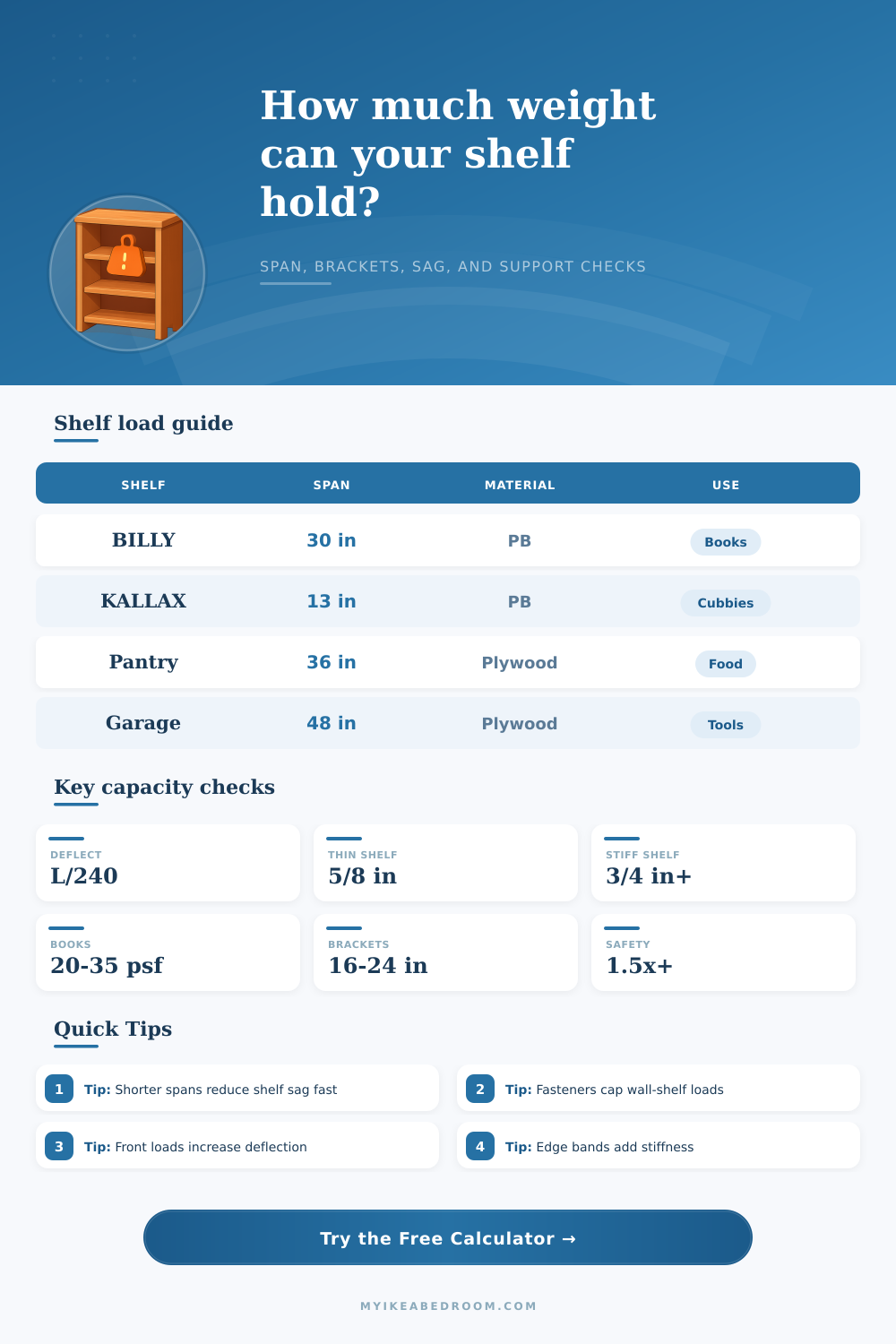
| Books and pantry goods | 20 to 35 lb per sq ft | High | Short spans and stiff material matter more than depth. |
| Records, tools, small appliances | 35 to 55 lb per sq ft | Very high | Fasteners, standards, and wall framing usually control. |
Cubby shelves
Short spans are naturally resistant to sag, so side-panel bearing and shelf-pin condition become the practical checks.
Dense books still need even loading across the cubby.
Adjustable bookcase shelves
Particleboard shelves can meet light loads but often deflect first on long book spans.
Adding a front nosing or center support changes the result quickly.
Wall and floating shelves
Fasteners often govern before the shelf board itself reaches its theoretical bending limit.
Use actual anchor, stud, and bracket ratings for final decisions.
Utility shelves
Framed supports reduce deflection by shortening the effective span and sharing load across more supports.
Impact loads need a higher safety factor.
To determine how much weight a shelf can hold, it is important to consider the strength of a shelf. Many people try to determine the weight capacity of a shelf by considering the thickness of wood used to make the shelf or the strength of the bracket that support that shelf. However, guessing at the weight capacity of a shelf isnt a reliable method for determining the weight that the shelf can hold before it begin to bend or break.
A shelf has a system of different part to it, and the strength of the shelf is limited only by the part of the shelf that is weakest. For instance, if the shelves is constructed with strong wood pieces but weak hardware, the hardware will fail before the wood does. Thus, it is necessary to evaluate both the material that is used to construct the shelf as well as the hardware used to support the shelf.
How to Tell How Much Weight a Shelf Can Hold
The material from which the shelf is constructed have a major impact upon the amount of weight that the shelf can hold. For instance, many people believe that the strength of a material is related to its hardness. However, the strength of a material is not the same than its hardness; strength is a description of the ability of the material to resist bending, while hardness is a description of the ability of that material to resist being scratched.
Materials like particleboard are often used to construct shelves. However, particleboard has low stiffness. Stiffness is the ability of the material to resist bending.
Because particleboard has low stiffness, the material tend to exhibit a process called “creep”; the tendency of a material to change from its original shape and to sag under a placed weight. Thus, if particleboard is used to construct a shelf, the shelf may sag over time due to the weight of the items that is placed upon it. The span of a shelf is the distance between the supports for the shelf.
The span of a shelf is an important measurement of the shelf. If the span of a shelf are increased, the amount of sag that the shelf will experience will also increase. The deflection of a shelf is the amount that the shelf bend.
The deflection of a shelf does not increase in relation to the length of the span of the shelf; rather, the deflection increases cubicly. For instance, if the span of a shelf is doubled, the amount that the shelf will sag will increase to eight times the original amount of sag. Thus, to prevent a shelf from saggling too much, you can shorten the span of the shelf by adding more bracket.
Shortening the span by adding more shelf supports is a more effective means of preventing saggling than increasing the thickness of the wood that make up the shelf. In addition to the material of the shelf and the span of the shelf, it is also important to consider how the weight that will be placed upon the shelf will be distributed. For instance, if the shelf’s weight is distributed evenly across its area, this is referred to as a uniform load.
However, many shelf load are not of this type. For instance, if an item is placed in the center of the shelf, the weight of that item will be concentrated in a small area of the shelf. This type of load can place more stress upon the shelf than a uniform load.
Additionally, if the weight is placed on only the front edge of the shelf, the shelf is “front loaded,” which can cause the shelf to experience torsion (twisting). Because these different type of loads can place different amounts of stress upon the shelf, it is necessary to consider the way that the items will be distributed upon the shelf. The amount of sagging that is permitted for a shelf also have an impact upon the total strength of that shelf.
For instance, a shelf that is placed in a utility room in the garage may allow for more deflection of the shelf than a shelf that is placed in a living room and that is used to display decorative item. The deflection of a shelf has a greater impact upon the function of a utility shelf than it does upon a decorative shelf. Thus, the individual that build the shelf should of decide the amount of deflection that is permitted for a shelf prior to the installation of the shelf.
This will allow the individual that build the shelf to determine how much weight can be placed upon that shelf. Finally, it is important to include a safety factor into the calculations of the shelf that is to be constructed. A safety factor is used to provide for the potential unexpected weight that may be placed upon the shelf.
For instance, individuals often lean upon shelves. Additionally, heavy object may be dropped upon the shelves. Thus, one may use a safety factor of 1.5 times or 2 times the calculated strength of the shelf to provide for the additional weight of these variable.
By including each of these factor: the stiffness of the material, the length of the span, the strength of the fasteners, and the safety factor, an individual can be certain that the shelf that is constructed will be able to support the intended weight of the items that will be placed upon it.