Sheer Panel Fullness Calculator
Estimate sheer panel count, achieved fullness, wall coverage, stack width, fabric take-up, and finished drop allowances for light-filtering curtain layers.
Choose a common sheer-layer setup, then adjust the track width, panel size, heading, returns, and target fullness to match the window.
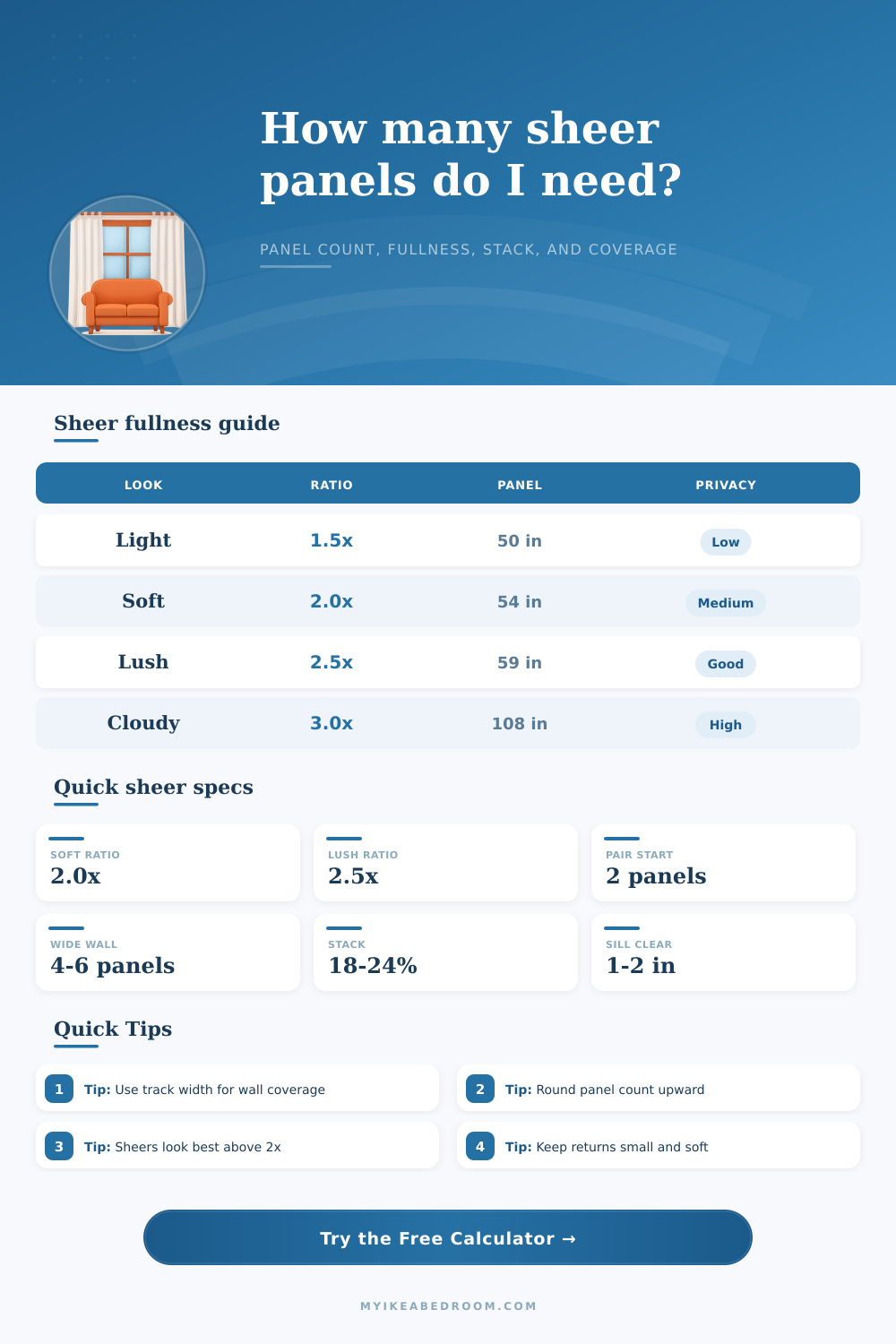
Fullness breakdown
| Fullness look | Ratio range | Best sheer use | What changes visually |
|---|---|---|---|
| Light and flat | 1.3x to 1.6x | Decorative side panels | More glass outline shows through the fabric. |
| Soft everyday | 1.8x to 2.2x | Standard voile pairs | Balanced folds with easy opening and closing. |
| Lush privacy | 2.3x to 2.7x | Bedroom and street-facing windows | More overlap in the folds improves daytime screening. |
| Cloudy and full | 2.8x to 3.2x | Ceiling track and wide walls | The sheer reads as a soft continuous layer. |
| Common panel width | Two panels cover | Four panels cover | Six panels cover |
|---|---|---|---|
| 50 in / 127 cm | 50 in at 2.0x | 100 in at 2.0x | 150 in at 2.0x |
| 54 in / 137 cm | 54 in at 2.0x | 108 in at 2.0x | 162 in at 2.0x |
| 59 in / 150 cm | 59 in at 2.0x | 118 in at 2.0x | 177 in at 2.0x |
| 108 in / 274 cm | 108 in at 2.0x | 216 in at 2.0x | 324 in at 2.0x |
| Heading type | Typical ratio | Stack behavior | Calculator setting |
|---|---|---|---|
| Rod pocket gathered | 2.0x to 2.7x | Soft but less easy to traverse | Average or full stack |
| Clip rings | 1.6x to 2.2x | Relaxed, movable folds | Slim or average stack |
| Grommet or eyelet | 1.6x to 2.0x | Wide waves with larger returns | Average stack |
| Wave tape track | 2.0x to 2.4x | Even ripple across the whole span | Slim track stack |
| Pinch pleat sheer | 2.2x to 2.8x | Tailored folds, less casual | Average stack |
| Window scenario | Measured width | Panel plan | Fullness target |
|---|---|---|---|
| Small apartment window | 48 in / 122 cm | 2 panels at 50 in | About 2.0x with small returns |
| Bedroom double window | 72 in / 183 cm | 4 panels at 50 to 54 in | About 2.4x to 2.8x |
| Patio door sheer | 96 in / 244 cm | 4 panels at 54 in | About 2.1x after overlap |
| Wide living wall | 144 in / 366 cm | 6 panels at 59 in | About 2.3x to 2.5x |
Light Voile
Best at 2.0x to 3.0x.
Very transparent cloth needs extra folds to soften daylight and reduce the window outline.
Linen-Look Sheer
Best at 1.8x to 2.5x.
Texture adds screening, so the same fullness feels denser than plain voile.
Wave Track
Best near 2.1x.
Even carriers create consistent folds; panel count should follow the track system spacing.
Layered Behind Drapes
Best at 1.6x to 2.2x.
Use enough fullness for daytime softness without crowding the main drapery stack.
One thing you always see when people hang new curtains is that they is flat to the window, lacking any sort of fullness. Just like hanging rod too low, this is a typical error in window dressing. Sheers need to do two things: Filter the light AND be elegant. If you don’t have enough fabric, you don’t get either benefit.
After entering in the dimensions of your space, this page do all the math for you. It will tell you if a standard panel will properly cover the glass, or if it will look like a skinny sheet hung up on wall.
How to Get Full and Beautiful Sheers
The ratio of full fabric width to rod (or track) width is called fullness. One-to-one will look cheap: the fabric just hangs straight down with no folds. Folds are what you want; they’re made by having more fabric. Two-to-two-and-a-half times your window width is typicaly best for sheer. This provides enough soft waves to diffuse the daylight without blocking your view.
How big? The reference table show a two-point-zero ratio as being standard-looking and a three-point.zero ratio as creating a thicker layer for privacy purposes. Why does this matter? Because stretched fabric reflects light different than gathered fibers.
Your choices of inputs represent actual physical restrictions. Your choice of heading type determine its movement. Wave tracks are their own beast entirely because they force the fabric into perfect sine waves, meaning your panel count has to align perfectly with the track’s carrier spacing. Grommets produce broader, defined waves that can absorbs slightly lower fullness before appearing limp. Rod pockets generate irregular folds, so more fullness is required for them to appear casual.
The number of panels must match the spacing between the track carriers (the wave system). Using a wave system instead of calculating for rod pockets will result in bunching or gaps that no amount of steaming will cure. And there’s also an issue with calculations falling short in terms of stack back. That’s what happens to the space that your curtains occupy once opened. Even though sheers is light weight, gathering four panel onto one side still takes up some visual space. Open your shears and block half your view? Oof! This is especially true if your window isn’t wide.
The tool estimates this based off track type and fabric density. This helps you determine how many panels or a wider rod to use. Seems like a small part of the calculation, but it determines whether your window looks airy or cramped.
But it’s not just about the size. The fabric also matters. A sheer with linen-look texture catches light different than one made of smooth voile. Because the texture has irregularities on its surface, maybe a textured sheer look full enough even at a lower ratio. Or perhaps a plain, sheer fabric like chiffon requires more folds before it no longer appears thin and see-through. A lighter fabric may require another panel in order to achieve same level of privacy. So that’s why there’s a question in the fabric density section of the calculator. The expectation of what you’ll really get when it’s all done changes based off the fabric.
Buy your panels on the large side. Go ahead and round up if the equation says 3 panels go for 4! Splitting/layering panels is far easier before they’re hemmed than sewing them together once hemmed. Sheers come in pairs most places you shop anyways, which is why making multiples of two make good sense in the logistics department. Just a bit more fullness is forgiving and photographs well too…gives that luxurius look.
There’s no such thing as too much fabric. But there is such a thing as not enough. Balance is everything with window treatments. The frame needs to improve the room not compete with it. The fullness needs to be just so or else you simply have windows that are covered instead of designed. It’s the difference between a house and a home, realy. Let that excess fabric soften those hard architectural lines. Choose your folds carefully and measure twice.