Shed Roof Felt Quantity Calculator
Estimate sloped roof area, strip courses, effective felt roll coverage, roll count, overlap loss, ridge cap length, waste allowance, and practical layout notes for apex, pent, lean-to, flat, and hipped shed roofs.
🏠Shed Felt Presets
Load a common shed roof layout, then adjust the actual felt roll, laps, ridge cap allowance, pitch, and waste percentage.
⚙Roof, Roll, Lap, Ridge, and Waste Inputs
Shed Felt Result
📦Roll Coverage Snapshot
🗒Felt / Roof Comparison Grid
Apex Shed Roof
Two equal roof planes create a ridge length about equal to the roof length. Include ridge cap allowance and courses on both sides.
Pent or Lean-To
One sloping plane usually has no ridge cap. Roll count is driven by slope width, eave length, laps, and waste.
Low Flat Roof
Pitch factor is small, but extra side laps, drip edges, and upstands can make effective roll coverage lower.
Hipped Roof
Hip cuts waste more felt than a simple rectangle. The calculator adds a style factor and ridge/hip allowance.
📊Shed Felt Reference Tables
| Roof style | Plane count | Ridge cap count | Planning effect |
|---|---|---|---|
| Apex / gable | Two equal sloped planes | Main ridge length | Good balance of simple courses and ridge cap felt. |
| Pent shed | One sloped plane | No ridge cap | Often the most roll-efficient felt layout. |
| Lean-to roof | One sloped plane | No ridge cap | Similar to pent, with extra care at the high wall edge. |
| Low flat roof | One low plane | No ridge cap | Short pitch factor, but laps and edge returns matter. |
| Saltbox roof | Two unequal planes | Main ridge length | Adds a small asymmetry factor for unequal roof sides. |
| Hipped shed roof | Four cut planes | Ridge and hip allowance | More trimming and diagonal cuts than rectangular roofs. |
| Pitch | Slope factor | Area increase | Common shed use |
|---|---|---|---|
| 0:12 to 1:12 | 1.000 to 1.003 | Minimal | Flat or very low tool stores and garden lockers. |
| 2:12 | 1.014 | About 1.4% | Low pent sheds and lean-to roofs. |
| 3:12 | 1.031 | About 3.1% | Garden offices and compact insulated sheds. |
| 4:12 | 1.054 | About 5.4% | Common small apex shed pitch. |
| 6:12 | 1.118 | About 11.8% | Steeper decorative or snow-shedding roofs. |
| Roll size | Gross roll area | Typical laps | Usable planning area |
|---|---|---|---|
| 3 ft x 33 ft | 99 sq ft | 3 in side, 6 in end | About 88 to 94 sq ft per roll. |
| 1 m x 10 m | 107.6 sq ft | 75 mm side, 150 mm end | About 96 to 102 sq ft per roll. |
| 3.3 ft x 49 ft | 162 sq ft | 3 in side, 6 in end | About 145 to 154 sq ft per roll. |
| 2 ft x 50 ft | 100 sq ft | 2 in side, 6 in end | About 88 to 95 sq ft per roll. |
| Project | Starting roof size | Main allowances | Typical roll count |
|---|---|---|---|
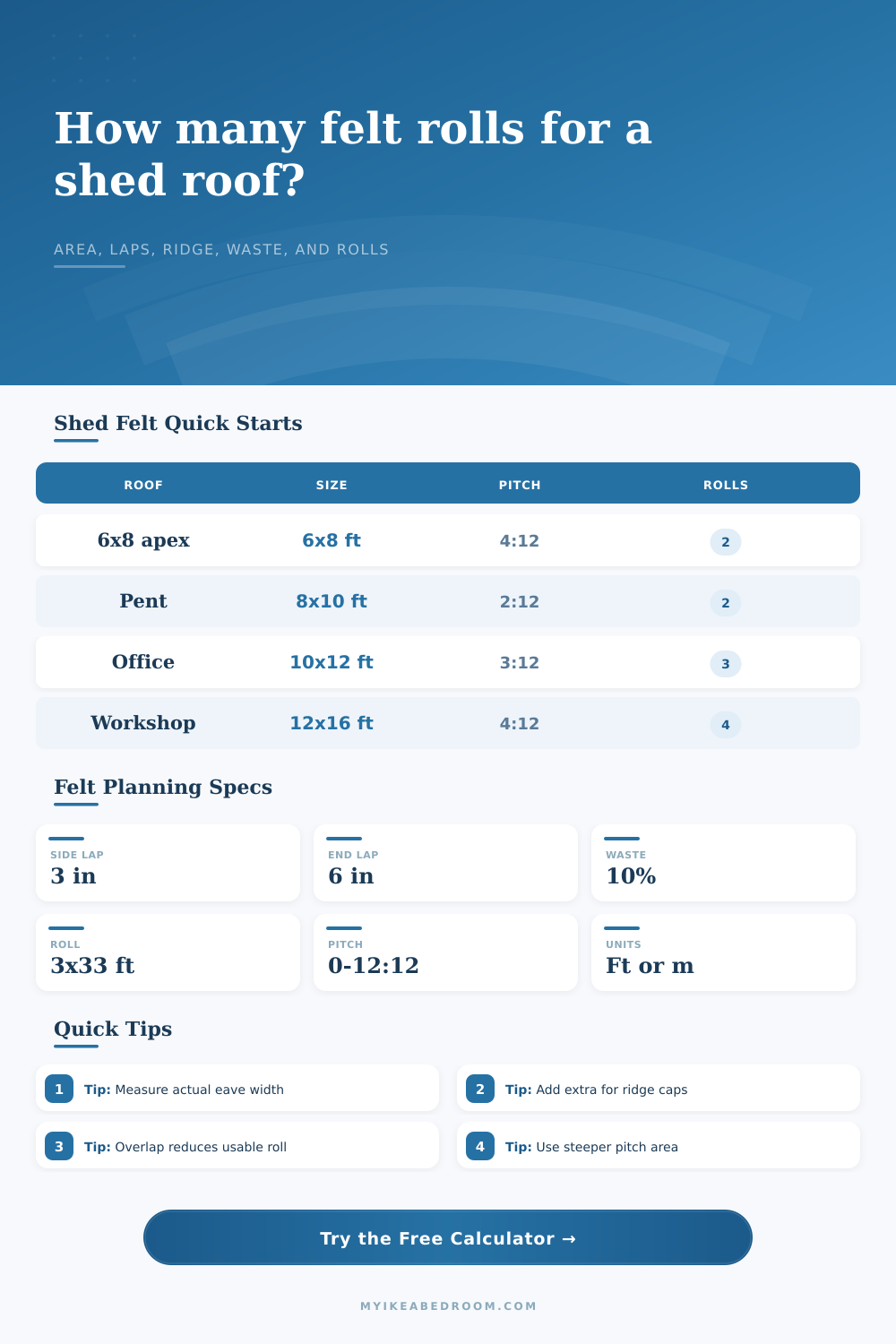
| 6x8 apex shed | 8 ft length, 6 ft width, 4:12 pitch | Ridge cap plus 10% waste | 2 rolls at 3 ft x 33 ft |
| 8x10 pent shed | 10 ft length, 8 ft width, 2:12 pitch | No ridge, 3 in side lap | 2 rolls at 3 ft x 33 ft |
| 10x12 garden office | 12 ft length, 10 ft width, 3:12 pitch | Wider roll, moderate waste | 3 rolls at 3 ft x 33 ft |
| 12x16 workshop shed | 16 ft length, 12 ft width, 4:12 pitch | Apex ridge and 12% waste | 4 rolls at 3 ft x 33 ft |
💡Shed Felt Tips
To use it, you input size of your roof and it calculates how much felt is required for the project. Then you choose the type, angle (pitch), and lap allowances. The app do all the math and converts it to an efficient coverage. It even lets you know exactly which number of rolls you need to purchase.
That way, you won’t be left with half a roll part-way up the roof. Don’t estimate by measuring footprint of the floor. The surface area increase with overhangs. If you have wide eaves and/or barge boards on your shed those extra inches multiply fast all along length of the slope. This means getting good measurements is critical to providing an adequate estimate.
How to Use the Roof Felt Calculator
Total surface area are greatly affected by pitch. For instance, a flat roof appears one way on paper but adding a four-to-twelve pitch adds roughly five percent more surface area different than what’s shown in the plan view. That little change mean you won’t run out of rolls when you’re done. Automatically applied slope factor removes having to reference a trigonometry table.
The biggest gap in any estimate come with lap allowances. Two sheets of felt butted up against each other will form a path for water leakage. To prevent this, industry standard call for a minimum of 6-inch end laps and 3-inches side lapping. Starting at the second row, every subsequent row must overlap three inches so it loses width. That lost space get subtracted from each roll’s yield in the calculator.
Ridge caps is also included; these are extra lengths of felt used to seal the roof peak on an apex roof. They appear as small pieces of trim, so it’s easy to forget about them until time to cut and staple them on.
The last buffer is waste. A good rule-of-thumb would of been 10-percent waste for basic rectangular roofs. If you’re working with more complex cuts like hipped sheds increase that amount. The nice part about this tool is it allow you to tweak the waste-percentage according to how confident you feel and details of your roof lines. Better to have a leftover half-roll than make a dash to hardware store in the rain.
The type of felt matters as well (in that it’s not an exact math). Heavier gauge felts will be stiffer, last longer; good for thicker, heavy shingles or slate roofs. For lightweight metal caps or shingles, a regular grade should suffices. The trick is to make surface underneath the top layer dry. If the deck itself can “breathe” then you’ll want an underlayment that lets air through… Not something solid.
That eliminates the guessing game. Now you have an exact number of rolls needed to cover your actual physical space. You won’t have to deal with vague “it’s about a 20’x15′ area” math that leads to chaos at hardware store. It’s a numbered roll count for a numbered task. Buy just enough to ensure that your shed doesn’t stay wet.