Shaker Door Calculator
Calculate finished shaker door stiles, rails, floating panel cut size, visible panel opening, cope allowance, expansion gap, and total frame linear footage.
Drawer Front
Frame: Narrower rails avoid a crowded center panel.
Check: Panel opening can disappear on short fronts.
Base Door
Frame: Balanced 2 to 2.5 in rails and stiles.
Check: Keep paired reveals equal at the cabinet center.
Inset Door
Frame: Same part math after the final door size is set.
Check: Door width already includes the inset clearance plan.
Tall Wardrobe
Frame: Wider rails help the large panel read in proportion.
Check: Increase panel float for wider solid panels.
| Part | Formula | Quantity | Result meaning |
|---|---|---|---|
| Stile length | Finished door height | 2 per door | Vertical outside frame pieces |
| Rail length | Door width - 2 stiles + 2 cope allowances | 2 per door | Horizontal parts cut before coping |
| Panel cut width | Opening width + 2 groove depths - expansion gap | 1 per door | Floating panel width before final fit |
| Panel cut height | Opening height + 2 groove depths - expansion gap | 1 per door | Floating panel height before final fit |
| Door style | Finished size cue | Stile width | Rail width |
|---|---|---|---|
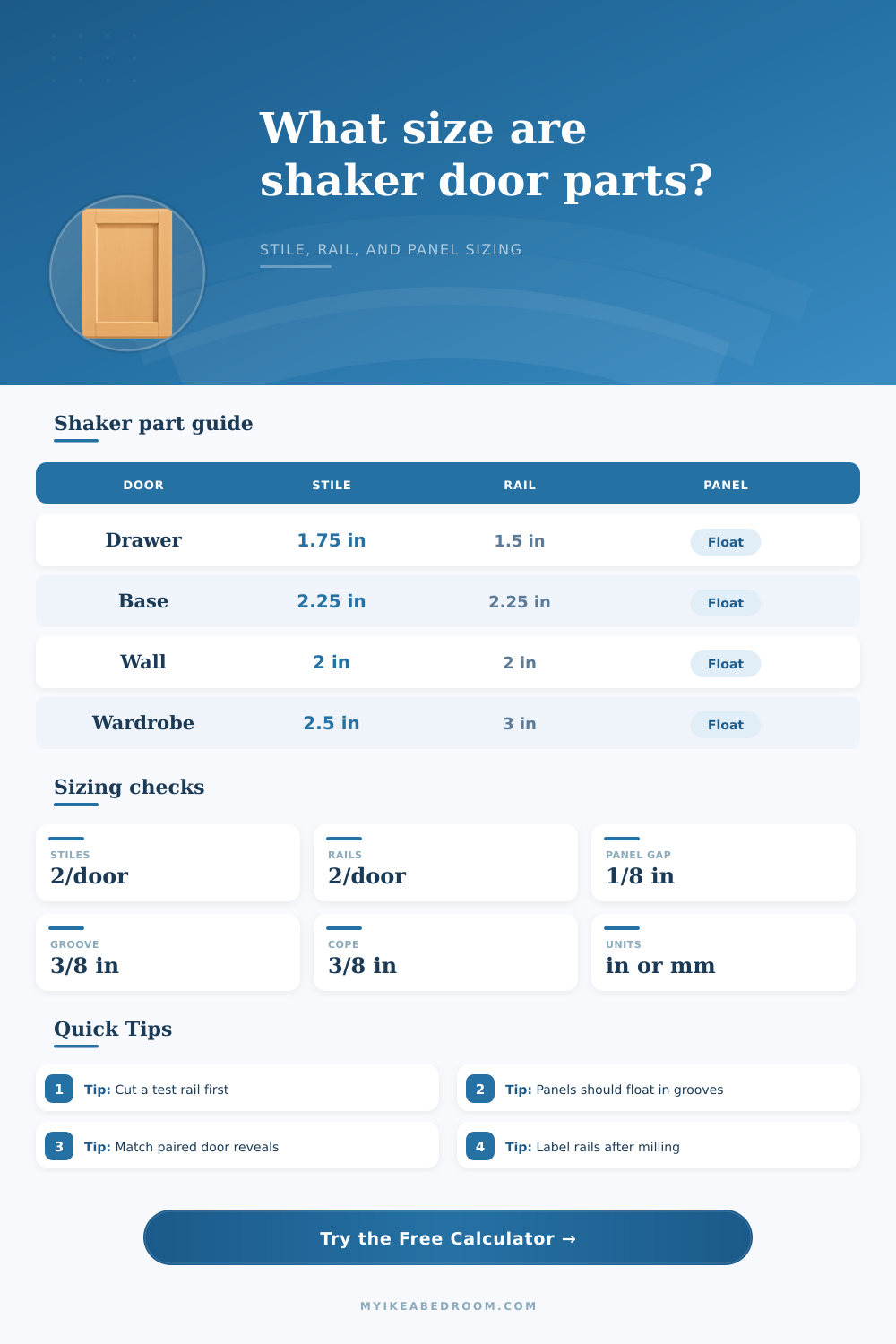
| Small drawer front | 6 to 10 in tall | 1.5 to 2 in | 1.25 to 1.75 in |
| Base cabinet door | 24 to 32 in tall | 2 to 2.5 in | 2 to 2.5 in |
| Wall cabinet door | 24 to 42 in tall | 1.75 to 2.25 in | 1.75 to 2.25 in |
| Tall wardrobe door | 60 in and taller | 2.25 to 3 in | 2.5 to 4 in |
| Setting | Common range | What it changes | Shop check |
|---|---|---|---|
| Panel groove depth | 1/4 to 1/2 in | How much panel hides inside the frame | Do not weaken narrow rails |
| Cope allowance | 1/4 to 1/2 in | Added to each rail end before coping | Match your cutter profile |
| Panel expansion gap | 1/16 to 1/4 in total | Subtracted from panel cut width and height | Use more for solid wide panels |
| Panel reveal | 1/8 to 3/8 in | Visual step from frame to flat panel | Confirm with a sample door |
| Check | Why it matters | Good sign | Revise when |
|---|---|---|---|
| Opening width | Sets panel width and visible center area | Positive and proportional | Stiles are too wide for the door |
| Opening height | Sets panel height and drawer-front balance | Large enough for reveal | Rails crowd a short drawer front |
| Groove to thickness | Shows how deep the groove is in the stock | Less than half thickness | Groove is too deep for thin material |
| Total frame footage | Summarizes rail and stile stock length | Matches door count | Door count or dimensions changed |
Rail fit: The rail length result assumes the cope or stub tenon is added to both rail ends. Cut one sample rail from the same milled stock and confirm the outside door width before batching.
Panel float: The panel size subtracts the total expansion gap after adding both groove depths. Center the panel during assembly so the free space is shared across both sides.
Shaker doors are a specific type of cabinet door. Shaker door panels consists of a frame and a center panel. The frame is made up of stiles and rails, and the panel sits inside this frame.
The proportion of the shaker door frame are essential because these proportions will determine how the frame will behave with changes in humidity. Furthermore, the proportions will also determine how the joinery will fit together after milling. The widths of the stiles and rails will determine the visual weight of the frame.
How to Use the Shaker Door Calculator
For example, if you make a narrow rail for a tall shaker door, the narrow rail will look too thin with the panel in place. Using an overly wide rail will crowd the opening for the panel if used on a small drawer front. A calculator will determine these measurements.
This calculator does the math for you after you enter the finished size of the shaker door and the widths of the components that you would like to cut. The calculator takes into account the panel that will be lost to the grooves and an expansion gap. The panel will need to have a panel float.
This allows the panel to expand without forcing the frame open. The panel should also not rattle within the frame. The expansion gap allows the panel to have the free space to expand.
If you make the expansion gap too small, the solid wood panel will bind when the humidity of the environment increases. Doing so will force the panel to expand beyond it’s capacity. On the other hand, providing too much expansion gap will allow the panel to shift within the frame.
The depth of the groove will impact the strength of the frame as well as the visual appearance of the frame. A deeper groove will hide more of the edge of the panel. It will also remove more material from the stiles and the rails.
If the depth of the groove takes up more than half the thickness of the material, the shaker door frame will be weak at the joint. Using a table will allow you to find the right groove depth for the thickness of the material that you will use. The cope allowance is the amount of extra length to the ends of the rails to ensure that the cope or the stub tenon will reach the depth of the stile.
The calculator will add this allowance to the length of the rail. It will also provide you with the length of the rail that you should cut for your shaker door frame. Using this calculator will ensure that you dont make the mistake of having a shaker door that is narrower than you had intended.
Depending on the type of cabinet that you will make your shaker doors for, the proportions of the shaker door frame will have to change. For example, drawer fronts will have narrower rails due to the small size of the drawer front panels. Base doors will have proportions in the middle range to provide a balance looking base door.
If the doors are wardrobe doors that will be tall, the doors will have wider rails at the top and bottom. Tall wardrobe doors have large panels for the doors to open into. The shaker door frame calculator will have presets for these dimensions so that you can set your shaker door proportions to these parameters.
However, the logic of the shaker door frame will remain the same as it should look intentional next to the panel for the wardrobe door. The thickness of the material impacts the depth of the groove that will be cut into the shaker door frame. If you use thinner material for your shaker doors, you will have to use a shallow groove.
This will limit the amount of the panel edge that you can hide under your shaker door frame. On the other hand, if you use thicker material, you can have a deeper groove. This will provide a stronger joint between the panels of the shaker door frame, however, it will also add to the weight of your shaker doors.
You can use the calculator to determine how the thickness of the material will impact each dimension of your shaker doors. The linear footage of the shaker doors will tell you how much wood stock you will need to make all of your shaker doors. This measurement will calculate the length of all of the stiles and rails for the number of shaker doors that you have entered into the shaker door frame calculator.
This measurement will help you to order your wood stock and will also allow you to determine if you have enough offcut from your wood stock. Many mistakes occur when people treat the measurements that are calculated from the shaker door frame calculator as the final measurements that the components should measure to. For example, even if you make your rail to the correct measurement, it may not fit correctly in the stile due to incorrect settings of the cope cutter.
Even if you cut and assemble your panel to perfectly float within the frame when you are in the shop, once the door is painted, the panel may bind to the frame due to the moisture that will be present in the wood. Always cut one test rail and one test panel before you begin to cut the remaining wood stock for your shaker doors. This will allow you to ensure that your machine is correctly set up to cut the shaker door components to the dimensions that the calculator targets for you.