Shade Sail Size Calculator
Plan triangle, rectangle, and square shade sails from anchor spacing, desired inset, sag percent, post height difference, clearance target, overlap allowance, and unit system.
Shade Sail Calculation Breakdown
| Preset | Shape | Anchor Spacing | Typical Inset | Use Case |
|---|---|---|---|---|
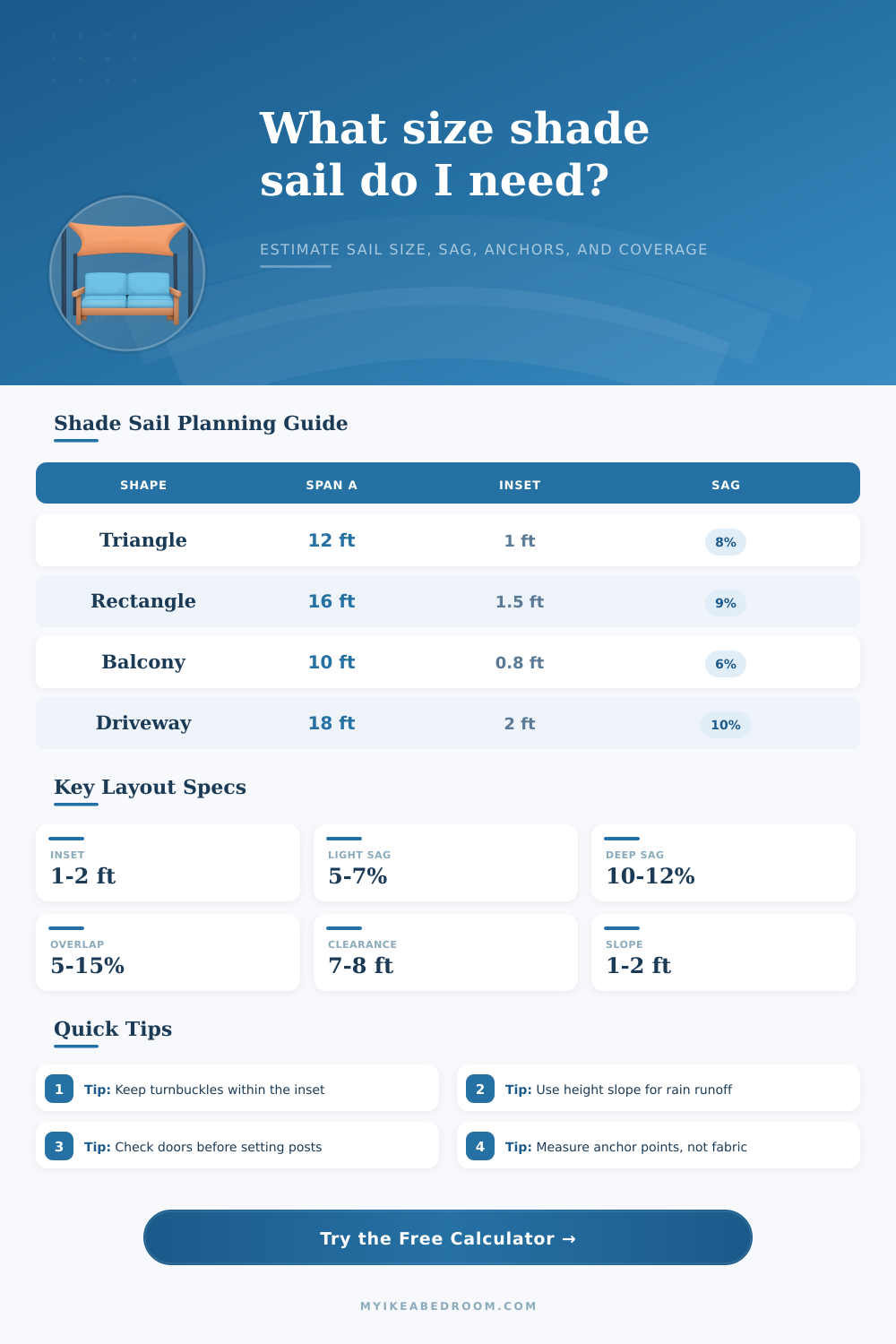
| Triangle patio sail | Triangle | 12 x 12 x 12 ft | 1 ft | Small seating area |
| Rectangle deck sail | Rectangle | 16 x 12 ft | 1.5 ft | Outdoor dining deck |
| Balcony shade | Rectangle | 10 x 6 ft | 0.8 ft | Apartment balcony or narrow porch |
| Driveway shade | Rectangle | 18 x 12 ft | 2 ft | Vehicle or side-yard coverage |
| Shape | Sail Side Formula | Area Formula | Best For |
|---|---|---|---|
| Triangle | Each side = spacing - 2 x inset | Heron: square root of s(s-a)(s-b)(s-c) | Corner shade, angled patios, pools |
| Rectangle | Length and width = spacing - 2 x inset | Length x width | Decks, driveways, courtyards |
| Square | Average A and B, then subtract 2 x inset | Side x side | Play areas, cafe corners, pergolas |
| Overlap | Net coverage = area x remaining percent | Area x (1 - overlap percent) | Multiple layered shade sails |
| Sag Percent | 20 ft Span Drop | 6 m Span Drop | Visual Result |
|---|---|---|---|
| 5% | 1.0 ft | 0.30 m | Very taut, minimal curve |
| 8% | 1.6 ft | 0.48 m | Balanced residential curve |
| 10% | 2.0 ft | 0.60 m | Clear catenary look |
| 12% | 2.4 ft | 0.72 m | Deep shade canopy drop |
| Hardware Allowance | Common Range | Why It Matters | Planning Note |
|---|---|---|---|
| Turnbuckle space | 8-16 in | Gives final tension adjustment | Keep inside the inset allowance |
| Corner plate gap | 2-6 in | Prevents fabric crowding hardware | Check manufacturer corner details |
| Post slope | 1-2 ft | Helps water shed from the sail | More slope for waterproof fabric |
| Edge clearance | 12-24 in | Keeps sail away from walls and fascia | Confirm door and window swings |
That’s when that great idea for a covered patio fails in the math part. You draw out the shape, you take some measurements of the corners, then you get the fabric hung up… only to find that edges scrape against fence or the middle puddles because you didn’t account for the way land slopes. Geometry and gravity lead to success in real space.
If you were making a sail for your house you’d probably just measure wall-to-wall distance thinking that’s how long the sail should be. However, there’s more than just the fabric itself; you’ve got hardware holding the material tight plus the slack required for the final adjustment. You’ll want some allowance for things like turnbuckles and shackles as well. By using the inset feature on calculator, you’re able to cut amount of material by allowing yourself that cushion. Now you have the proper length for your sail. Not doing this will result in having a too-small sail or one that pulls at edges.
How to Measure and Plan Your Patio Cover
The second factor is that shape impacts how wind pressure applies against the fabric. For example, a rectangle distribute the force to 4 points. Triangle distributes to 3. With rectangular shapes I can get more coverage with one piece than triangles. So if I want to cover a patio corner for instance, a triangle provides the cleanest visual line. However, triangles requires fewer anchors and tend to look nicer in corners. Where does tool come into play? It will show dimensions of sides and amount of coverage based off your selected shape.
One variable that can trip up a novice installer is sag. Fabric, hung as a flat sheet, acts like a wing catching the wind and straining the posts. To demonstrate the droop, calculator turns the percentage into an actual drop height. Eight percent is typically ideal for residences where fabric remains tight but still sheds water. In a windy location, twelve percent will let the fabric move rather than resist force.
Complicating matters are materials. Some fabrics don’t breathe; heavy PVC fabrics should of be pitched at a greater angle than lightweight HDPE meshes for drainage purposes. The tool allows you to choose fabric type and therefore see how that impacts your scenario. If you know your fabric composition, you’ll also know how much elevation change is necessary between each anchor point. One or two feet might sound like nothing but it’s all that’s required to keep things dry post-storm.
Balancing comfort and safety: Clearance height The clearance height will vary depending on how much you want your shade structure to sag. For most, it’s about walking under a shade structure comfortabley, meaning around seven or eight feet of clearance height at the lowest spot. Use the calculator backwards, enter in what height you think is comfortable and add to that any desired sag for your shade structure. This way you don’t end up putting post down too low (hanging into tables or blocking door frames). It’s easier and less expensive to do this in advance.
Take accurate measurements, plan for hardware, and consider how much tension will exist with the furnitures. Until you get out into yard and drive stakes in the ground, everything that pops up on the screen is an estimate. But input the correct data and those numbers can be a good predictor of what works outside.