🚽 Septic Tank Size Calculator
Estimate septic tank capacity from bedrooms, occupants, daily wastewater, retention time, and reserve margin.
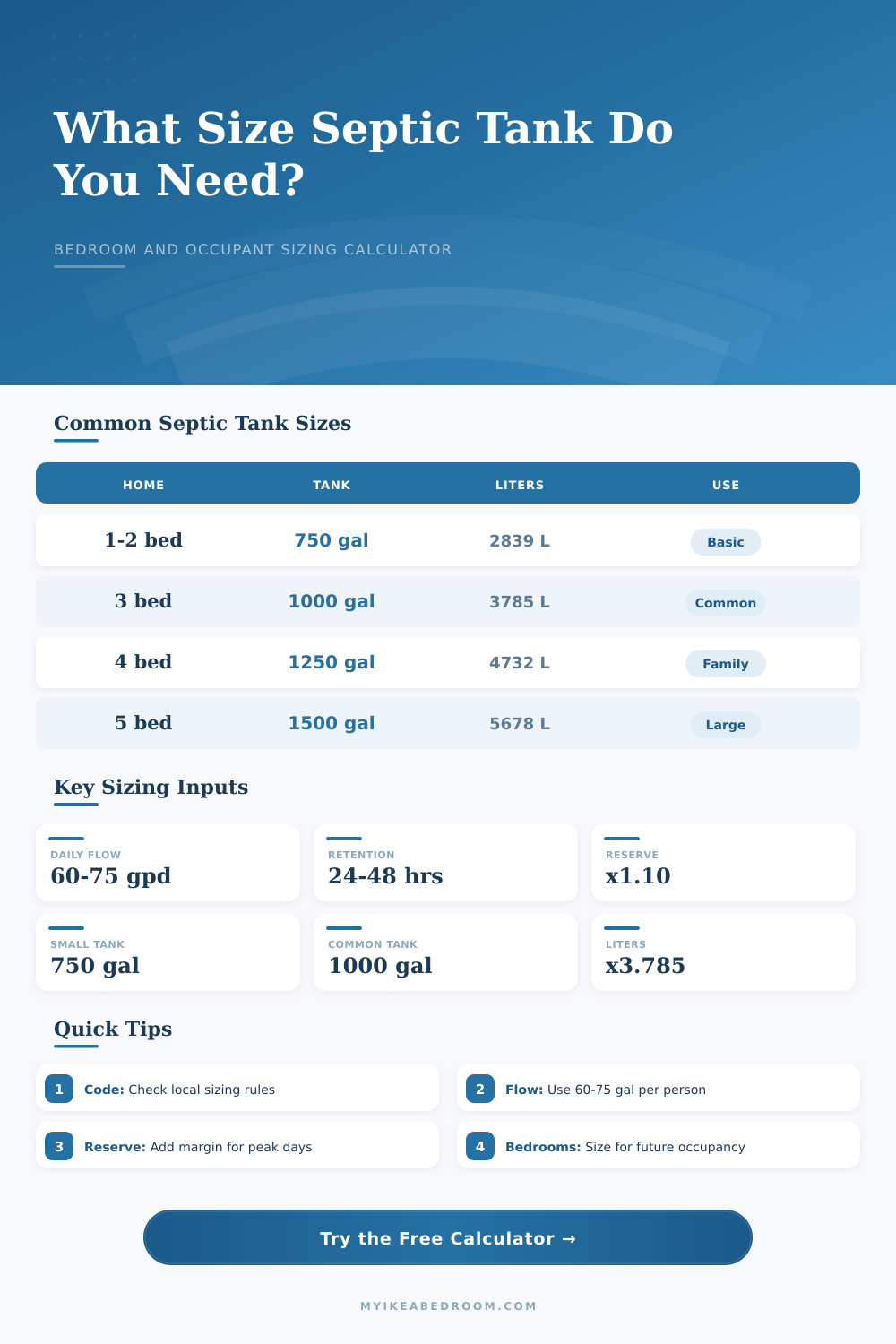
2839 L
3785 L
4732 L
5678 L
7571 L
| Bedrooms | Design Occupants | Common Tank | Liters | Typical Use |
|---|---|---|---|---|
| 1-2 | 2-4 | 750 gal | 2,839 L | Small home or cabin |
| 3 | 6 | 1,000 gal | 3,785 L | Standard family home |
| 4 | 8 | 1,250 gal | 4,732 L | Large family home |
| 5 | 10 | 1,500 gal | 5,678 L | Higher bedroom count |
| 6+ | 12+ | 2,000 gal+ | 7,571 L+ | Large or expanded system |
| Planning Flow | Per Person | Metric | Best For | Notes |
|---|---|---|---|---|
| Low | 60 gal/day | 227 L/day | Efficient fixtures | Use only when habits are known |
| Standard | 70 gal/day | 265 L/day | Typical home | Balanced residential assumption |
| High | 75 gal/day | 284 L/day | Conservative sizing | Good for peak-day planning |
| Extra | 90 gal/day | 341 L/day | Heavy water use | Use for frequent laundry loads |
| Setting | Multiplier | Meaning | When To Use |
|---|---|---|---|
| 24 hour retention | x1.00 day | One day of design flow | Compact baseline estimate |
| 36 hour retention | x1.50 days | More settling time | Common planning midpoint |
| 48 hour retention | x2.00 days | High hydraulic storage | Conservative estimate |
| 10% reserve | x1.10 | Peak-use buffer | Default margin |
| 20% reserve | x1.20 | Higher demand margin | Busy households |
| 30% reserve | x1.30 | Growth allowance | Possible future bedrooms |
| Scenario | Bedrooms | Occupants | Flow | Expected Tank |
|---|---|---|---|---|
| ADU suite | 1 | 1 | 60 gpd/person | 750 gal |
| 2 bed cottage | 2 | 3 | 65 gpd/person | 750 gal |
| 3 bed family | 3 | 4 | 70 gpd/person | 1,000 gal |
| 4 bed house | 4 | 5 | 70 gpd/person | 1,250 gal |
| 5 bed large home | 5 | 7 | 75 gpd/person | 1,500 gal |
| 6 bed multi-gen | 6 | 9 | 75 gpd/person | 2,000 gal+ |
Use the stricter result: If bedroom sizing and occupant sizing disagree, the larger capacity is usually the safer planning number.
Check local code: Septic tank requirements vary by health department, soil conditions, system type, and permit rules.
Plan for peaks: Laundry clusters, guests, and disposal use can raise short-term flows above the daily average.
Round upward: The calculator rounds to 750, 1000, 1250, 1500, or 2000 gallons before flagging custom sizing.
Septic tanks don’t like surprises. If you have a small tank, it won’t last until you start noticing red flags (usually when there’s a downpour and your back yard starts surfacing or your washing machine get backed up). Don’t guess, size matters.
Sizing mean calculating how much water your house produce versus the time required for solids to settle. Enter your number of bedrooms and typical occupancy habits in size calculator above. It spits out answer, saving you headache of trial and error, which can cost thousands.
Why Septic Tank Size Matters
I’m putting bedroom count first because it’s something you typically can’t adjust (unless you’re building or buying a new home), but you CAN adjust how many people will be using those room. Bedrooms is an indicator of maximum occupancy in most building codes; they assume you’ll have 2 occupants per bedroom. So if you live in a four-bedroom home, even if only two of you inhabit it, a standard code may still drive you to a larger tank. And yes, it IS a safety buffer. It allows for guests, plus the inevitable spike in water usage that occurs when everybody want to take a shower all at once.
The other side is actualy usage. A household with four people doing heavy laundry loads produce far more wastewater than a couple who composts food scraps and air dries their clothes. This extra wastewater affect the daily flow and the appliance load. So there formula takes this into account and adjusts the baseline gallons per person accordingly. And if you don’t take this into consideration, you could have a legally-sized tank in technical terms but one that isn’t large enough to actualy do its job. What you want is a tank that accommodates peak use, not the average.
But this is where engineering meets biology. The wastewater must remain in the tank long enough to allow heavier solids to settle out and light grease rise to the top. Otherwise, those solids will get washed out to drain field. The drain field is the expensive part of the system and is what gets all clogged up. So any way you can extend the retention time (in the calculation) means you need a larger tank to accommodate it.
We instinctively want to make things smaller so they hold less, but there is a big difference between having a system last two decades than having to pump it every six months. Life gets messy. People come over. Your pipes leak. What counts as “empty” varies. Adding a buffer of say ten or twenty percent reserve give the system some breathing room. It keeps scum layer from getting pushed out if you suddenly use more water than normal. This is a tiny up-front investment that avoids expensive emergency situations.
A little bump in reserve will often jump you into the next standard tank size (the table on the page illustrates this). They are convenient but inflexible. The tanks themselves also has standard sizes (they come in 750, 1000, 1250, 1500, etc.). You can’t just order a 1100 gallon tank because they don’t exist. So depending on how much overage you may have with your calculation you could be rounding up quite a bit. 950? Ok, we’ll give you 1000. 1010? Ok, we’ll give you 1250. That’s a big step up, but that’s just the way the hardware works.
And better to plan to go bigger initially than deal with headache of having to make your system work once it is too small. The last factor is soil conditions and local regulations. Local environmental rules may be stricter, or your percolation might be bad, which means bigger tanks for some location. The tool generates a hydraulic estimate; it’s not a permit. It’s always best to consult your local health department, but a good estimate of what you really use means that you’re at least in the ballpark when talking to designers and inspectors.
The sizing of a septic tank has as much to do with guessing human behavior as anything else. When we size a septic tank, we’re predicting what your house will do for the next ten years, and creating a bit of a buffer for those things we can’t predict. You should of planned for this. If done right, a septic tank is invisible; it’s designed to handle the waste without ever drawing attention to itself. Good design means something dissapears into the daily grind, fading away so you’re free to worry about everything else that really matters.