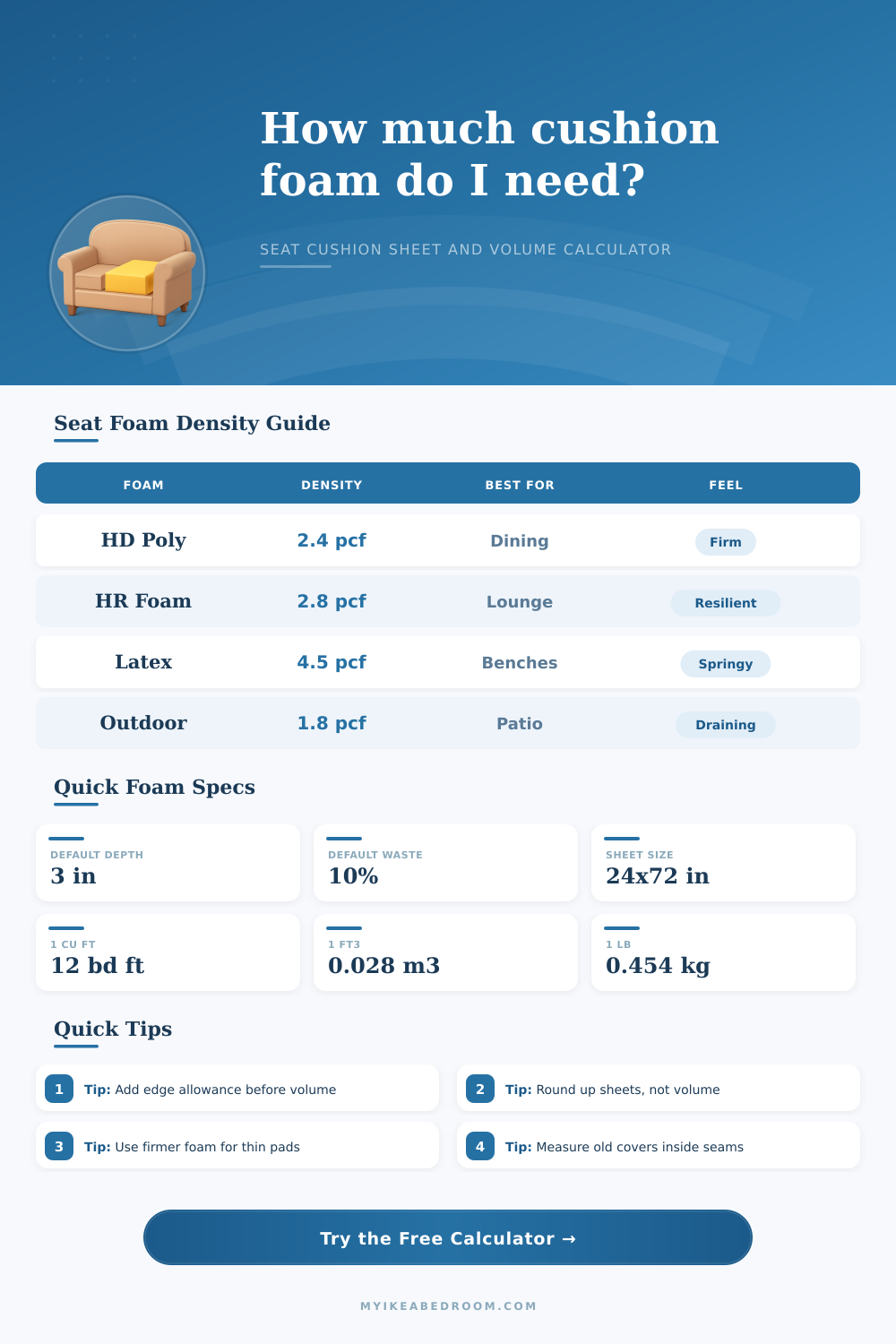
Seat Cushion Foam Quantity Calculator
Calculate foam volume, board feet, sheet count, density weight, and cutting overage for chair, bench, stool, banquette, and window-seat cushions.
Foam volume is calculated from the cushion blank size after edge allowance, then multiplied by cushion count and the selected yield buffer.
Foam Cutting Breakdown
| Foam type | Density | Typical seat use | Cutting note |
|---|---|---|---|
| Standard upholstery polyfoam | 1.8 lb/ft³ / 28.8 kg/m³ | Light dining pads, occasional chairs | Best above 2 in thickness |
| High-density polyfoam | 2.4 lb/ft³ / 38.4 kg/m³ | Everyday chair and bench seats | Reliable default for boxed covers |
| High-resilience foam | 2.8 lb/ft³ / 44.9 kg/m³ | Lounge chairs and long sitting sessions | Springs back well after compression |
| Memory foam layer | 3.0 lb/ft³ / 48.1 kg/m³ | Top comfort layer over support foam | Usually paired with firmer base foam |
| Reticulated outdoor foam | 1.8 lb/ft³ / 28.8 kg/m³ | Patio chair seats and draining cushions | Use larger waste buffer for open cells |
| Natural latex foam | 4.5 lb/ft³ / 72.1 kg/m³ | Premium bench, nook, and floor seats | Heavier sheet handling than polyfoam |
| Closed-cell EVA foam | 5.6 lb/ft³ / 89.7 kg/m³ | Firm stools, kneeling pads, utility seats | Thin pieces need precise templates |
| Rebond support foam | 6.0 lb/ft³ / 96.1 kg/m³ | Firm bases and built-in banquettes | Use where compression support matters |
| Thickness | Board feet per sq ft | Cubic feet per 10 sq ft | Best cushion match |
|---|---|---|---|
| 1 in / 2.5 cm | 1.0 bd ft | 0.83 cu ft | Thin stool topper or cover padding |
| 1.5 in / 3.8 cm | 1.5 bd ft | 1.25 cu ft | Low-profile dining chair insert |
| 2 in / 5.1 cm | 2.0 bd ft | 1.67 cu ft | Dining chair or vanity seat |
| 3 in / 7.6 cm | 3.0 bd ft | 2.50 cu ft | Everyday chair and compact bench |
| 4 in / 10.2 cm | 4.0 bd ft | 3.33 cu ft | Window bench or banquette cushion |
| 5 in / 12.7 cm | 5.0 bd ft | 4.17 cu ft | Deep lounge chair seat |
| 6 in / 15.2 cm | 6.0 bd ft | 5.00 cu ft | Floor seat, daybed, or thick nook pad |
| Stock sheet | Sheet area | Board feet at 3 in | Example seat yield |
|---|---|---|---|
| 24 x 72 in | 12.0 sq ft / 1.11 m² | 36 bd ft | Two 20 x 20 in chair blanks |
| 30 x 72 in | 15.0 sq ft / 1.39 m² | 45 bd ft | Three narrow dining pads |
| 36 x 72 in | 18.0 sq ft / 1.67 m² | 54 bd ft | One 48 x 18 in bench plus offcut |
| 48 x 72 in | 24.0 sq ft / 2.23 m² | 72 bd ft | One long bench or four chair pads |
| 48 x 96 in | 32.0 sq ft / 2.97 m² | 96 bd ft | Banquette runs and cushion sets |
| 60 x 82 in | 34.2 sq ft / 3.17 m² | 102.5 bd ft | Large nook or daybed-style seat |
| Seat shape | Area formula | Allowance method | Good use case |
|---|---|---|---|
| Rectangle or square | Length x width | Add allowance to all four edges | Chair pads, benches, storage seats |
| Rounded rectangle | Length x width x 0.97 | Size blank first, then allow rounded waste | Soft corners in zippered cushion covers |
| Trapezoid | (front + back) / 2 x depth | Add allowance to widths and depth | Angled banquettes or corner seats |
| Circle | π x radius² | Add allowance to diameter before area | Round stools and swivel chairs |
| Custom measured area | Entered area x count | Add separate yield buffer | Paper templates and irregular seats |
| Common seat project | Typical blank size | Common thickness | Foam quantity cue |
|---|---|---|---|
| Dining chair set of four | 18 x 18 in each | 2 in | About 18 bd ft before waste |
| Small entry bench | 36 x 15 in | 3 in | About 11.25 bd ft before waste |
| Window seat cushion | 48 x 18 in | 3 to 4 in | About 18 to 24 bd ft before waste |
| Long bay bench | 72 x 20 in | 4 in | About 40 bd ft before waste |
| Round stool pad | 16 in diameter | 2 in | About 2.8 bd ft before waste |
| Reading nook floor seat | 30 x 30 in | 4 to 6 in | About 25 to 37.5 bd ft before waste |
Selecting the correct types of foam for your seat cushion is important because the comfort and durability of the cushion rely on the type of foam you select. If your cushion is too soft, it will bottom out when you sit on it. If the seat cushion is too firm, then it will feel like a board.
The amount of foam that you use will determine whether the foam will fit inside the cushion cover and whether it will hold it’s shape. A quantity calculator will help you determine the volume, sheet count, and weight of the foam that you need. The first step in using a quantity calculator is to understand the cushion blank.
How to Measure and Order Foam for a Seat Cushion
The cushion blank is the size of the foam piece once you add an allowance for the edges of the cushion. Many people uses old foam to determine the size of the cushion blank. The problem with using old foam is that foam often lose some of its shape and the measurements will be off.
Instead, use the inside seam measurement of the cover. Add an allowance for the edges of the foam. Most quantity calculators will automatically calculate the amount of foam you need once you select the type of edge allowance you want to use for your project.
The shape of the cushion can change the calculations that your quantity calculator performs. If your cushion is in the shape of a rectangle, then your quantity calculator will calculate the area of the cushion using the length times the width formula. For circles, the formula is pi times the radius squared.
For trapezoids the front width and back width will be averaged and then the calculator will multiply it by the depth of the cushion. Your quantity calculator will automatically run the correct formula for the shape of your cushion so that you dont make any error in calculating the sheet count and volume of the foam. The thickness of the foam that you order will affect the project cost.
For cushions that are light in use, two inches of thickness are suitable. For cushions that will receive heavier use or for footrests, four inches of thickness is appropriate. For floor seats, use six inches of thickness.
The thickness of the foam will directly affect the volume and the board feet of the foam. Suppliers use the unit of board feet to quote the price of the foam. The thicker the foam, the more board feet there will be in the order.
Thus, changing the thickness will change the cost of the foam. Density is another factor that will affect the comfort and durability of the seat cushion. Foam with a low density will feel soft but will compress quick.
High-density foam will be less comfortabley to the touch but will hold its shape for longer periods of time. There are different weight for each type of foam. The weight of the foam will affect the charges for the shipping of the product.
Shipping costs is based on the weight of the foam. Thus, the quantity calculator will allow you to choose the density of the foam that you want to use in your seat cushion to ensure that the estimated weight of the foam is accurate. Another important part of the quantity calculation is the waste percentage.
For rectangular cushions, five percent waste are typical. For shapes that require cutting the foam sheets into specific sizes, such as circles or trapezoids, a higher waste percentage is required. For instance, fifteen percent waste is typical for rounded cushions.
The quantity calculator will find the total area of the cushion and multiply it by the waste percentage. Based off that figure, the quantity calculator will calculate the number of sheet of foam you need to order. The quantity calculator will round that number up to the nearest whole number because you cant order a fraction of a sheet of foam.
Calculate the volume and sheet count of the foam separately. The volume will tell you how much material you are using. The sheet count will tell you how many sheets of foam you need to purchase from the supplier.
These two calculations do not necessarily move together. Therefore, calculate each separately and view both calculations on the screen side-by-side. Measure your seat cushion cover while it is on the seat.
When you remove the cover from the seat, the fabric will relax and the measurements may not be accurate. Taking the measurement of the inside seam of the cover while it is on the seat will provide you with an accurate measurement of the size of the cushion blank. Knowing the correct size of the cushion blank will allow you to order the correct amount of foam for your project.
Although the quantity calculator for seat cushions will provide you with a good starting point for your project, you must still choose the type of density and thickness of the foam. The quantity calculator will remove the guesswork in determining the volume, board feet, sheet count, and the weight of the foam. Once you have chosen the density and thickness, the numbers will provide you with a workable margin for your project.