Scribner Board Foot Calculator
Estimate Scribner log scale from small-end diameter, log length, bark deduction, trim allowance, sweep or defect percent, log count, species density, moisture state, unit system, and rounding rule.
Start with a common sawlog scenario, then adjust the measurements and deductions to match the log on your deck or mill bunks.
Calculation breakdown
Measurement tip: Scribner scale is very sensitive to small-end diameter. Measure inside bark when possible, or enter an outside-bark diameter with a realistic bark deduction before applying defects.
Yield tip: Use gross Scribner board feet to compare log size, then use net scale for practical planning after sweep, stain, rot, metal checks, end trim, and handling weight are considered.
A sawyer and a mill buyer need to have a sense of how much usable lumber a log will produce. The amount of usable lumber from a log isnt immediate apparent from the outside of the log. Several different factors will impact how much usable lumber ends up being produced from that log, including its diameter, its length, the thickness of its bark, the amount of trim allowance, and its moisture content.
The board foot estimate will convert the three-dimensional log into a single figure that both buyers and sellers can understand without guesswork. The Scribner rule is an older form of estimating the lumber that will come from a log. This rule takes into account the waste that will result when a round log becomes square lumber boards.
How to Estimate Board Feet in a Log
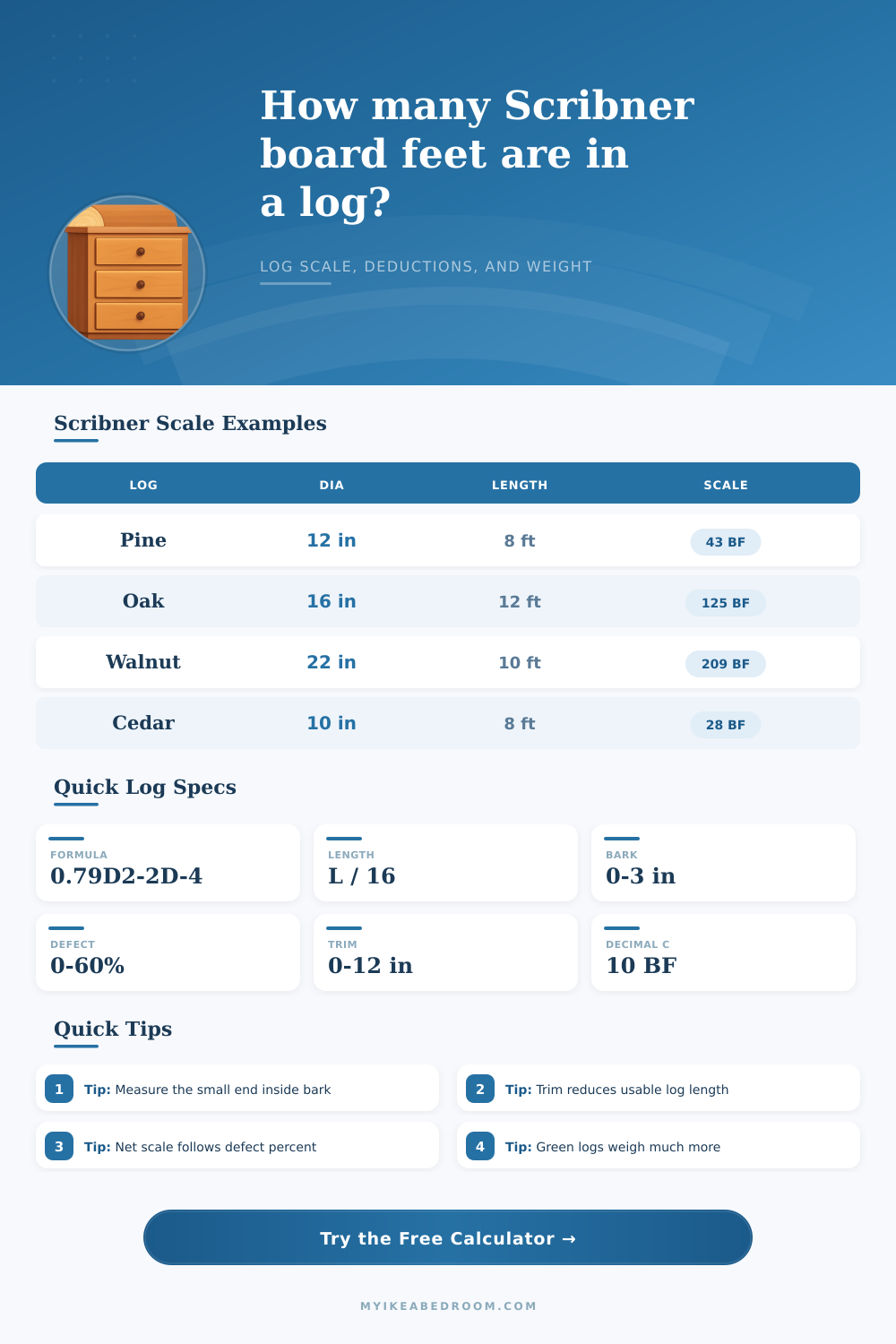
To calculate how many board-feet are in the log, take the diameter of the small end of the log, square it, subtract a few inches to account for slabs and saw kerf, multiply by the length of the log, and divide by sixteen. This number represent the gross board-feet of lumber that the log will contain. This number has yet to factor in the amount of defect in the logs.
The Scribner rule tends to be conservative when dealing with logs that have small diameters. However, when applying the rule to logs that have a diameter that is larger than sixteen or eighteen inches, the rule becomes more generous in the amount of usable lumber that is produced. This bias built into the rule is important to the sawyer when making a determination of the worth of the log.
The most sensitive of the inputs to the Scribner rule is the small end diameter of the log. A change of only a half-inch to the diameter will impact the board-foot calculation by ten or fifteen percent. It is best to measure the diameter of the log inside the bark; however, if it is necessary to measure over the bark, it is first important to apply a deduction for the thickness of the bark.
While the length of the log is also an important input to the rule, the length is less sensitive to fluctuations in the measurement. The Scribner rule accounts for a trimming allowance to the log to provide for usable lumber scaling; logs with a large trimming allowance will produce a smaller board-foot figure due to the division of the length of the log by sixteen. Now that the buyer has calculated the gross board-feet of the log, it is important to factor in the defects in the logs.
Any defects such as sweep, metal, heart shake, and stain will reduce the amount of lumber that will be seen as usable lumber. A defect percentage can be entered into a calculator to determine the net board-feet that the log will contain. This calculation can be performed with the assumption that the defects are uniform along the log; however, it is also an option to calculate the value of the good portions of the log and the bad portions of the log separately.
The sawyer and the buyer must agree on a method for calculating net board-feet from the log prior to the logs being moved. The density and moisture content of the lumber is different than the board-foot scale. Green logs will weigh more than dry logs.
In some cases, green logs will weigh forty or fifty percent more than the same type of lumber after it has been air dried. The weight of the logs is an important factor for both the truck that will be used to transport the logs and the sawmill itself. The moisture content of the lumber will factor into the amount of water that must be evaporated in the sawmill to dry the lumber.
A moisture multiplier will determine the dry weight of the logs and allow the sawmill to create a realistic estimate. The various markets will have different rules regarding how lumber logs are rounded. For example, one buyer might calculate the number of board-feet to the nearest whole foot whereas another buyer might use the Decimal C convention to round the number of board-feet to the nearest ten board-feet.
Other field scalers will floor the diameter and the length of the logs as a means of simplifying the calculations. However, the different rounding methods will not impact the formula itself. A board-foot scale for the logs is an estimated figure that represents an approximation of how much sawn lumber will be produced.
A board-foot scale will never account for the exact amount of lumber that the sawmill will saw out of a log. For instance, a sawmill that uses thin-kerf saw blades will produce more lumber than a sawmill that uses circle saw blades to cut crooked hardwood trees. The sawyer and the buyer can calculate the ratio of the logs net board-feet to the gross board-feet prior to any sawing operations to ensure that the percentage of lumber recovery is realistic to the type of logs that are being sawn.
The source of the logs can have an impact on the percentage of defects in the logs. For example, logs that come from urban areas may have a higher percentage of defects due to the fact that the trees may have once contained nails or cables. Additionally, trees in urban areas may have experienced irregular growth of the sawn lumber.
In contrast, logs from plantation areas may have even better growth of logs with less defects; however, they may have a smaller diameter. Buyers of veneer may be willing to accept a lower net scale for a log such as a large walnut log due to the value of the clear faces of the wood. The yield class for logs can assist the sawyer and the buyer in determining whether the log will be classified as logs that are to be used in producing veneer or sawn lumber.
By taking certain steps, sawyers and mill buyers can create more consistent estimates of the amount of lumber that will be produced from logs. For example, it is important to have a consistent spot along the log to measure the small end diameter. In addition, a trim allowance should be established before sawing the logs and defects can only be accounted for after the logs have been walked to determine the percentage of defects.
Taking these steps will create a common language between the sawyer and the sawmill regarding the value of the logs.