🔥 Sauna Heater Size Calculator
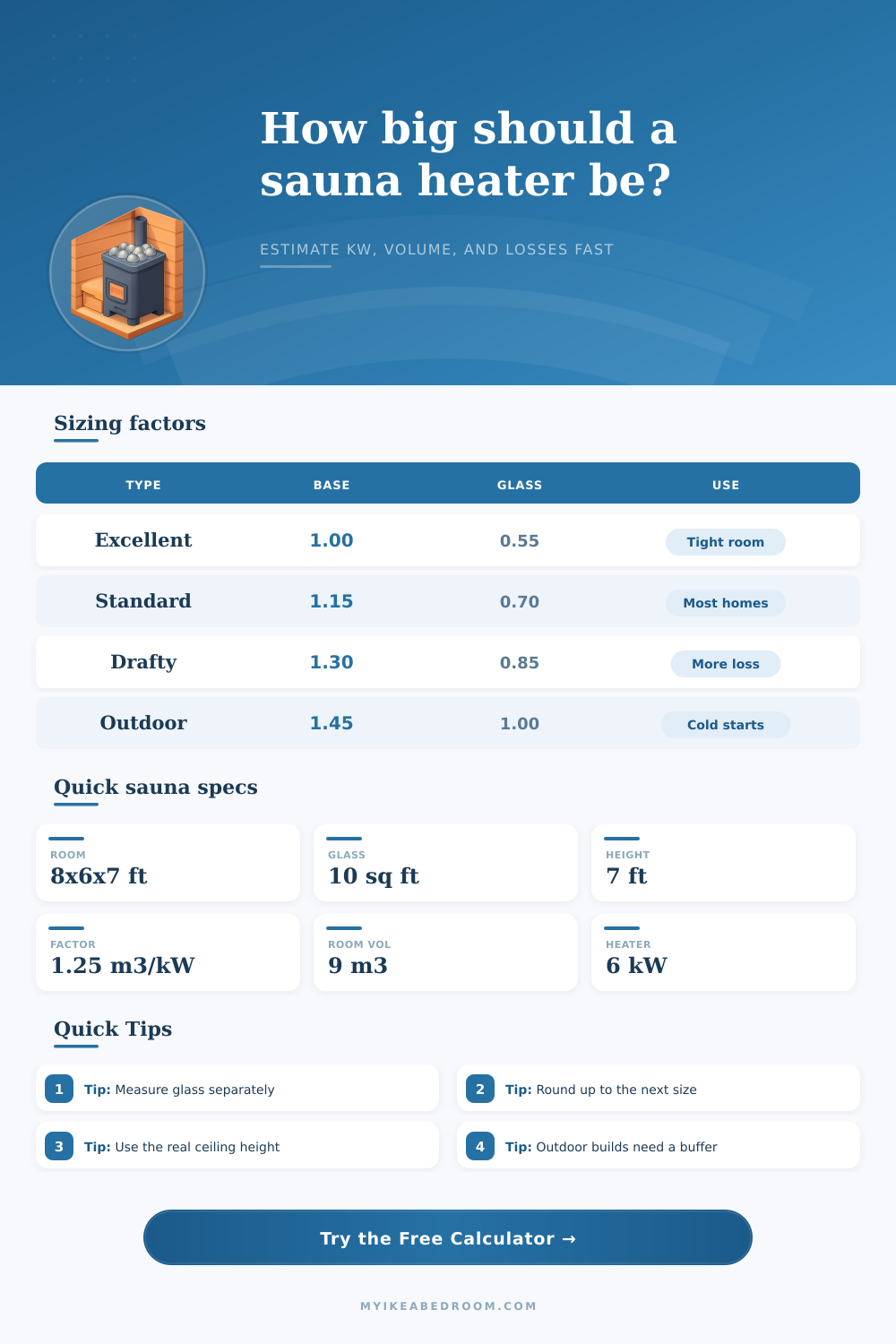
Estimate the right sauna heater kW rating from room volume, glass area, insulation, and exposure in one quick pass.
📋Sauna presets
🔧Calculator inputs
📊Sizing factor grid
📋Reference tables
💡Practical tips
📈Calculation results
Choosing a correct size for sauna heaters is a necessary step in sauna construction because the sauna heater will fail to maintaining the necessary temperature if its an incorrect size. If the sauna heater chosen for the sauna are too small, it will fail to reach the necessary high temperatures within the sauna. Alternatively, if the sauna heater is too large for the sauna, it will waste electricity.
Additionally, the electrical wiring for the sauna heater will be more expensive or difficult to install if the sauna heater are too large for the sauna. In order to calculate the size of the sauna heater that is necessary for the sauna, you must first calculate the volume of the sauna. The volume of a sauna is the total amount of air within the sauna.
How to Choose the Right Size Sauna Heater
You must measure the length, the width, and the height of the sauna to calculate the volume of the sauna in cubic foot or square meters. However, the volume of the sauna is not the only factor that will impact the performance of the sauna heater. For example, saunas with glass doors or windows will lose heat from the sauna more fast than saunas with wooden walls.
Therefore, the amount of heat that is lost from saunas with glass will require a larger sauna heater than saunas that has wooden walls and doors. Another of the main factor that will impact the size of the sauna heater is the quality of the insulation of the sauna cabin. Saunas that use high-quality insulation, such as thick foil vapor barrier and rock wool, will allow the sauna to hold heat very efficiently.
Therefore, saunas of high-quality insulation will require smaller sauna heaters. Saunas that have average insulation will lose heat from the cabin through the sauna walls. Thus, these saunas will require larger sauna heaters to compensate for the heat that is lost.
Additionally, outdoor saunas will lose heat at a much faster rate than indoor saunas. Outdoor saunas will require larger sauna heaters to compensate for the increased rate of heat loss. Finally, the number of square meters of glass within the sauna will impact the size of the sauna heater.
Any sauna that contains glass conducts heat at a faster rate than wooden saunas. Therefore, the sauna heater will lose heat faster from saunas with glass doors and windows. To account for this, sauna heater manufacturers will include a penalty for each square meter of glass within the sauna.
When calculating the size of the heater that you will use for your sauna, you must account for each square meter of glass in the sauna as if it were an additional amount of cubic meters of volume that the heater will have to heat. If you dont account for the surface area of the glass in your sauna, your heater will likely be too small to heat the sauna to the desired temperature. Additionally, the height of the ceiling also plays a role in the size of the heater that you will have to purchase.
Saunas with vaulted ceilings or high ceilings have more air within the sauna that must be heated; more air to heat requires more energy to heat that air to the desired temperature. Therefore, you should measure the height of the ceiling accurately to ensure that you do not purchase a heater that is too small for the sauna. Furthermore, the location of the sauna may also factor into the size of the heater that is required.
For instance, a sauna that is located within a basement will lose less heat to the ground than a sauna that is located within an outdoor sauna structure. Thus, the basement sauna may require a smaller heater than the outdoor sauna. Many individuals make the mistake of guessing at the size of the heater that they need rather than calculating the size of the heater that is required.
Using a three-kilowatt heater in a sauna that is small may not allow the sauna to become hot enough to be regularly used. Using a heater that is too large for an outdoor sauna may result in the heater within the sauna continuously cycling between heat and off cycles, which will dry out the sauna too quick. Thus, it is better to purchase a heater that is slightly larger than the calculated size rather than risk purchasing a heater that is too small to heat the sauna to the desired temperature.
In addition to the size of the sauna itself, you may wish to consider how it will be used and how many person may be within the sauna. While the people within the sauna will contribute to the heating of the sauna, it is recommended that you calculate the amount of heat that is required for an empty sauna. Another factor to consider is the type of heater that you would like to use within the sauna.
Saunas typically use electric heaters, but such heaters require specific electrical circuits. For instance, a 9-kilowatt heater may require a 40-amp electrical circuit. Finally, as mentioned above, it is always better to purchase a sauna heater that is slightly larger than the calculated size of the heater that is required for your sauna; it is better to have a sauna that heats too much rather than too little.