Sandbox Sand Quantity Calculator
Estimate play sand volume from sandbox length, width, round diameter, depth, density, and overfill allowance, then convert it into 50 lb bags, 0.5 cu ft bags, weight, and metric totals.
Detailed Breakdown
| Sandbox preset | Inside size | Area | 6 in fill before buffer |
|---|---|---|---|
| Toddler sand table | 3 ft × 3 ft | 9 sq ft / 0.84 m² | 4.5 cu ft / 0.13 m³ |
| Small square box | 4 ft × 4 ft | 16 sq ft / 1.49 m² | 8.0 cu ft / 0.23 m³ |
| Classic sandbox | 5 ft × 5 ft | 25 sq ft / 2.32 m² | 12.5 cu ft / 0.35 m³ |
| Backyard digging box | 6 ft × 6 ft | 36 sq ft / 3.34 m² | 18.0 cu ft / 0.51 m³ |
| Shared play sandbox | 8 ft × 8 ft | 64 sq ft / 5.95 m² | 32.0 cu ft / 0.91 m³ |
| Depth | Volume per sq ft | Coverage per cubic yard | Best sandbox use |
|---|---|---|---|
| 2 in / 5.1 cm | 0.167 cu ft / 0.0047 m³ | 162 sq ft / 15.1 m² | Low sand tables, display trays, and shallow toddler sensory play. |
| 3 in / 7.6 cm | 0.250 cu ft / 0.0071 m³ | 108 sq ft / 10.0 m² | Light play in small boxes where a thinner layer is intentional. |
| 4 in / 10.2 cm | 0.333 cu ft / 0.0094 m³ | 81 sq ft / 7.5 m² | Everyday scooping, raking, and leveling in compact backyard sandboxes. |
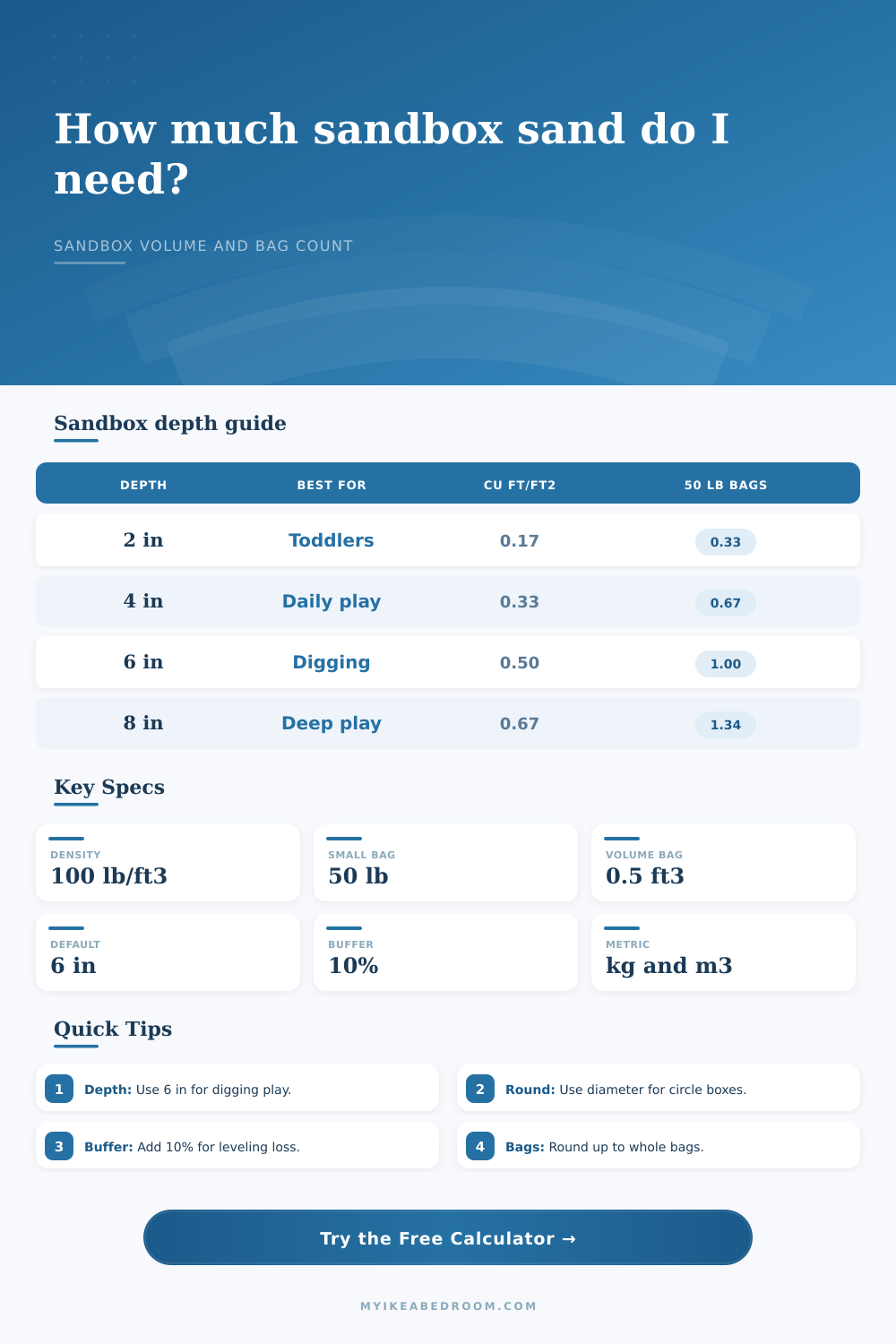
| 6 in / 15.2 cm | 0.500 cu ft / 0.0142 m³ | 54 sq ft / 5.0 m² | Common digging depth for castles, molds, tracks, and active play. |
| 8 in / 20.3 cm | 0.667 cu ft / 0.0189 m³ | 40.5 sq ft / 3.8 m² | Deep digging boxes where the frame height can safely hold the extra sand. |
| Bag method | Assumption | Conversion | Planning note |
|---|---|---|---|
| 50 lb bags by weight | 100 lb/cu ft sand | About 0.5 cu ft each | At the default density, a 50 lb bag and a 0.5 cu ft bag estimate often match closely. |
| 0.5 cu ft bags by volume | 2 bags per cu ft | 54 bags per cubic yard | Useful when the bag label lists volume instead of weight. |
| Cubic feet to cubic yards | 27 cu ft per cu yd | cu ft divided by 27 | Helpful for comparing larger sandbox fills with bulk volume units. |
| Cubic feet to cubic meters | 0.0283168 m³ per cu ft | cu ft multiplied by 0.0283168 | Shown in the calculator breakdown for metric planning. |
| Pounds to kilograms | 0.453592 kg per lb | lb multiplied by 0.453592 | Use the metric weight to understand handling load, not structural design. |
| Sand density setting | Approx lb/cu ft | Approx kg/m³ | When to use it |
|---|---|---|---|
| Light dry play sand | 90 lb/cu ft | 1442 kg/m³ | Use for very dry, loose material that pours easily from bags. |
| Typical play sand | 100 lb/cu ft | 1602 kg/m³ | Good default when the label does not publish a bulk density. |
| Damp or packed sand | 110 lb/cu ft | 1762 kg/m³ | Use if sand is stored wet, compacted, or noticeably heavy for its volume. |
| Very dense fill sand | 120 lb/cu ft | 1922 kg/m³ | Use only when the supplier specifies a heavier material than play sand. |
| Shape | Area formula | Volume formula | Measurement reminder |
|---|---|---|---|
| Rectangle or square | Length × width | Area × depth in feet | Measure the clear inside dimensions after the frame boards are in place. |
| Round sandbox | 3.1416 × radius² | Area × depth in feet | Enter inside diameter; the calculator divides it by two for radius. |
| Custom area | Known square area | Area × depth in feet | Use for built-ins, clipped corners, or play areas already measured in square feet. |
| Metric dimensions | Converted to sq ft internally | Converted back to m³ | Metric inputs are converted with 1 m = 3.28084 ft and 1 cm = 0.3937 in. |
Building a sandbox sounds easy, just grab some sand! But how much do you buy? How many bag will you move, and how heavy are they?
Use the tool above (all you have to do is input your measurements) and it do the calculations for you. It’s like having a concrete number instead of an approximation.
How to Calculate the Sand You Need for Your Sandbox
People’s greatest error is taking the exterior measurement of frame. Remember, it’s wood, and it has thickness; therefore, a six-foot sandbox probably has interior space more like five and a half feet. That little bit reduce your volume need a lot. You cannot buy less than you need because tool requires the interior dimension.
There are also mistakes made based off depth. For toddlers two inches is plenty. For casual play four inches is normal. Six inches will ensure that children can dig properly without reaching the bottom. Each inch has an effect on total volume as indicated in the reference table. Going too deep result in a damaged wooden frame and potential spillage of sand.
One cubic foot weigh 100 lbs on average. Different types of sand also has different weights. Packed concrete sand is heavier then dry play sand. Expect at least 100 lbs/foot as a starting point. If the sand is wet, you might want to bump that up since it will be heavier, especially with all that extra weight to carry! Bring along some extra muscle to protect your back while lifting all those bag.
It gets more complicated when considering bag size. Sand typicaly comes in fifty-pound bags that will contains approximately one-half of a cubic foot. In other words, the calculator includes volume as well as weight calculations. That way you can choose between buying by the pound or by the cube based off what your store offers for sale. You’ll know either way so you can shop accordingly.
One last thing: include an additional 10% as wiggle room. Yes, the sand will settle into place. Some of it will get kicked up and walk outside on your shoes. That extra bit would of prevent you from running out before filling the entire box. Better to have a thin layer of extra sand at the end than not quite having enough.
A sandbox requires not just building, but also logistics. How many time will I have to go to the car? What kind of fill do I want? Knowing these numbers allow you to plan what the play area will be without having to think about what’s on your shopping list.