🏗 Sand Coverage Calculator
Estimate sand volume, bags, coverage, and weight for beds, paths, pads, and drainage runs with imperial or metric inputs.
📋Project presets
🔧Calculator inputs
📊Material weight grid
📋Reference tables
💡Practical tips
📈Calculation results
Calculating the correct amount of sands is a necesary step in any landscaping project because sand is used for a variety of purposes within the landscape, and because sand can have different weight depending upon the type of sand that are to be used. You can calculate the volume of sand that is needed to be ordered by determining the volume that will be used in the project; too little sand will require additional orders for completion of the project, while too much sand will result in excess weight to be moved to the project site. The amount of sand that is cover by sand also depends upon the type of sand that is to be use in the project, which can depend upon the purpose for which the sand is to be use.
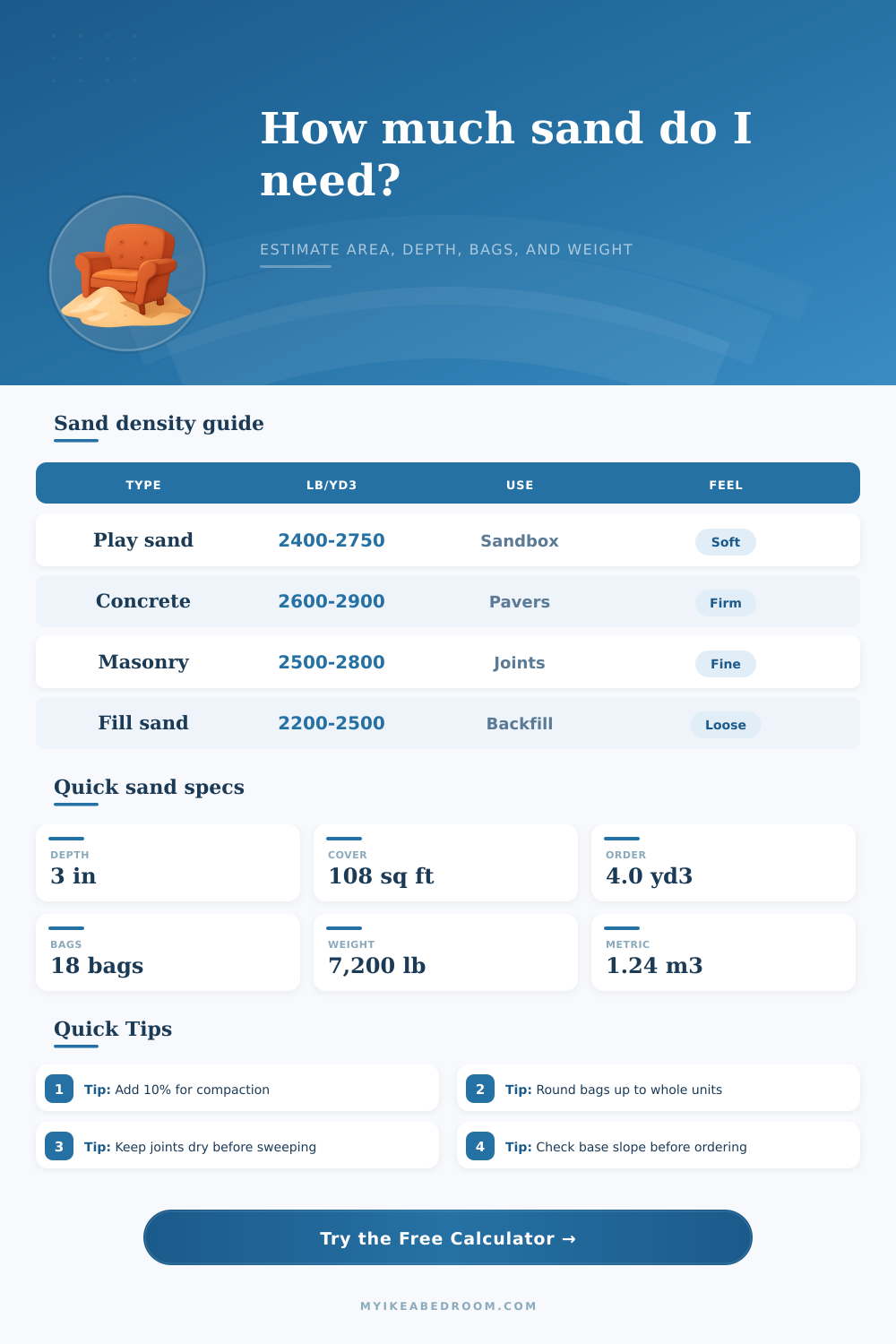
There are several different types of sand that can be used for landscaping projects. Play sand is the soft sand that is often used to create sandboxes for young children. Concrete sand is a firmer sand that is used as a base layer for pavers to distribute the weight of individuals who walk upon the area.
How Much Sand You Need for Your Landscaping Project
Masonry sand is sand that is used to fill the joints within brickwork, and which is much more fine than concrete sand. Finally, fill sand is used in landscaping projects to fill in any loose spots within the ground. Each of these sand types have a different weight per unit of volume (such as per cubic yard).
The density of the sand to be used within the project will determine the weight of that sand to be hauled to the project by hand or in a vehicle. In order to calculate the volume of sand that will be needed for a project, it is first necessary to calculate the area that will be covered by the sand. You can measure the length and width of the area to be covered, and any obstacle to the even spread of sand can be subtracted from the total area.
For instance, if a tree stump is located within the area to be covered by sand for a patio, you can subtract the area of that tree stump from the total area of the patio. The area that remain can then be used in calculating the volume of sand needed for the project. It is also necessary to determine the depth of the sand that will be used.
For instance, sand depths of one or two inches may be used to fill the joints between stones, but depths of four to six inches may be required to create a solid base for pavers. The area and depth of the sand can be used to calculate the volume; the area can be multiplied by the depth to determine the number of cubic feet of sand that will be require, which can then be converted to the number of cubic yards of sand that are to be ordered. It is recommended to include a buffer for the sand calculation.
Sand tends to compact over time, especially if the sand is packed by its own weight or with a tamper. Because sand can compact over time, it is common to add 10% to the total amount of sand to be ordered. If sand is laid without providing for its natural compaction over time, sand may settle into the ground with a resulting formation of dip in the sand layer.
Additionally, sand that becomes wet will compact more than dry sand. It is also necessary to consider the transport of the sand to the project. Sand can be purchased from suppliers in bulk, which is often cheaper for larger landscaping projects.
The disadvantage of purchasing sand in bulk is that it is very heavy; if you use a pickup truck to transport the sand to the project, the weight of the sand should not exceed the payload weight of the truck. Alternatively, sand can be purchased in bags. Sand that is in bags is much easier to transport to a project site that is small in size, but sand in bags is more expensive when purchased in large quantity for a large landscaping project.
Finally, it is necessary to ensure the purchase of the correct sand for the project. For instance, if sand that is to be used to fill joints between paving stones is selected, the sand may compact and not allow for proper contact between the sand particle. Similarly, if sand is used for creating a base for pavers but the sand is too firm, it will not allow for proper distribution of the weight of pavers upon the ground.
Sand can be tested by placing a long board upon it and ensuring that it is level to the ground; any puddles will form within those joints that is beneath the paving stones. By ensuring that each of these factors is considered prior to the addition of sand to a landscaping project, it is assured that the necessary amount of the correct type of sand will be obtained for that project. You should of checked the soil first.
Its important to recieve the right amount so you dont have to order more.