Runner Rug Length for Stairs Calculator
Estimate the continuous runner length for straight stairs, landings, turns, waterfall installs, Hollywood wraps, top tails, bottom tails, pattern repeats, and trimming waste before ordering a stair runner.
Choose a realistic stair layout, then adjust the measurements for your exact tread depth, riser height, landing depth, runner width, and installation style.
Current stair runner plan
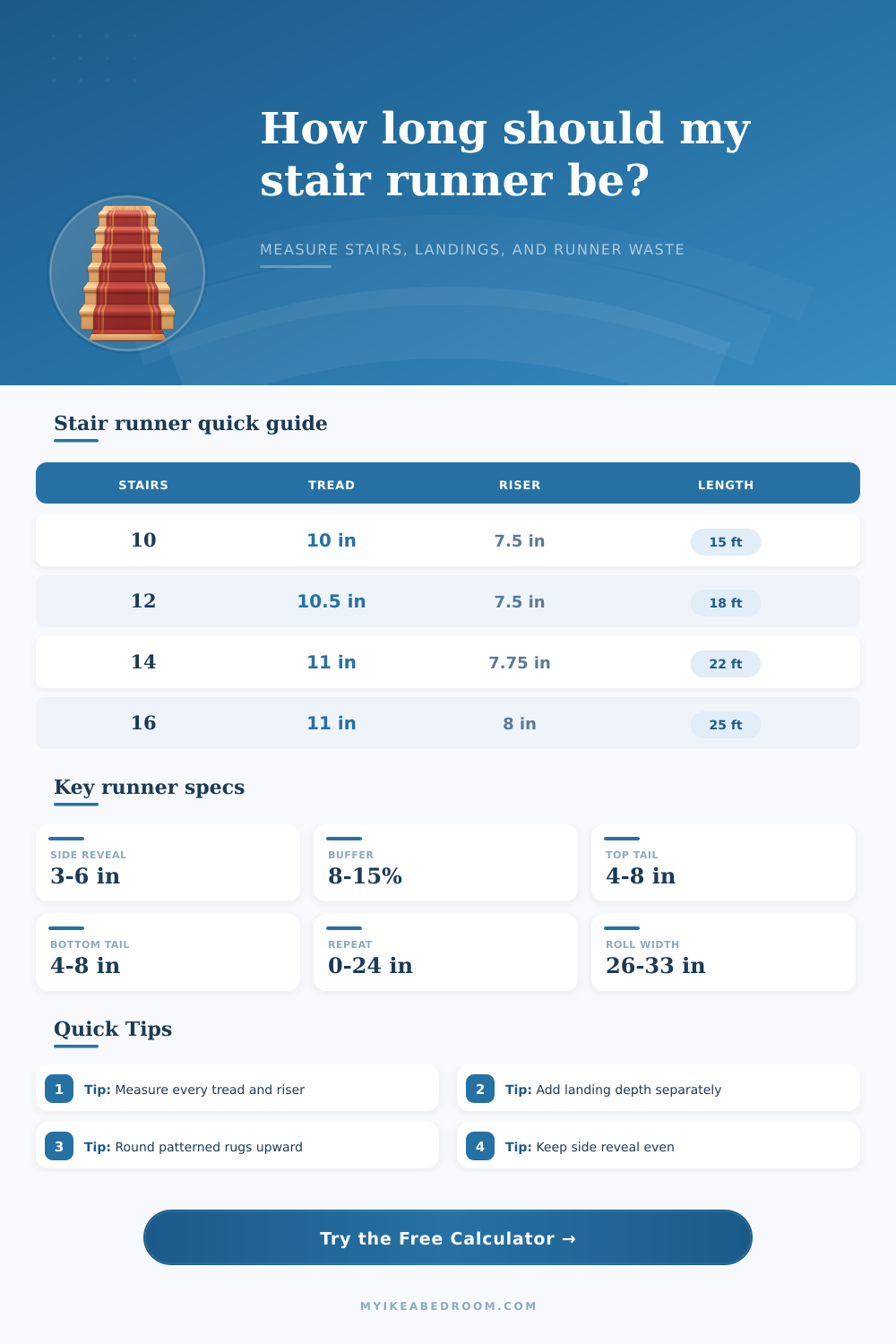
A 12-step straight stair with a 27 in runner usually needs a continuous cut near 20 linear feet after extensions and a typical trimming buffer.
Formula used: steps x (tread + riser + nosing/tuck) + landings + top tail + bottom tail + installation adjustment + buffer, then rounded upward for pattern repeat when entered.
Width check: finished stair width minus runner width, divided by two, gives the visible stair reveal on each side.
| Step count | 10 in tread + 7.25 in riser | 10.5 in tread + 7.5 in riser | 11 in tread + 7.75 in riser | Best use |
|---|---|---|---|---|
| 10 steps | 15.2 ft with tails | 15.8 ft with tails | 16.5 ft with tails | Compact apartment or short basement stair |
| 12 steps | 18.1 ft with tails | 18.9 ft with tails | 19.6 ft with tails | Typical main stair run |
| 14 steps | 21.0 ft with tails | 21.9 ft with tails | 22.7 ft with tails | Townhouse or taller floor height |
| 16 steps | 23.8 ft with tails | 24.9 ft with tails | 25.8 ft with tails | Older homes and steep staircases |
| Landing type | Measure to add | Extra tuck | Pattern note | Common check |
|---|---|---|---|---|
| No landing | 0 in | 0-2 in | Repeat can start at top or bottom | Confirm first and last tails only |
| Small square landing | 36-42 in | 2-4 in | Center motif on the flat area | Measure travel direction, not diagonal |
| L-turn landing | 40-54 in | 4-8 in | Allow for turn and binding alignment | Decide if runner turns or stops |
| U-shaped landing | 48-72 in | 6-10 in | Often needs separate cut planning | Check whether one continuous cut works |
| Stair width | Runner width | Reveal each side | Visual result | Fit note |
|---|---|---|---|---|
| 32 in | 26 in | 3 in | Full, narrow reveal | Good for tight stairs |
| 36 in | 27 in | 4.5 in | Balanced traditional look | Very common pairing |
| 40 in | 30 in | 5 in | Generous but centered | Check stair rods or brackets |
| 44 in | 33 in | 5.5 in | Wide hall scale | Useful for broad staircases |
| Planning item | Typical value | When to increase | Calculator field | Why it matters |
|---|---|---|---|---|
| Top extension | 4-8 in | Runner tucks under landing lip | Top extension | Prevents a short top edge |
| Bottom extension | 4-8 in | Bottom riser is wrapped | Bottom extension | Gives trimming room at first step |
| Pattern repeat | 0-24 in | Medallion or stripe alignment | Pattern repeat | Rounds length to a usable motif cut |
| Waste buffer | 8-15% | Landings, turns, or DIY layout | Waste buffer | Covers binding, trimming, and stair variation |
Measure the stair path, not the room. For each step, the runner travels across the tread, over the nosing, and down the riser. Landings are separate flat runs, so add their travel direction after the step total.
Center the width before ordering. Subtract runner width from finished stair width, then divide by two. A reveal near 3-6 inches per side usually looks intentional and leaves enough exposed tread for a balanced stair.
A stair runner isn’t just a piece of fabric you cut. It’s tricky geometry: wrapping around vertical risers and turning corners where the material gets used up fast, miscalculating means the strip falls short at the bottom nosing. Now you have an ugly gap where there should of been a finished end of the runner. The stair calculator do all those calculations for you when you input your stair measurements. You no longer have to add each tread and riser by hand or try to keep track of repeat pattern in your head.
It is not just a length thing. Before you get to the carpet store counter, you need to know how far that material is going to go based off your floor plan. Each step use more carpet than the tread depth suggests. You look at a tread and what you see is the horizontal portion where your foot will land. But then there’s also the vertical face which need the fabric to drop down into it. So if we take a typical house step as an example, it may be ten inches deep with a seven-and-a-half inch high riser. That’s a total of seventeen-and-a-half inches of material used in each step for a very simple geometric shape. Then throw in some wrap-around or tuck-under allowance for the nosing and that’s how it becomes higher.” Using just the overall rise doesn’t work; you need to know depth of each face the runner has to cross. This is why you end up getting it wrong. What the tool do is multiply your steps by the sum of height plus depth, that’s your starting point before any adjustments, but it’ll still be closer than if you’d guessed from a tape measure alone.”
Why You Should Use a Stair Runner Calculator
Landings are also difficult to estimate. Because they’re often just a flat surface in-between flights we tend to overlook them or underestimate how much length they require. But that’s a lot of linear footage. To compensate, you has to include the entire depth of an average landing into your overall length needed. Use the Landing Depth field and Count to input flat areas individually and let the calculator do the math. Essentially, it will treat the landing as an extended straight run, as opposed to one that’s part of the rhythm of the stairs. That makes a difference because the draping of fabric across the steps is different than its tension across a flat surface. You’ll need just a bit more material to get the right taut fit.
Additions: Solid colors don’t have this problem, but patterns like runners with designs offers more complexity. When selecting a pattern (such as one with a repeated element. E.g., a border stripe or medallion) you must account for extra fabric to match the pattern from top to bottom. Because of this, the calculator include an adjustment for matching the pattern’s repeat. It rounds up your final measurement to ensure you’ll have enough. In practice, that’s not much on paper, but if the repeat happens to be large then that little adjustment may add a few feet to your order. Otherwise, that medallion could end up getting split right down the middle where it lands! It is not exactly how it was meant to look.
The last thing to consider is width selection. Ideally we want a balanced reveal on both sides of the runner, which is normaly three to six inches. To see if what you have selected has enough reveal, you take total width of your finished stairs and subtract the width of the runner. So if you have a 40 inch wide stairs and purchased a 30 inch wide runner, you will have 5 inches exposed on either side of your runner. That’s a nice proportioned frame around the wood below and doesn’t appear as an afterthought. The calculator finds that ratio and tell you if it’s a good fit or not for your stair opening size.
Lastly, consider the wastage factor. Older houses have stairs that don’t match exactly; there will be cut mistakes. A ten to fifteen percent buffer will allow for any small variation in step dimension plus trimming errors and binding adjustments. It’s affordable peace-of-mind insurance against running out of material when you are only three steps away from completing the project. Do your measuring well and enter those figures into the calculation with a generous error allowance. Will your runner make it to the bottom? Let the math tell you.