Rug Binding Tape Length Calculator
Estimate the tape length for straight rug edges, round rugs, oval rugs, rounded runners, octagonal cuts, partial binding, corner miters, seam overlaps, and roll planning.
Choose a rug edge scenario, then adjust the dimensions, exposed edge percentage, tape width, and roll length to match the actual binding job.
Binding tape estimate
| Shape | Formula Used | Best Input | Notes |
|---|---|---|---|
| Rectangle or square | 2 x (length + width) | Finished edge length and width | Works for standard area rugs, runners, mats, and square rugs. |
| Circle | pi x diameter | Finished outside diameter | Use the average diameter if the rug is slightly out of round. |
| Oval or ellipse | Ramanujan ellipse approximation | Major and minor diameters | Accurate for common oval rugs without tracing the full edge. |
| Runner with rounded ends | 2 x straight length + pi x width | Overall length and width | Treats both ends as two semicircles plus two straight sides. |
| Regular octagon | 8 x side, side = diameter / 2.4142 | Flat-to-flat diameter | Good for nook rugs and clipped-corner rugs with equal sides. |
| Custom traced edge | Measured perimeter | Flexible tape around the finished path | Best for notches, L-shapes, fireplace returns, and irregular edges. |
| Edge Treatment | Corner Basis | Typical Add-On | Use When |
|---|---|---|---|
| Straight sewn edge | 0.5 x tape width per square turn | 2 to 4 in on a 4-corner rug | Simple folded binding with butt or hidden closing seam. |
| Mitered corners | 1.0 x tape width per corner | 5 to 8 in on a 4-corner rug | Visible square corners where each miter needs trimming room. |
| Rounded corners | 0.25 x tape width per corner | 1 to 3 in on soft curves | Rounded mats or rugs with eased corners and flexible tape. |
| Serged return | Return allowance plus seam lap | 4 to 8 in total | Edges where the thread or tape returns under the rug at closure. |
| Leather-look folded tape | 1.5 x tape width per corner | 8 to 12 in on a 4-corner rug | Stiff binding that needs extra slack to avoid buckled corners. |
| Fringe ends left open | Long-side perimeter only | No end corners counted | Runners where short ends keep fringe and only long sides are bound. |
| Roll or Cut Length | Feet | Meters | Planning Use |
|---|---|---|---|
| 3 yard shop cut | 9 ft | 2.74 m | Small entry mats, one exposed edge, or sample binding. |
| 5 yard card | 15 ft | 4.57 m | Small rectangular rugs and short hallway mats. |
| 10 yard roll | 30 ft | 9.14 m | Most runners, round rugs, and 5 x 7 area rugs. |
| 15 yard roll | 45 ft | 13.72 m | 8 x 10 and 9 x 12 rugs with normal seam allowance. |
| 25 yard roll | 75 ft | 22.86 m | Multiple rugs or large rooms with partial wall-edge binding. |
| 50 yard roll | 150 ft | 45.72 m | Workroom use when several rugs share the same binding color. |
| Project | Base Perimeter | Typical Allowance | Suggested Cut Length |
|---|---|---|---|
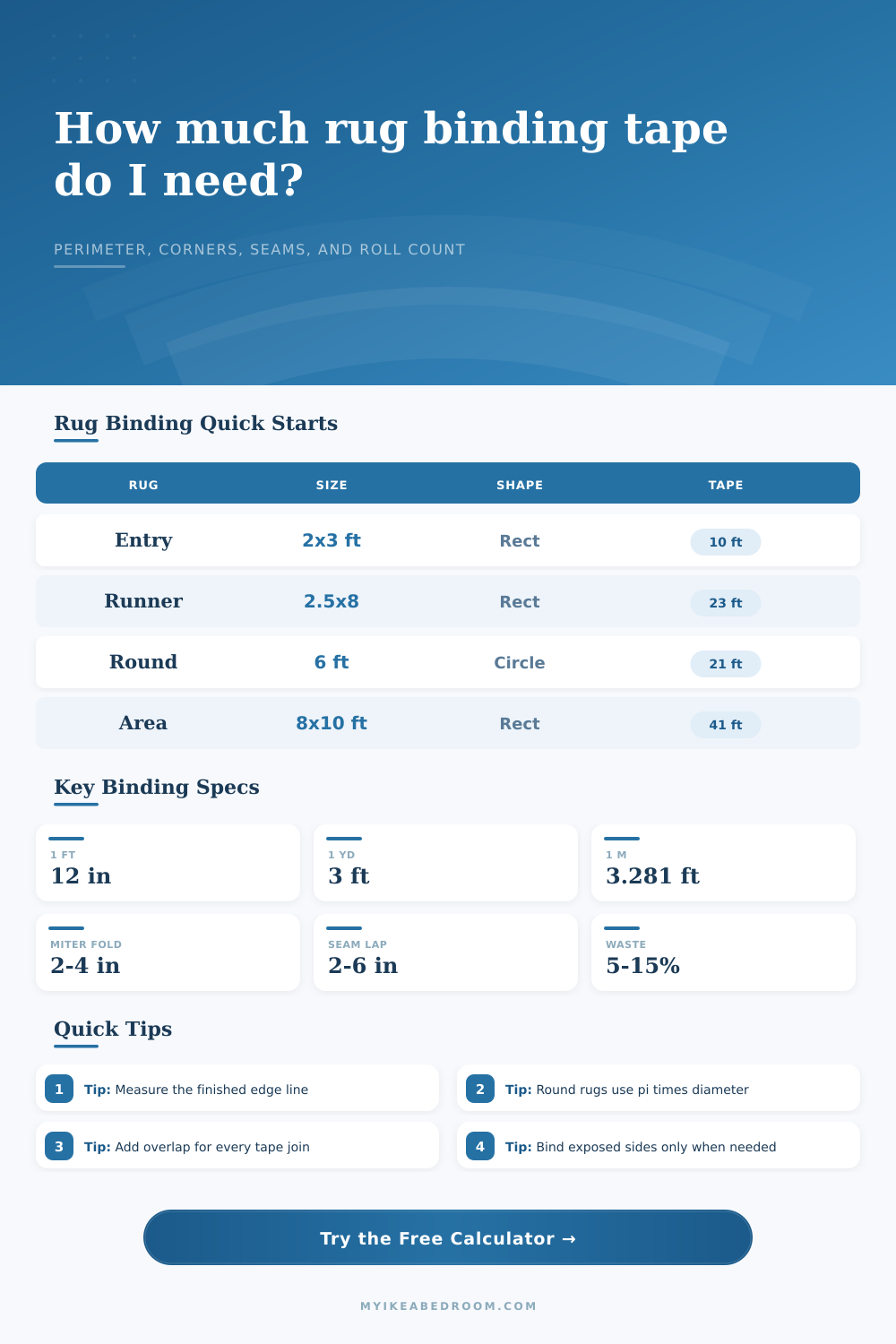
| 2 x 3 ft entry mat, all edges | 10 ft | 0.8 to 1.5 ft | 11 to 12 ft |
| 2.5 x 8 ft hall runner, all edges | 21 ft | 1.5 to 2.5 ft | 23 to 24 ft |
| 5 x 7 ft bedroom rug, all edges | 24 ft | 2 to 3 ft | 27 to 28 ft |
| 6 ft round rug, full circumference | 18.85 ft | 1.5 to 2.5 ft | 21 to 22 ft |
| 8 x 10 ft area rug, all edges | 36 ft | 3 to 5 ft | 40 to 42 ft |
| 9 x 12 ft large rug, all edges | 42 ft | 4 to 6 ft | 47 to 49 ft |
Cotton twill
Best for: indoor mats, soft bedrooms, simple rectangles.
Allowance: low to moderate because it folds cleanly.
Watch: lighter colors may show edge soil faster.
Polyester binding
Best for: runners, doorways, high-traffic edges.
Allowance: moderate because synthetic tape can spring slightly.
Watch: heat settings and needle choice during sewing.
Jute tape
Best for: natural fiber rugs and casual woven edges.
Allowance: higher because the tape is thicker and less stretchy.
Watch: bulky seams at the closing lap.
Wool serge
Best for: decorative finished edges and curved rugs.
Allowance: moderate, with extra closing overlap.
Watch: consistent tension around round rugs.
Polypropylene
Best for: utility rugs, outdoor mats, and damp zones.
Allowance: moderate for handling and fused or sewn joins.
Watch: stiffness on very small radius corners.
Canvas binding
Best for: large heavy rugs and thick carpet remnants.
Allowance: higher because wide tape needs miter room.
Watch: bulky corners if folded layers stack.
Leather-look tape
Best for: crisp modern borders and square area rugs.
Allowance: high for miter trimming and closing overlap.
Watch: tight curves, which may buckle.
Self-fabric strip
Best for: matched borders and custom textile projects.
Allowance: highest because strip joins and pattern matching add waste.
Watch: bias stretch and seam placement.
Measure the finished edge, not the old edge. If the rug is being cut down, calculate from the final trimmed dimensions. Binding follows the new edge line after squaring, clipping, or rounding.
Place seams away from the most visible edge. The calculator counts each overlap, but seam location still matters. Put the final join near a low-traffic side when the shape allows it.
Rug binding tape is bought by estimate, not by exact quantity. To be safe, you usually overbuy or go back for more. How much do I need? That depends on how the tape acts as it goes around corners and along seam. After establishing shape, the calculator figure out the number for you. No more guesswork: no conversions, no coefficients.
First, determine what part of your carpet you want covered. Remember: trim first, then measure the final edge. New binding matches that final, trimmed line. That’s true if you’re cutting down the size of an existing area rug, or using a new one.
How to Measure Rug Binding Tape
For instance, with a rectangular rug, it’s just twice (length + width). With ovals, you’ll need a formula for minor and major diameter. For round rugs, multiply the diameter by pi, though most round rugs aren’t perfectly round. An average diameter will help you estimate. The tool shape picker tweaks the underlying formula for you so you don’t need to learn any geometry proofs.
But then there are the complexities of corners and joints. A straight edge is easy to predict. Turns require additional tape to ensure they can folds neatly without buckling up. And squares like mitered corners requires way more slack than rounded corners; there has to be enough material to trim off and fold back perfectly to ensure there are no gaps. This is why the calculator includes an allowance (not just a buffer, mind you) dependent on the type of edge you select: mitered vs. Serged vs. It includes a basic fold. I’m telling you; it’s not guesswork. It’s the real-world amount of space necessary to accommodate the turn without deforming the edge of the rug. Most DIY-ers don’t anticipate this component, thinking that “a foot of excess will handle my screw-ups.”
Then there is the overlapping of seams. It’s necessary waste but adds an additional layer. When you get to a join, you can’t just butt the ends of the tape up against each other. No, no. That won’t do. You must have a few inches overlap so you can hide the join with stitches. Multiply that by however many seam you’ll have (that will depend on the length of the roll you buy compared to how much perimeter you’re going to bind). If you’re binding a rug that needs forty feet of binding and you buy twenty-five foot rolls, you’re talking about at least one join and a closing seam at the end. You lose some tape at every joint when it doesn’t reach the final edge. This is what the tool accounts for by asking how many joins you have and how much overlap each of them has, which it adds to the total length needed.
In actual use, the type of material alters the amount of excess necessary. Soft, forgiving cotton twills bend comfortabley through a tight radius using little additional length. Stiff leathers or heavy canvases resist folding well; so they need to be cut with larger seam laps and wider corner allowances to avoid bunching. Jute tape bulks up at each turn. You can see the variation in widths and handling among these bindings on the page’s binding comparison grid. This isn’t just about looks. Unless accounted for in the cut length, the stiffer tape will battle you at each corner.
Include a waste buffer. No matter how precise your measurements, there will be cutting mistakes. You’ll have to trim pattern match fabric strips. Sometimes things don’t work out exactly right at first go. Adding ten or 15 percent to your final figure accounts for these real-world factors without costing much more at the start. You can set the percentage you want here. After that, it will automatically add that percentage to the total.
This shows you the total amount of cut fabric needed for corners, perimeter, seam allowance, and safety margin. You can see in the results: the spares length and the roll counts. No more running out of tape half-way through your project with an awkward pause. A bit of spare isn’t bad, but it’s good to know if you’re making something big enough you’ll need more and can plan ahead. Or plan to return!
The handy reference tables lets you check common situations like hall runners or entry mats quickly so you have some benchmark against which to test whether your custom input makes sense. A lot of rug binding is actualy prep work. The technique works best if the rug is long enough. The tape won’t buckle out of place, the corners will turn crisply, and the seams will hide themselves. So you measure twice. You think about how stiff your fabric is and allow the tool to do the adding. And then you’re left with nice clean edges and not one extra trip to the craft store. These are little things, but they matter so much in that last stitch on the final corner.