Round Tablecloth Diameter Calculator
Calculate the finished round tablecloth diameter, cutting diameter, actual drop, floor clearance, fabric panels, and yardage from table diameter, drop style, hems, shrinkage, and fabric width.
Start with a common round table setup, then adjust the exact diameter, table height, drop, floor gap, hem, shrinkage, and fabric width.
Balanced dining diameter
Finished size: 90 inches round.
Cut size: 94 inches round after hem and shrink allowances.
Fit check: The cloth gives a 15 inch drop from the tabletop edge.
| Drop style | Typical side drop | Best use | Diameter formula example |
|---|---|---|---|
| Short casual | 6 to 10 in / 15 to 25 cm | Kitchen, kids, cafe, washable everyday cloths | 48 in table + 2 x 10 in = 68 in cloth |
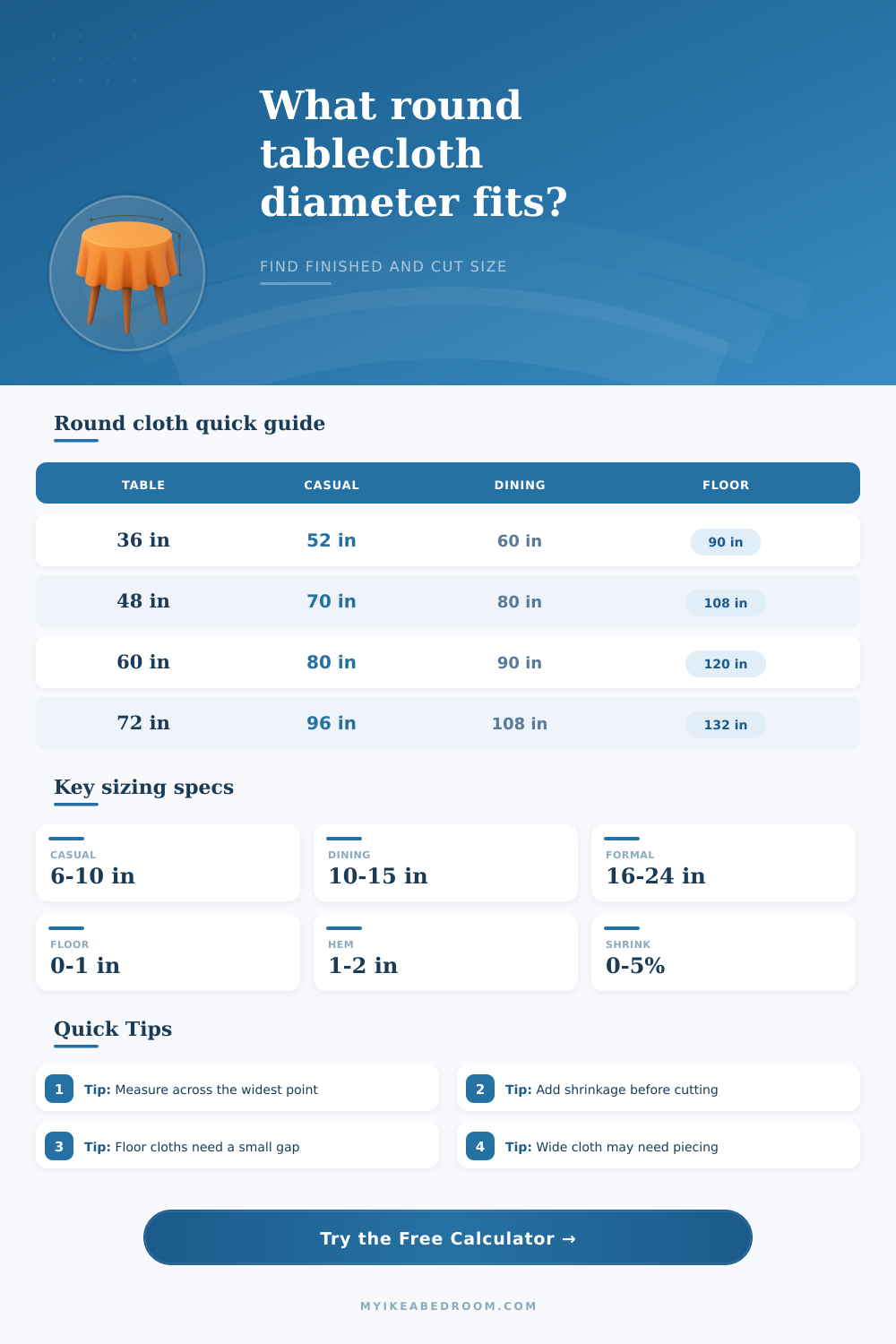
| Dining lap | 10 to 15 in / 25 to 38 cm | Seated dining where the cloth should look full but stay off laps | 60 in table + 2 x 15 in = 90 in cloth |
| Formal long | 16 to 24 in / 41 to 61 cm | Special meals, displays, and layered table settings | 54 in table + 2 x 21 in = 96 in cloth |
| Floor length | Table height minus 0 to 1 in / 0 to 3 cm | Buffet, event, dessert, registration, or cocktail tables | 30 in table + 2 x 29 in = 88 in cloth |
| Round table diameter | Short cloth range | Dining cloth range | Long or floor cloth |
|---|---|---|---|
| 24 in / 61 cm side table | 36 to 44 in round | 44 to 52 in round | 72 to 84 in round for full cover |
| 30 in / 76 cm cocktail table | 42 to 50 in round | 54 to 60 in round | 90 to 112 in round, depending on height |
| 36 in / 91 cm bistro table | 48 to 56 in round | 60 to 66 in round | 90 in round on 30 in height |
| 48 in / 122 cm family table | 60 to 70 in round | 70 to 80 in round | 108 in round for floor length |
| 60 in / 152 cm dining table | 72 to 80 in round | 84 to 90 in round | 120 in round for floor length |
| 72 in / 183 cm event table | 84 to 96 in round | 96 to 108 in round | 132 in round for floor length |
| Allowance item | Where it goes | Typical value | Round cloth effect |
|---|---|---|---|
| Finished diameter | Visible final cloth size | Table diameter + 2 x drop | Controls the drop seen from the tabletop edge |
| Hem allowance | Added around the cut edge | 1 to 2 in per edge | Add 2 x hem to the cut diameter |
| Shrinkage allowance | Added after hem allowance | 0 to 5 percent for many table linens | Multiply the hem-added size by 1 + shrink percent |
| Panel seam allowance | Between joined panels | 0.5 to 1 in per joined edge | Reduces usable panel width for planning |
| Usable fabric width | Good for | Panel planning note | Yardage cue |
|---|---|---|---|
| 44 to 45 in / 112 to 114 cm | Small overlays, side tables, children tables | Larger dining rounds usually need three or more panels | Plan each panel at least the cut diameter long |
| 54 to 60 in / 137 to 152 cm | Bistro and moderate dining rounds | Often two panels for 70 to 100 inch cut diameters | Panel count x cut diameter gives base yardage |
| 72 to 90 in / 183 to 229 cm | Wide dining cloths and event overlays | May avoid extra side panels on many dining cloths | Check print direction before rotating layout |
| 108 to 120 in / 274 to 305 cm | Floor-length rounds and seamless banquet cloths | Can cover many 90 to 120 inch rounds in one panel | Cut diameter plus trimming room may be enough |
Everyday short
Easy to sit at, easy to wash, and less likely to catch on knees or chair arms.
6-10 inDining balanced
Looks intentional on a round table while leaving comfortable clearance for seated guests.
10-15 inFormal long
Creates a fuller drape for special settings without necessarily reaching the floor.
16-24 inFloor length
Best for event, buffet, cocktail, or display tables where legs should be hidden.
0-1 in gapMeasure the actual tabletop diameter. A round table can vary by an inch at the apron or beveled edge, so measure the top surface where the cloth begins to hang.
Separate finished size from cut size. The finished diameter sets the visual drop; the cut diameter adds hem and shrink allowances so sewing does not make the cloth too short.
The reason for this is that most of us choose a round table not just because we like its shape (though we do), but also because it seems friendlier then a rectangular one. It softens the look of our dining room and invites conversation. And then you go out and buy a square cloth to hang on it, see the corners drape awkwardly down to the floor, and notice that the magic is gone.
The issue isn’t usually with the table; it’s almost always with the ratio between diameter of your tablecloth and the length you want the thing to drop. And achieving that circle is less about guesswork, and more about understanding exactly how fabric fits, shrinks, and drapes around an edge without any corners to hide your mistakes in.
How to Measure for a Round Tablecloth
On paper, it’s easy math: Add twice the length you want the fabric to drop, then add diameter of the table. Voilà, there’s the finished size. This applies except when you’re planning to cut or sew the fabric yourself. What you really need is the cut diameter, to adjust for fabric shrinkage, hemming, etc. The online calculator (above) do the work for you, so you don’t have to do math in your head at checkout time. It connects the ideal image in your mind to what will be a bolt of cotton or linen with a real-world finish.
Most people don’t take hem allowances into account. If you has a table with fifteen inch drops, you figure you can get away with a sixty inch cloth and still have plenty of material at the bottom. Yes, that’s true on finished piece. However, on a piece you’re going to sew, you must first add twice your hem allowance to that diameter (and also factor in shrinkage). So, one inch double fold hem = two inches added to the overall cut width. Sounds like nothing…until you order fabric in the finished size and realize you’re missing out on a quarter of an inch all the way around. Yep, that’s when projects falls apart.
The second quiet killer of table linen math is shrinkage. When they goes into the washing machine, natural fiber cloths like linen and cotton will shrink slightly. Unless you account for this, a thoughtful calculation of lap drop will translate into a high tea apron by wash number one. The calculator here prompts you to enter an expected shrinkage rate (typically two to five percent for stable fabric blends; up to eight percent for unprocessed naturals). This widens the cut size so the cloth stays full after relaxation in the heat of washwater. Fail to factor this variable, and well-meaning DIYers find their table edges puckered and taut.
Then there is width of the fabric. Most normal home decor has fifty four or sixty inch wide fabric. When making a large round piece, it’s possible the diameter of the cloth are too big for one bolt. (Think about it; if it exceeds the usable width of a single bolt, you’ll need to piece panels together.) So you would of ended up having to cut out panels and sew them together to make your whole circle. The math lets you know approximately how much yardage to buy and how many panel you are likely going to need. No more panic at the fabric store when you realize you forgot that seams eat up your width and so now you’ll need two bolts… not one.
This section covers posture and function. A drop’s style is mostly a matter of form and function. Six- to ten-inch casual drops allows the cloth to stay out from under laps and chair arms. They are good for everyday use around the family dining table, which always gets something spilled on it. Ten- to fifteen-inch laps over dining tables balance out your seated diners nicely while not overpowering the setting. Floor drops need careful measurements so the cloth skims the floor but doesn’t drag along with any food crumbs.
You can find some quick benchmarks on the type of drop you’re looking for here in the tool’s reference tables. They help you pair the right cloth with the event, not just the furnitures. Choosing your diameter isn’t really a strict formula; it’s a prediction of what kind of function will occupy this space. A heavy damask needs a different drape than a sheer overlay. Floor-length elegance is necessary for a dark banquet hall. This is different from casual short drops over a bistro table bathed in natural light. It’s a balance between form and function…you want to have a polished looking table without compromising the comfort of guests as they move around it.
First, determine the diameter of your tabletop at its widest point, and don’t include any extra bulk like a thick rim or an apron. Next, do you prefer ceremony or comfort? Whatever your decision, the rest is left up to the calculator. It takes your wishes and turns them into exact cutting dimensions. Your next round table will match in your mind and in real life, and you’ll have the confidence to know just how much fabric to order.