📐 Room Volume Calculator
Calculate cubic footage for HVAC sizing, air purifiers, humidifiers & ventilation
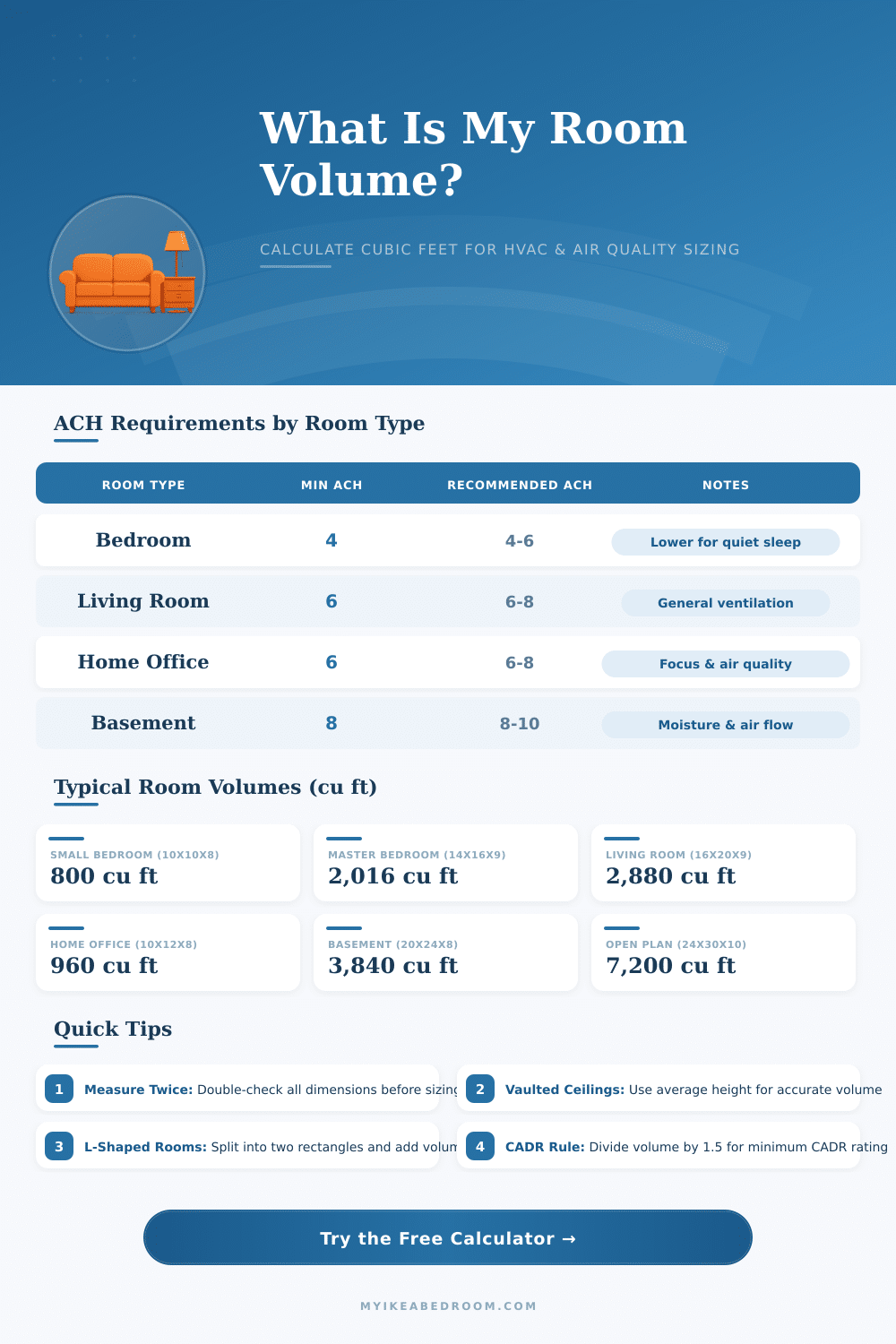
Air Changes Per Hour (ACH) by Room Type
| Room Type | Min ACH | Recommended ACH | Notes |
|---|---|---|---|
| Bedroom | 4 | 4–6 | Lower for quiet, restful sleep |
| Living Room | 6 | 6–8 | Standard general ventilation |
| Home Office | 6 | 6–8 | Supports focus & air quality |
| Basement | 8 | 8–10 | Higher due to moisture risk |
| Open Plan / Great Room | 6 | 6–8 | Large combined space |
| Studio Apartment | 6 | 6–8 | Combined living area |
Air Purifier CADR Guide by Room Volume
| Room Volume (cu ft) | Min CADR (CFM) | Recommended CADR | Room Type Example |
|---|---|---|---|
| Up to 800 | 53 | 100+ | Small bedroom |
| 801–1,200 | 80 | 150+ | Guest bedroom / office |
| 1,201–2,000 | 133 | 200+ | Standard bedroom |
| 2,001–3,000 | 200 | 300+ | Master bedroom / living room |
| 3,001–5,000 | 333 | 400+ | Large living room / basement |
| 5,001–8,000 | 533 | 600+ | Open plan / great room |
Humidifier Output Guide by Room Volume
| Room Volume (cu ft) | Min Output (gal/day) | Recommended Output | Notes |
|---|---|---|---|
| Up to 1,000 | 0.5 | 0.5–1.0 | Small portable unit |
| 1,001–2,000 | 1.0 | 1.0–1.5 | Medium tabletop unit |
| 2,001–3,500 | 1.5 | 1.5–2.5 | Console humidifier |
| 3,501–6,000 | 2.5 | 2.5–4.0 | Large console unit |
| 6,001–10,000 | 4.0 | 4.0–6.0 | Whole-house or large unit |
Room volume is the amount of space inside a room. It shows you how many cubic feet or cubic meters fit in that area. Figuring it out is quite easy and does not require hard math
To find the volume, measure the length, the width and the height of the room (from the floor to the ceiling). Later, multiply those three measures. This way you get the cubic volume.
How to Find Room Volume
If you use feet, the result will be in cubic feet, and if you use meters, it will be in cubic meters.
For instance, if a room measures 20 feet long, 15 feet wide and 8 feet high, the volume is 20 times 15 and later times 8. That equals 2,400 cubic feet. Other sample: a room of 10 x 5 x 9 feet gives 50, and later 50 times 9 equals 450 cubic feet.
Because most rooms have ceilings of 8 feet, measuring the height with a metal tape measure and later finding the length and width works well.
Sometimes you measure first with inches and need to convert that to feet before multiplying. For instance, 363 inches become 30 and one-quarter feet, 232 inches become 19 and a third of feet, and 108 inches become 9 feet. Later you multiply those numebers together.
Many folks already know the square area of their home, which is the sum of length times width of all rooms. Volume simply adds the height measure. A room volume calculator can give the result in cubic feet, yards or meters, all equivalent.
Some programs allow you to enter the dimensions in feet and easily convert them to cubic meters.
Knowing the volume of a room is important for more than just the size of the space. For ventilation, a good rule is to have about one square inch of air vent for every 25 cubic feet of volume. That helps the air flow properly.
Volume also matters for acoustics, but the ratios between the dimensions are also important. The smaller the room, the more important it is to have dimensions that are not simple multiples of each other. Many acousticians and designers say that the minimum volume for good acoustics is around 47 cubic meters.
Lowering the ceiling can dramatically reduce the volume. For instance, lowering the ceiling to 2.6 meters dropped the volume from 53 cubic meters to only 34.
Regarding sound, if the absorption stays same, doubling the volume of the room usually reduces the sound level by about 3 dB, because the energy spreads in double space.