Room Molding Quantity Calculator
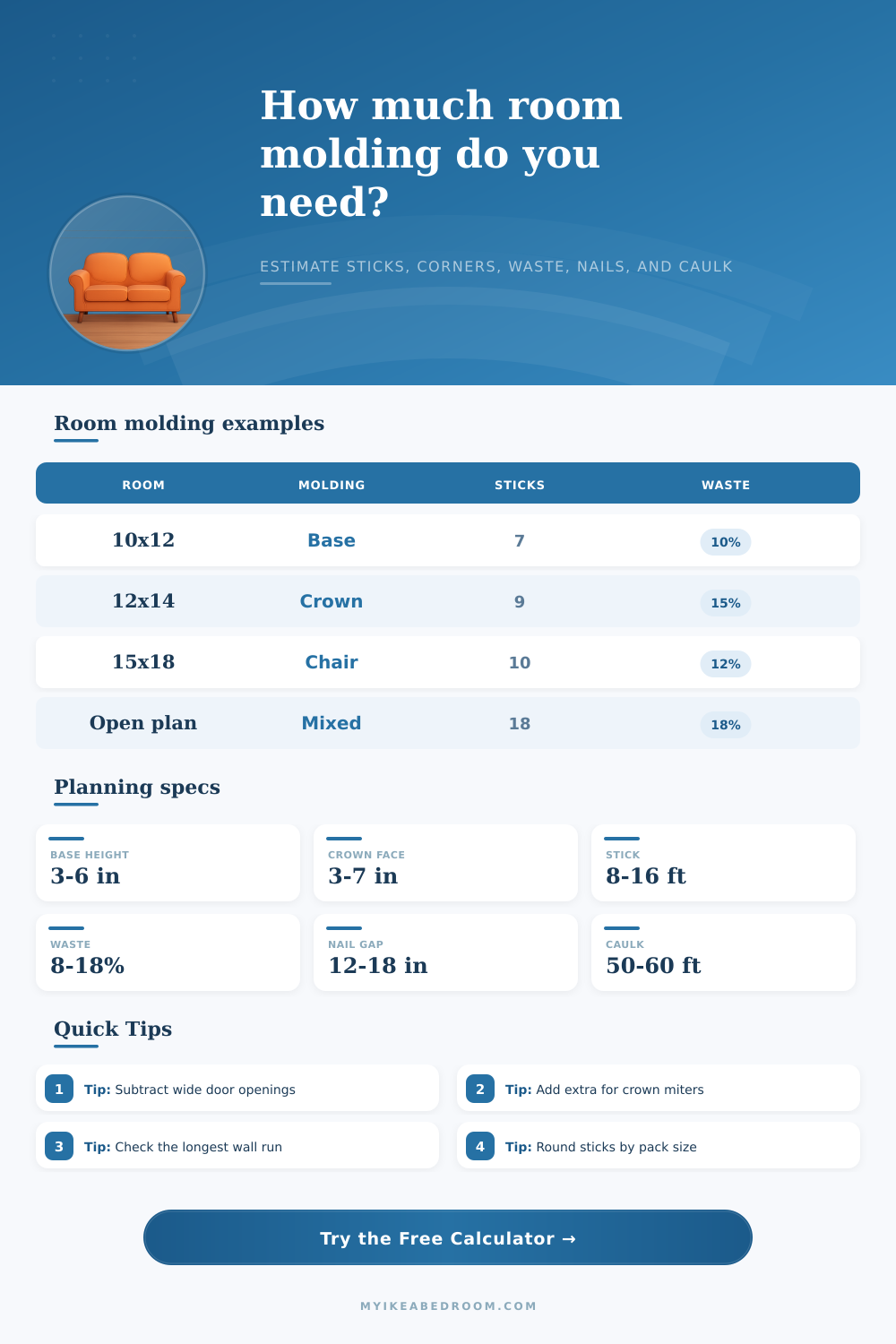
Estimate molding length, stick count, cut pieces, inside and outside corners, waste, nails, caulk, and paintable surface for baseboard, crown, chair rail, picture rail, and panel molding runs.
Choose a starting layout, then adjust the room shape, wall breaks, molding type, stock length, corner count, and waste allowance.
| Type | Typical run | Waste range | Nail spacing | Caulk edges |
|---|---|---|---|---|
| Baseboard | Room perimeter minus doors | 8% to 12% | 14 to 16 in | Top, plus bottom if needed |
| Crown molding | Ceiling perimeter, usually no door subtraction | 12% to 18% | 12 to 16 in | Wall and ceiling edges |
| Chair rail | Wall perimeter minus wide openings | 10% to 15% | 12 to 16 in | Top and bottom edges |
| Picture rail | Upper wall perimeter | 10% to 15% | 12 to 16 in | Wall edge and joints |
| Panel molding | Each box perimeter plus wall breaks | 12% to 20% | 10 to 14 in | Both visible edges |
| Stock length | Metric length | Sticks per 100 ft | Best use | Joint note |
|---|---|---|---|---|
| 8 ft | 2.44 m | 13 sticks | Small rooms, transport-limited jobs | More scarf joints on long walls |
| 10 ft | 3.05 m | 10 sticks | Bedrooms and offices | Good compromise for storage |
| 12 ft | 3.66 m | 9 sticks | Common bedroom wall lengths | Often spans one wall in a small room |
| 14 ft | 4.27 m | 8 sticks | Dining rooms and larger bedrooms | Fewer mid-wall joints |
| 16 ft | 4.88 m | 7 sticks | Living rooms and long base runs | Best for cleaner continuous runs |
| Room | Base perimeter | Typical openings | Net base run | 8 ft sticks at 10% |
|---|---|---|---|---|
| 10 x 12 bedroom | 44 ft | 3 ft door | 41 ft | 6 sticks |
| 12 x 14 bedroom | 52 ft | 3 ft door | 49 ft | 7 sticks |
| 12 x 16 office | 56 ft | 6 ft doors | 50 ft | 7 sticks |
| 15 x 18 living room | 66 ft | 8 ft openings | 58 ft | 8 sticks |
| 20 x 24 open room | 88 ft | 12 ft openings | 76 ft | 11 sticks |
Measure wall by wall. Long stock can reduce joints, but a single long piece only helps if it fits your vehicle, stairwell, and longest wall run.
Treat crown separately. Crown molding waste is usually higher than baseboard waste because spring angle, copes, outside corners, and test cuts consume more material.
To calculate the correct amount of room moldings that is needed for the project, you has to first understand that most people either buy too little room molding or they buy too much room molding. If they buy too little, then they will run out of molding before the project is complete. However, if they buy too much, they will end up with molding that they cant use and that will sit in the garage for many year.
In order to avoid both of these scenarios, people can use a calculator that takes into account the corner, the type of molding, and the room dimensions to calculate the amount of molding that will be needed. Furthermore, this calculator can manage the variables in order to ensure that the number that are calculated are accurate instead of the individual estimating them. The inputs that is required for this calculation are also important to consider.
How to Figure Out How Much Molding You Need
The shape of the room is one of these important variables because it will determine if the room is a rectangle or if it is an L shaped jog. The type of molding that the person will use in the project is another important variable because it will impact the amount of molding waste that will be created. For instance, if the type of molding is crown molding, then there will be more molding waste than if using baseboard molding because compound miters is required for crown molding.
The stock length of the molding is another important variable because it will determine the number of scarf joints that must be created in the molding. Finally, the waste allowance for the project is another important variable because some of the waste allowance will be for test cuts of the molding and for accounting for any molding that may get damage during the transport of the molding or when installing it into the room. Another of the variables that must be accounted for in the calculation is the corners of the room.
The number of corners in a room will impact the amount of molding that is lost when cutting it, as each corner will require molding to be cut. Furthermore, the corners will impact the amount of molding loss because some cuts will occur at inside corners that must be coped to fit the wall, but others will be at outside corners that will require miter returns that may not hide well if they are cut incorrect. A calculator that accounts for molding can account for corners separately so that they are not treated the same as the rest of the molding for the project.
Finally, nail spacing and caulk estimates must also be accounted for because these estimates will convert the linear footage of the molding to the number of nails and caulk that will be needed for the project. Including these estimates when calculating the amount of molding required for a job will ensure that people dont make extra trip to the store to purchase molding once the job has been started. Other design choices for the job may also have an impact on the list of quantities of molding that are required.
For instance, if panel molding boxes are to be added to an accent wall in the room, then the perimeter of those boxes will be important to calculate. The perimeter of those boxes is as important as the perimeter of the outer room being side with molding. Furthermore, the calculator can account for the panel boxes as if they were closed shape in order to calculate the total run of molding that will be required for the project.
Many people tend to make mistakes with this calculation. For instance, many people will only measure the longest walls in the room. This can result in people forgetting to measure for the short returns around the doors in the room, as well as the amount of molding needed for closet opening in those same rooms.
Furthermore, another mistake that many people make is using the same percentage for the waste allowance for each type of molding that is to be used in the room. For instance, crown molding and stain grade molding will have a higher percentage of waste than other types of molding due to the compound joints that are created in these types of molding. The reference tables that is included in the calculator will help to show the typical waste percentages for each type of molding.
Thus, people can adjust the waste percentage for their project before completing the calculation of the amount of molding that is required to complete the project. Another factor to consider is the way that the molding will be transported to the job site. For instance, if long piece of molding are selected for the project, then fewer scarf joints will be created for the molding.
However, long pieces of molding will require a vehicle to be use to transport the molding to the job site. Shorter pieces of molding are easier to transport to the job site, but more scarf joints will have to be created in the shorter pieces of molding. Each scarf joint will have to be glued and sanded prior to installing the molding into the room.
The calculator for this project will show how many pieces of molding will be of each length once the individual chooses the length of the stock molding. Thus, this will allow the person to ensure that they purchase enough molding to complete the job and that it will fit in the vehicle that will be used to transport the molding to the job site. The goal of calculating how much molding is required for a job is to have enough molding to complete the job, but not have so much excess molding that it will sit in the garage for many year.
A calculator that considers all of the variables described above will allow people to find this balance. Furthermore, the individual that is performing the job will also have to pay attention when measuring the room for molding and when cutting the molding to the necessary lengths to complete the project.