🪟 Roman Shade Pleat Calculator
Calculate exact pleat count, spacing, and total fabric needed for perfectly even Roman shade folds
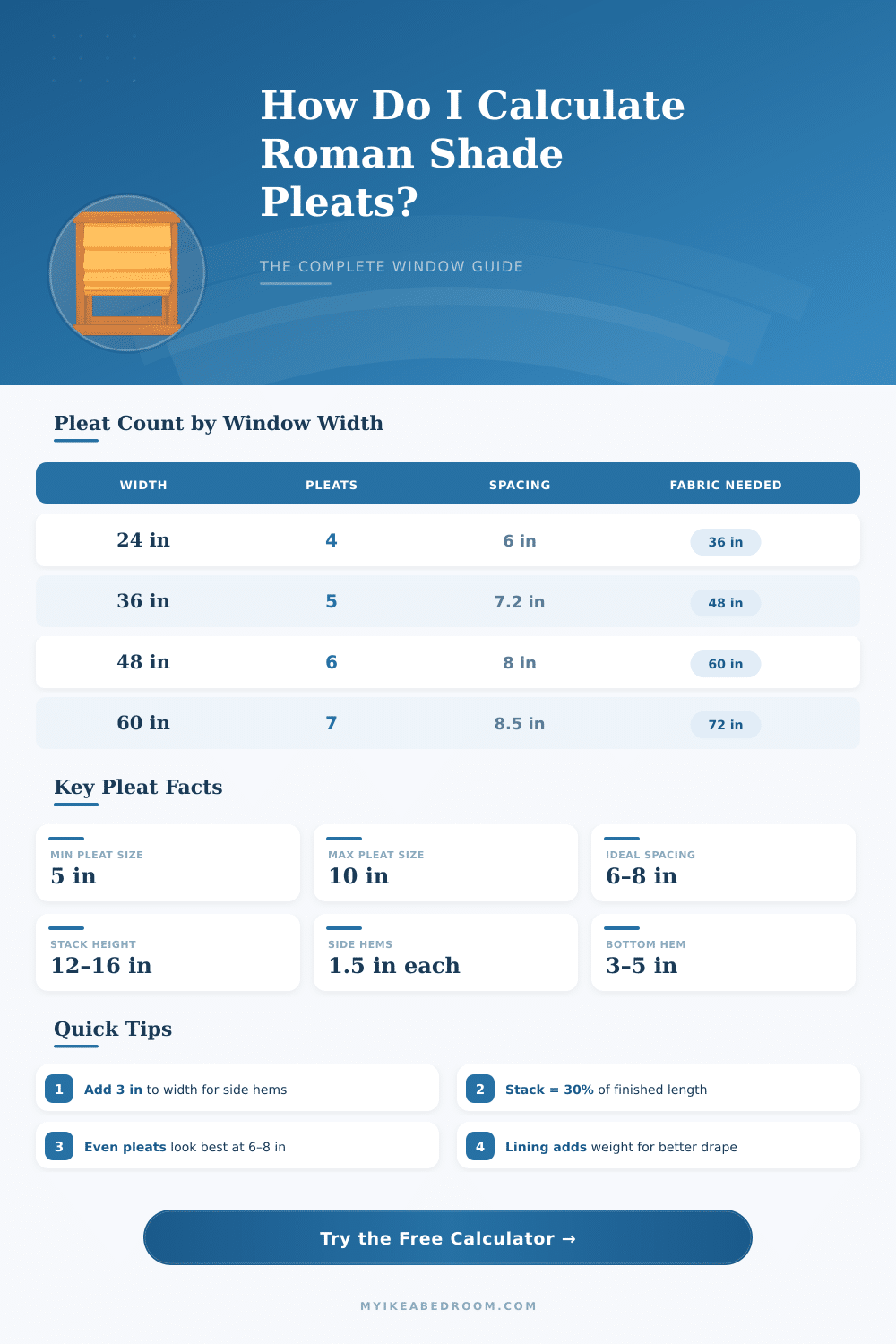
| Finished Length | Pleat Depth 6 in | Pleat Depth 7 in | Pleat Depth 8 in | Stack Height (est.) |
|---|---|---|---|---|
| 36 in (91 cm) | 4 pleats | 3–4 pleats | 3 pleats | 10–12 in |
| 48 in (122 cm) | 5–6 pleats | 5 pleats | 4 pleats | 12–14 in |
| 60 in (152 cm) | 7 pleats | 6 pleats | 5–6 pleats | 14–16 in |
| 72 in (183 cm) | 8–9 pleats | 7–8 pleats | 7 pleats | 16–18 in |
| 84 in (213 cm) | 10–11 pleats | 9 pleats | 8 pleats | 18–20 in |
| 96 in (244 cm) | 12 pleats | 10–11 pleats | 9–10 pleats | 20–24 in |
| Shade Style | Fabric Multiplier | Hobble Extra | Stack % of Length |
|---|---|---|---|
| Flat Roman | 1.0x length | — none | 25–30% |
| Hobbled Roman | 1.5–2.0x length | +50–100% extra | 35–45% |
| Relaxed Roman | 1.1–1.2x length | Soft curve add | 28–35% |
| Balloon Roman | 1.5x length | Puff volume add | 40–50% |
| Cellular Roman | 1.2–1.3x length | Cell depth add | 30–38% |
| Finished Width | Min. Cord Rows | Recommended Rows | Cord Spacing |
|---|---|---|---|
| Up to 24 in (61 cm) | 2 | 2–3 | 8–12 in |
| 24–36 in (61–91 cm) | 2–3 | 3 | 10–14 in |
| 36–48 in (91–122 cm) | 3 | 3–4 | 12–16 in |
| 48–60 in (122–152 cm) | 3–4 | 4 | 12–15 in |
| 60+ in (152+ cm) | 4–5 | 5–6 | 10–14 in |
| Window Type | Typical Width | Typical Length | Fabric Needed (Flat) |
|---|---|---|---|
| Bathroom | 24 in (61 cm) | 36 in (91 cm) | ~0.75 yd |
| Kitchen | 36 in (91 cm) | 48 in (122 cm) | ~1.0 yd |
| Bedroom Standard | 36 in (91 cm) | 72 in (183 cm) | ~1.5 yd |
| Bedroom Large | 48 in (122 cm) | 84 in (213 cm) | ~1.75 yd |
| Living Room Standard | 48 in (122 cm) | 72 in (183 cm) | ~1.5 yd |
| Living Room Wide | 60 in (152 cm) | 96 in (244 cm) | ~2.25 yd |
| Patio Door | 72 in (183 cm) | 96 in (244 cm) | ~2.5 yd |
Roman shades reach ideal harmony between grace and style, they combine the sweet, protective feeling of curtains with the simple function of blinds. Made from fabric, they have horizontal folds that fold up nicely when one raises them. The newest part?
A collection of various Pleat types, and each of them adds its own character to the room.
Types and Benefits of Pleated Roman Shades
The smooth or pleated type works like a simple Roman Shade but it forms seams each eight to ten inches or more. Those seams have a real benefit, they allow the shade to move upward and down without staying stuffed. Here the main point however: if your fabric has strict patterns, those seams can break the image quite a lot clearly.
So, for patterned materials, this style does not always work well.
So, there is the knife Pleat Roman Shade, that uses a fully other method. The folds in this type fall inwardly and are sewn together, what gives a truly clean and polished look, because it does not show horizontal sewing across the front. They work for almost any space and deliver structured, precise style without losing the actual function.
The ribbed Pleat shade flips the idea by placing those pockets on the front instead, what stresses every fold and draws the look too the Pleat details.
Here something worth mentioning: each that extra fabric, that rests in the folds up, does offer good privacy. So pleated Roman Shades work for windows, that allow cold to enter… The thicker material blocks the cold air well.
They come in almost every fabric, color and pattern, that one would want. Whether one searches something simple and modern, or something with more traditional style, pleated Roman Shades work perfectly.
When one lowers some styles, they stretch and take less visible space, practical for low windows or glass doors. Raise them fully, and the pleated parts stack up neatly at the upper edge of the window. Hobbled Roman Shades work a bit differently, because they keep their soft folds even when lowered.
Support poles sit in pockets behind every fold, so they work best with solid colored or textured materials, that do not have busy patterns.
Safely, cordless Roman Shade uses magnets in the build, so it stays fixed at any height, that one chooses. That really helps, if in the home are children or pets, because no hanging string could create danger. Remote versions exist for big windows or spots, that are hard to reach, just press a button, andeverything is ready.
Lay a pleated Roman Shade above a roller or sunblind is the best mix for style without loss of light control. Some come with dark covering also, what gives full darkness for bedrooms.