Roman Shade Fabric Calculator
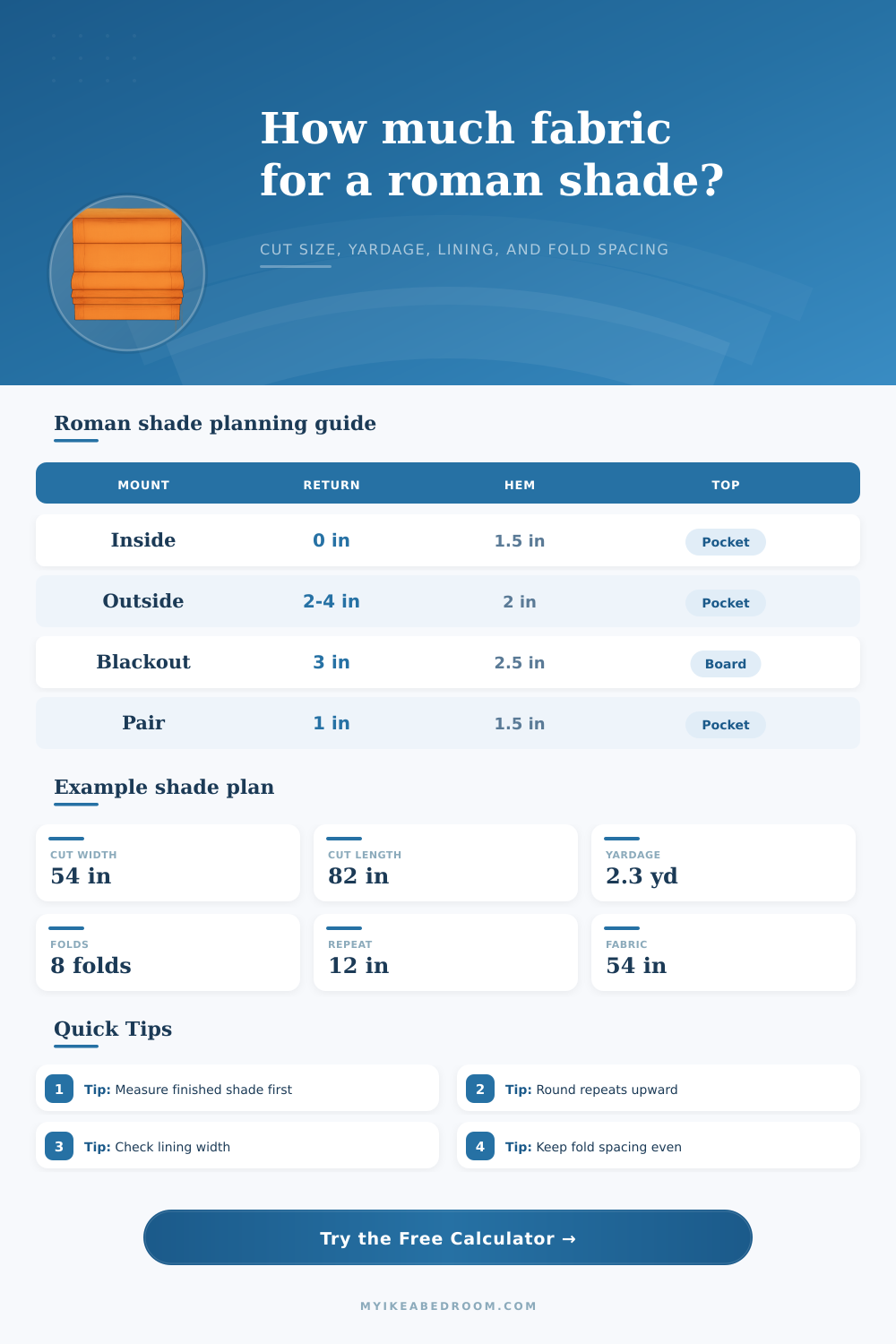
Plan a roman shade cut list from window size, mount style, return allowance, hems, rod pocket depth, fold spacing, pattern repeat, lining choice, shade count, and fabric width.
Choose a common window treatment setup, then adjust every allowance to match your workroom method and fabric repeat.
Fabric breakdown
| Mount setup | Finished width math | Finished height math | Best use |
|---|---|---|---|
| Inside mount | Window width | Window height | Clean recess fit when the opening is square and deep enough. |
| Outside mount | Window width plus two allowances | Window height plus two allowances | More privacy, less light gap, and coverage around trim. |
| Outside with returns | Window width plus two returns | Window height plus two returns | Side return or projection coverage on a board-mounted shade. |
| Multiple shades | Each shade calculated separately | Each shade repeats the same length | Pairs, bays, and grouped windows with matching folds. |
| Fabric repeat | How length is rounded | Visual effect | Planning note |
|---|---|---|---|
| 0 in plain fabric | No repeat adjustment | Uses the raw cut length | Solids, small textures, and railroaded plain goods. |
| 6 in repeat | Next 6 in increment | Small motif alignment | Good for stripes, checks, and small printed patterns. |
| 12 in repeat | Next 12 in increment | Medium motif alignment | Common for florals, geometrics, and directional prints. |
| 24 in repeat | Next 24 in increment | Large motif placement | Often adds a meaningful amount of face yardage. |
| Lining choice | Yardage multiplier | Cut length basis | Shade note |
|---|---|---|---|
| No lining | Face fabric only | Repeat-adjusted face length | Lightweight decorative shade where opacity is not needed. |
| Privacy lining | One lining layer | Raw cut length | Bedroom or living space shade with softer back appearance. |
| Blackout lining | One lining layer | Raw cut length | Nursery, bedroom, or media room shade with light control. |
| Interlining plus lining | Two lining layers | Raw cut length twice | Fuller folds and extra body on decorative face fabric. |
| Fold spacing | Finished height range | Typical fold count | Resulting look |
|---|---|---|---|
| 5 to 6 in | Short shades under 36 in | 5 to 7 folds | Compact folds for small bath or cafe windows. |
| 7 to 8 in | Bedroom windows 48 to 64 in | 7 to 9 folds | Balanced folds with manageable ring spacing. |
| 8 to 10 in | Tall windows 64 to 84 in | 8 to 10 folds | Softer larger folds for drapery-weight fabric. |
| 10 to 12 in | Doors and very tall shades | 8 to 11 folds | Fewer rows, useful when fabric is bulky or lined. |
Inside mount
Lowest fabric use
Cutting starts from the opening size, so returns are usually zero and the shade sits inside the frame.
Outside mount
More coverage
Allowance is added to both width and height, improving privacy and reducing side light gaps.
Patterned fabric
Repeat controlled
The cut length rounds up to a full pattern repeat so a motif can land predictably.
Joined widths
Wide shade layout
If the cut width exceeds fabric width, the calculator adds full vertical widths and notes joins.
When planning to make a roman shade, a person must calculate the total amounts of fabric that will be needed for that roman shade. A person cant simply measure the widths and height of the window and purchase the necessary amount of fabric for the roman shade, as there is additional fabric that must be purchased to account for the folds and the header of the roman shade. The total amount of fabric that will be used for the roman shade will have to account for the folds that will be included within the roman shade, the way that you’ll mount the roman shade, the pattern of the roman shade (if any), the lining of the roman shade, and the width of the roman shade.
The first step in calculating the amount of fabric that will be required for a roman shade is to decide whether the roman shade will be mounted inside of the window or outside of the window. Should the roman shade be mounted into the inside of the window, measurements will have to be precise in ensuring that the roman shade will not allow light into the window; should the measurements be off slightly, light could be visible through the roman shade. Conversely, if the roman shade is mounted outside of the window, it is more forgiving of the size of the window, and does not require as precis measurements in order to prevent light from entering the window.
How to Measure Fabric for a Roman Shade
In addition to deciding the way that the roman shade will be mounted into the window, a person must also decide if the roman shade will feature a pattern. If the roman shade features a solid color for the fabric, it can be cut to the length that is necessary to create the roman shade. However, if the roman shade features a pattern, such as a floral or geometric design, you will need to allow for the pattern to be aligned on each roman shade.
In order to allow for the pattern to be aligned with the other roman shades, additional fabric will have to be purchased. Additional factors to consider in the calculation of the amount of fabric for a roman shade are the number of folds that will be included within the roman shade. Roman shades with many small folds will require more fabric than those with fewer large folds.
However, the number of folds that is selected for the roman shade must be balanced with the height of the window; too many folds will make it difficult for the roman shade to be lifted. Proper folds will allow the roman shade to naturaly drape from the window without the need for additional support. Another important factor to consider in the creation of a roman shade is the lining.
Roman shades may include a privacy lining to cover the opening from outside of the window, or may include a blackout lining that will evenly cover the opening from outside of the window and prevent light from entering the room. Blackout linenings is typically thicker than those used for privacy purposes. An additional option is to interline the roman shade; interlining involves placing batting or fleece layer between the roman shade fabric and lining.
Including interlining will make the roman shade heavier, and a person will have to purchase more lining for those roman shades. In addition to the factors mentioned above, a person must also consider the width of the fabric that will be used to create the roman shade. Most decorative fabrics are available in widths of 54 inches.
Should the width of the window be greater than 54 inches, the roman shade will have to be made from joining multiple panels of roman shade fabric together. The patterns will have to be allowed to match at the seam created between panels of fabric, and additional fabric will be required to allow for these joins in the roman shade. Finally, additional fabric will have to be purchased for the roman shade to account for the hem and rod pocket.
Should the roman shade simply be cut to the height of the window, it will not feature the necessary hem at the bottom of the shade, and will not feature a rod pocket necessary to allow for the hardware to be placed into the roman shade to hang the roman shade. A weighted hem at the bottom of the roman shade will help to keep it from moving within the window, and a deep rod pocket at the top of the roman shade will allow for the hardware to be placed into the shade. Thus, the amount of fabric must be calculated for each of these components (folds, pattern, lining, joins, hem, and rod pocket) to ensure that there is enough fabric to create roman shade with the necessary components to allow for proper function of the roman shade.
You should of checked the measurements twice.