Rocking Chair Clearance Calculator
Estimate the full rocking motion envelope, rear wall gap, front walkway, side sweep, floor pad size, and room fit for nursery rockers, bedroom reading chairs, gliders, recliners, and porch rocking chairs.
Pick a close match, then adjust the chair measurements and clearances. Use the outside dimensions of the chair and runner, not only the cushion size.
Placement summary
Enter dimensions to size the clearance zone.
The calculator separates rocking motion from the front walkway, so the path stays usable while the chair is occupied.
Use painter tape to mark the final rectangle before moving beds, dressers, cribs, side tables, or floor lamps.
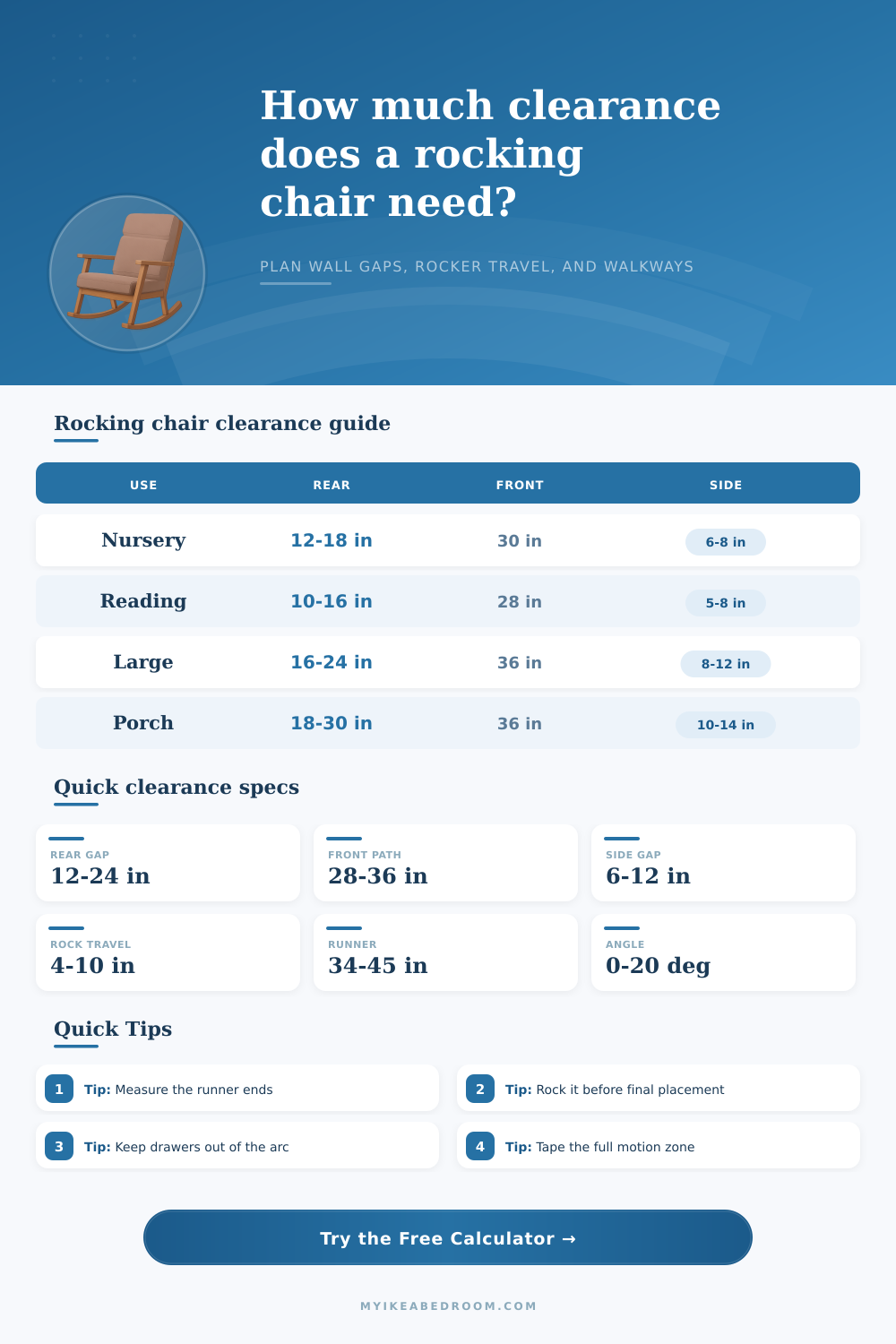
| Location | Rear wall planning gap | Front walkway after motion | Side clearance each side |
|---|---|---|---|
| Bedroom reading corner | 10 to 16 in behind the resting chair | 26 to 30 in after forward rock | 5 to 8 in plus any table gap |
| Nursery rocker or glider | 12 to 18 in so quiet rocking avoids trim | 30 to 36 in near crib or changing route | 6 to 10 in for arms and blankets |
| Living room seating group | 12 to 20 in depending on rear travel | 30 to 36 in when people pass in front | 8 to 12 in near lamps or side tables |
| Porch or balcony rocker | 18 to 30 in near rails or siding | 36 in or more for outdoor circulation | 10 to 14 in for arm movement and breeze |
| Large recliner rocker | 18 to 28 in, especially with tall backs | 36 to 42 in when a footrest may open | 10 to 14 in for side handle access |
| Chair style | Outside width | Resting depth | Base or runner planning note |
|---|---|---|---|
| Compact wood rocker | 25 to 30 in | 32 to 38 in | Runner tips may extend past the seat frame. |
| Standard nursery glider | 28 to 34 in | 34 to 40 in | Base usually slides front to back within a short track. |
| Upholstered rocker | 32 to 40 in | 36 to 44 in | Soft arms often control the side clearance more than the base. |
| Recliner rocker | 34 to 42 in | 38 to 48 in | Add footrest or handle access if the chair reclines. |
| Porch rocking chair | 26 to 34 in | 36 to 44 in | Long curved runners often need the largest rear gap. |
| Use case | Buffer around motion zone | Best sizing method | When to increase it |
|---|---|---|---|
| Hard floor runner protection | 2 to 3 in beyond runner travel | Use calculated pad width and pad depth. | Increase if the runner ends are sharp or narrow. |
| Nursery rug under rocker | 3 to 6 in beyond full chair motion | Cover rear travel, front travel, and foot area. | Increase if a footstool sits in front. |
| Porch mat or outdoor rug | 4 to 6 in beyond rocker contact area | Keep all runner contact inside the mat. | Increase near uneven decking or railings. |
| Apartment noise pad | 3 to 6 in beyond the full motion track | Size to the rocking arc, not the chair at rest. | Increase for enthusiastic rocking or glider tracks. |
| Scenario | Chair and motion inputs | Approx total width | Approx total depth |
|---|---|---|---|
| Nursery glider | 32 in wide, 39 in base, 6 in rear, 5 in front | 52 in with side clearance | 80 in with wall gap and path |
| Classic wood rocker | 29 in wide, 42 in runner, 8 in rear, 6 in front | 45 in with side clearance | 86 in with normal walkway |
| Large recliner rocker | 39 in wide, 46 in depth, 10 in rear, 14 in front | 67 in with side clearance | 112 in with larger front path |
| Angled reading corner | 31 in wide, 40 in runner, 7 in rear, 6 in front | 60 in at 15 degrees | 90 in at 15 degrees |
| Porch rocker | 30 in wide, 44 in runner, 10 in rear, 7 in front | 58 in with outdoor side room | 103 in with porch walkway |
Measure motion, not just the chair. Rock the chair gently and note the farthest rear runner, back, and front foot positions before finalizing the gap.
Protect the front path. The walkway should remain open after the chair moves forward, especially near beds, cribs, dressers, and door swings.
Use side clearance for real use. Hands, blankets, side handles, pillows, and nearby tables can all need more room than the chair arms alone.
Check angled placement twice. A diagonal rocker can reduce one conflict while increasing the projected width and depth of the motion envelope.
For example: You purchase the chair. Its soft cushy pillows look great in the nursery (or even the bedroom corner)…until you attempt to sit on it and hear the runner rattle noisily against the wall trim or bookshelf. The sound is the sound of bad clearance planning!
A rocking chair doesn’t stay stationary. Instead, it move dynamically back and forth in an arc that’s bigger than just the physical size of the chair. So if all you do is measure how wide and deep it is when stationary, you’re setting yourself up for trouble.
How to Measure Clearance for Your Rocking Chair
Once you input your own measurements, our handy-dandy calculator will do the math for you so you can convert your vague worries about bumping-into-things into real numbers. What really matter is knowing what moves. Most folks consider only cushion area, but those bases can be much longer than seat frame. It all depends on how long your runners or gliders are.
When measuring for clearance, take the measurement from the very tip of the rear runner to front edge of the base when the chair is at rest. Next, you must factor in travel, if you’ve got a real rocking party going on, the front may move out another five inches into the room while the back could swing back towards the wall an additional six inches. Add some sort of safety buffer to that as no one rocks gently each and every time. To do so, the tool break down each of those motions, how far you want to push a piece back (and leave as a safety gap), how far forward you will pull the item, and how far your chair is going to drop; into a total number that accounts for all three parts.
Yes, I know: tiny detail! But it is so important when trying to preserve not only your furniture but also your walls in the process.
Another trick is width. When visualizing clearance on either side, we imagine only enough space for our arms to hang down at rest, but there’s also got to be clearance for blankets falling, hands moving, whatever, since we lean in and out of chairs slightly as we use them. If you’re positioning a chair beside a dresser whose drawers jut out when opened, you’ll want to include an allowance for any side-to-side sway in your calculations. You can use the calculator to insert this allowance for side sway specifically. Why? Because it’s better different than when you think of the side gap not as empty air but as part of the functional zone. Then when you move to one hip, you won’t bang your elbow against some dresser hardware.
And then there is the matter of where you place it: the angle of placement alters everything. Setting a rocker at an angle facing your favorite reading lamp (or view) makes sense; it’s cozy and natural, yet that same placement throws the range of motion out in the opposite direction, more across the room, diagonally. Even a fifteen degree angle can mean adding several inches to the necessary side clearance. A straight up and down placement will keep the width tight to the wall but the range of movement extends further outward and diagonally. The table on the page use a graphic to show all this. It explains how location changes required safety margins based off how users behave, what traffic flows through, and where else they might need to be.
If you’re using a rocker as a crib rocker, you’ll want to keep cribs clear and operate quietly, so you may increase the rear gap to eliminate any noise against the wall. If you have outdoor furnitures or wind on a porch, you will need larger side buffers.
After measuring out those numbers, use them to tape off an outline on the ground and test walking around in there (while leaving the front walkway clear so that others can still pass when you’re busy). The tool’s visual preview will give you a sense of the rectangle’s shape. However, it can’t replace actualy taping it out in real life. You’ll find conflicts with radiator covers or door swings that won’t be shown in the drawing.
After knowing exactly where the motion zone ends, go ahead and cut a rug (or use a floor protector) just big enough to keep the runners protected from getting caught at carpet edges, or slipping across exposed hardwood.
Clearance planning isn’t about limiting movement. It’s about facilitating it. Giving the chair enough room to swing freely without hitting anything will restore the relaxed rhythm that attracted you to it in the first place. Measure both the runner and the seat, and account for both the arc and the rest position. Now you can sit back and enjoy the rock.