Refrigerator Capacity for Household Calculator
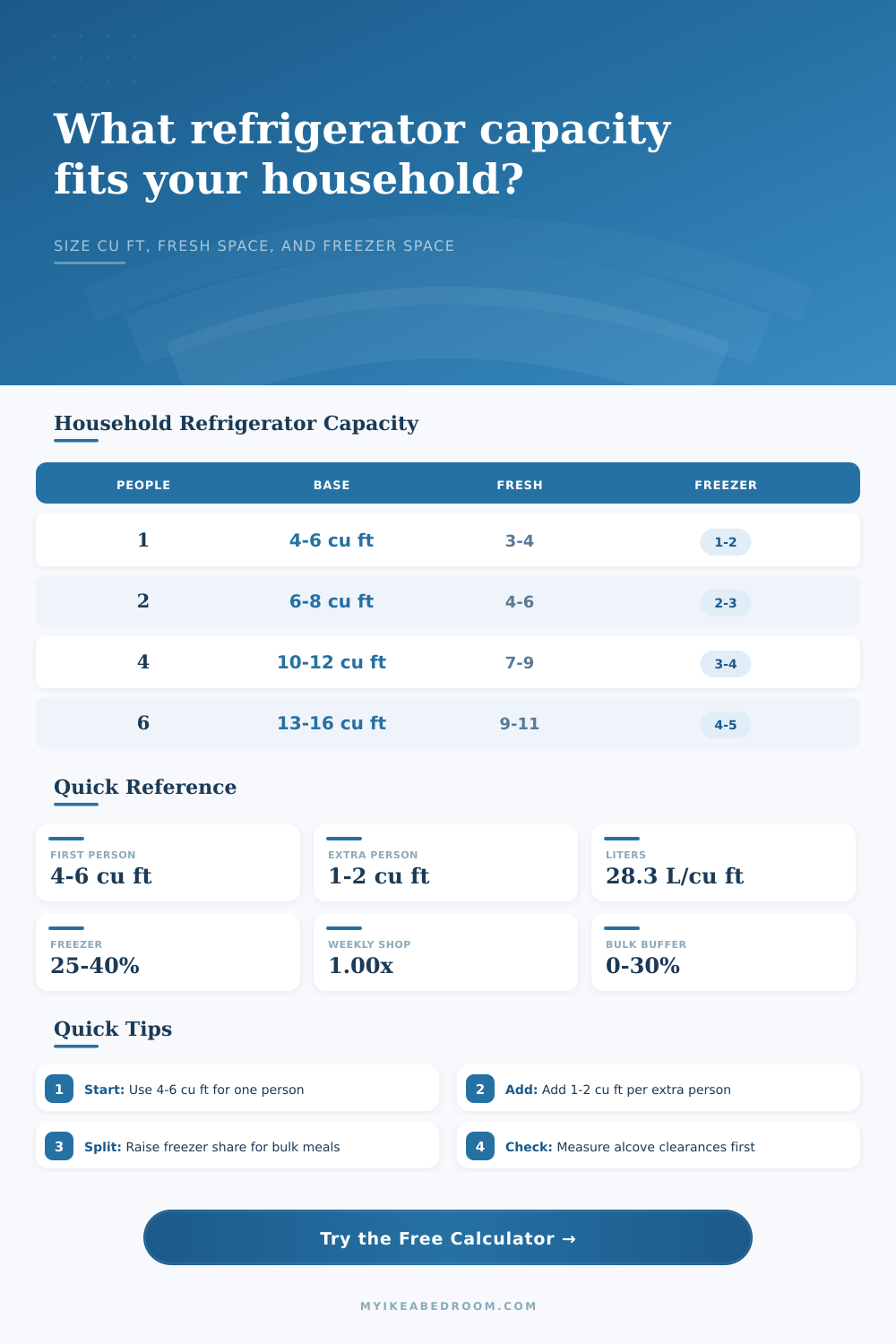
Estimate refrigerator size from household members, shopping interval, cooking habits, bulk storage, freezer share, and the standard 4-6 cu ft first-person rule.
📌Household Presets
🧮Capacity Inputs
Your Refrigerator Capacity Estimate
📏Household Member Capacity Reference
| Household members | Base capacity rule | Balanced estimate | Approximate liters | Best fit note |
|---|---|---|---|---|
| 1 person | 4-6 cu ft first person | 5 cu ft | 142 L | Compact fresh food, limited freezer volume. |
| 2 people | 4-6 plus 1-2 cu ft | 6.5 cu ft | 184 L | Good for weekly groceries with modest leftovers. |
| 3 people | First person plus two extras | 8 cu ft | 227 L | Works for mixed cooking and normal freezer use. |
| 4 people | First person plus three extras | 9.5 cu ft | 269 L | Often needs more once bulk food or meal prep is added. |
| 5 people | First person plus four extras | 11 cu ft | 311 L | Plan extra freezer share if shopping every two weeks. |
| 6 people | First person plus five extras | 12.5 cu ft | 354 L | Large households benefit from organized fresh zones. |
🛒Shopping Interval Adjustment
| Shopping rhythm | Factor used | Capacity effect | Fresh-space impact | Freezer impact |
|---|---|---|---|---|
| Every 2-3 days | 0.85x | Lower holding capacity | Small produce and dairy buffer | Minimal frozen reserve |
| Weekly groceries | 1.00x | Reference planning load | Normal produce drawer use | Balanced frozen meals or proteins |
| Every 10 days | 1.12x | Moderate extra capacity | More cartons and meal ingredients | Slight frozen buffer |
| Every 2 weeks | 1.28x | Larger appliance range | Extra produce and leftovers | More frozen protein and meals |
| Every 3 weeks | 1.45x | Substantial storage buffer | Fresh space may be the limiter | Freezer share often needs 35-45% |
❄Fresh and Freezer Split Guide
| Freezer share | Fresh share | Use when | Example on 15 cu ft | Planning note |
|---|---|---|---|---|
| 25% | 75% | Fresh produce, drinks, dairy | 11.3 fresh / 3.8 freezer | Best for frequent shopping and little frozen food. |
| 30% | 70% | Balanced household use | 10.5 fresh / 4.5 freezer | Good default for weekly grocery planning. |
| 35% | 65% | Frozen meals or proteins | 9.8 fresh / 5.3 freezer | Helpful for batch cooking and fewer shopping trips. |
| 40% | 60% | Bulk frozen storage | 9.0 fresh / 6.0 freezer | Choose only if fresh shelves will still feel usable. |
| 45% | 55% | Maximum freezer planning | 8.3 fresh / 6.8 freezer | Consider a separate freezer if fresh space feels tight. |
🏠Common Household Examples
| Household example | People | Shopping interval | Suggested total | Fresh / freezer split |
|---|---|---|---|---|
| Studio or guest suite | 1 | Every few days | 4-6 cu ft / 113-170 L | Fresh-heavy, small freezer |
| Couple with weekly groceries | 2 | Weekly | 7-9 cu ft / 198-255 L | 70% fresh / 30% freezer |
| Family of four | 4 | Weekly to 10 days | 11-15 cu ft / 311-425 L | 65-70% fresh / 30-35% freezer |
| Meal-prep household | 4 | Every 2 weeks | 15-19 cu ft / 425-538 L | 60-65% fresh / 35-40% freezer |
| Large shared home | 6 | Weekly | 16-21 cu ft / 453-595 L | Keep fresh zones easy to divide |
💡Capacity Planning Tips
Before you choose your kitchen cabinet size, did you measure your consumption of frozen pizza? Probably not.
A typical error: you see appliance as a fixed box for fitting into a wall, not as an adjustable storage machine showing your lifestyle. The calculator above converts habits into volume. It translates fuzzy thoughts such as “I freeze everything” or “we shop a lot” into hard numbers: liters and cubic feet.
How to Choose the Right Fridge Size for Your Family
That rule starts from the ground floor: how many cubic feet of storage does each person require? Four to six for the first, then add one to two cubic feet per additional household member. Why? That range take into account the basic needs for eating something. And that’s all!
This is where most folks end the math. Their heads nod. A family of four equals x. Done. They don’t consider what they do with food. Do they go out daily and pick up only what is needed? In that case, they don’t need as much. Or do they load up once every two weeks? This means they needs more space.
In the tool, I take care of this by adding a multiplier to your total. Yes, it fits the food. It also accounts for the time between visits.
The cooking style makes all the difference. If your household frequently dines out, you need fewer shelves of fresh produce. If you’re a Sunday meal-prep family, you’ll be using plenty of containers to stash leftovers, more area-consuming than raw ingredients.
Perhaps you think bulk purchasing will save you some cash. It does. But it requires freezer storage, too. This allows you to adjust the ratio of fresh versus frozen areas. Want to fit those warehouse club-size packages and garden harvests in a bigger freezer? Go for it. Want to maintain a larger fresh section so you’re ready for daily meals from scratch? That works, too. Chances are it won’t be a 50-50 split at any rate. It will be strategic: What happens to the food is key.
The other thing is that while an alcove may measure one way, that doesn’t mean its need measures the same. Maybe it’s big enough for a huge unit. But do you need one?
If you overfill your fridge, you’ll end up wasting food because you can never find anything. If you underfill it, you’re going to make extra trips anyway, and then stuff will get crammed onto the shelf until it goes bad or gets forgotten. You want some kind of comfortable buffer there. Enough room to stock up in bulk when something goes on sale. Not so much that you’re rooting around in the frost looking for last year’s ice cream.
Those tables on the page break it down nicely. They outline how capacity bands change depending on household size. Maybe five cubic feet is plenty if you’re a solo shopper. Twenty might be necessary if you’re in a large shared home. The conversion math takes care of itself. All you have to do is be honest with your inputs.
Let’s think about the kitchen in real world terms. What are the physical limitations? How do doors swing? Where is the ventilation hole? Where does the food come from? You’ve got limited options. On paper, a massive fridge sounds awesome. In reality, it may not pass through the hall.
The calculator spits out a target size. It doesn’t create the space. You must physically measure it. However, it informs you what to find. The output says, “Twelve Cubic Feet.” Know what? Go look around for something in that ballpark. Avoid spending time looking at compact units with six cubes. Likewise, you’ll avoid getting sucked into an oversized model that overwhelms the area.
Another hidden variable is thinking about leftover food. How long do you keep your food? Three days? Five? Is it a week? Every additional day represents a tiny cushion in the estimate of your fresh food. Containers have volume. You can easily forget how much they take up on your shelves. By including a little extra room for holding days, the tool reflects this reality. It’s an easy-to-overlook feature. But it also captures real life. We don’t just store food. We store the evidence of our meals.
And then there’s rounding. Appliances comes in standard sizes. There isn’t an exact, 12.3-cubic-foot fridge out there. There’s a 12- or a 13. With the calculator, you have a planning band, which allows you to walk into the showroom confident. You know what size you need to start at and what size you shouldn’t go over. You can choose appliances that fit how you live.
First, consider the number of people. Then adjust for shopping frequency. Next tweak the freezer split depending on whether you cook more or less from scratch. What does that say? The numbers will tell you. Don’t guess. Measure your habits.
Filling the wall isn’t the right size. Right size fits your life. That’s where folks screw up. They buy for the space. You should of bought for your schedule.
That’s what the calculator above will do for you. It’ll run the math. All you gotta do is think about what’s actualy happening in your kitchen.