Recycling Bin Quantity Calculator
Estimate sorted recycling bin count, total capacity, and cabinet fit for kitchens, laundry rooms, pantries, and shared home stations.
♻Choose a recycling setup preset
📏Enter your recycling load and space
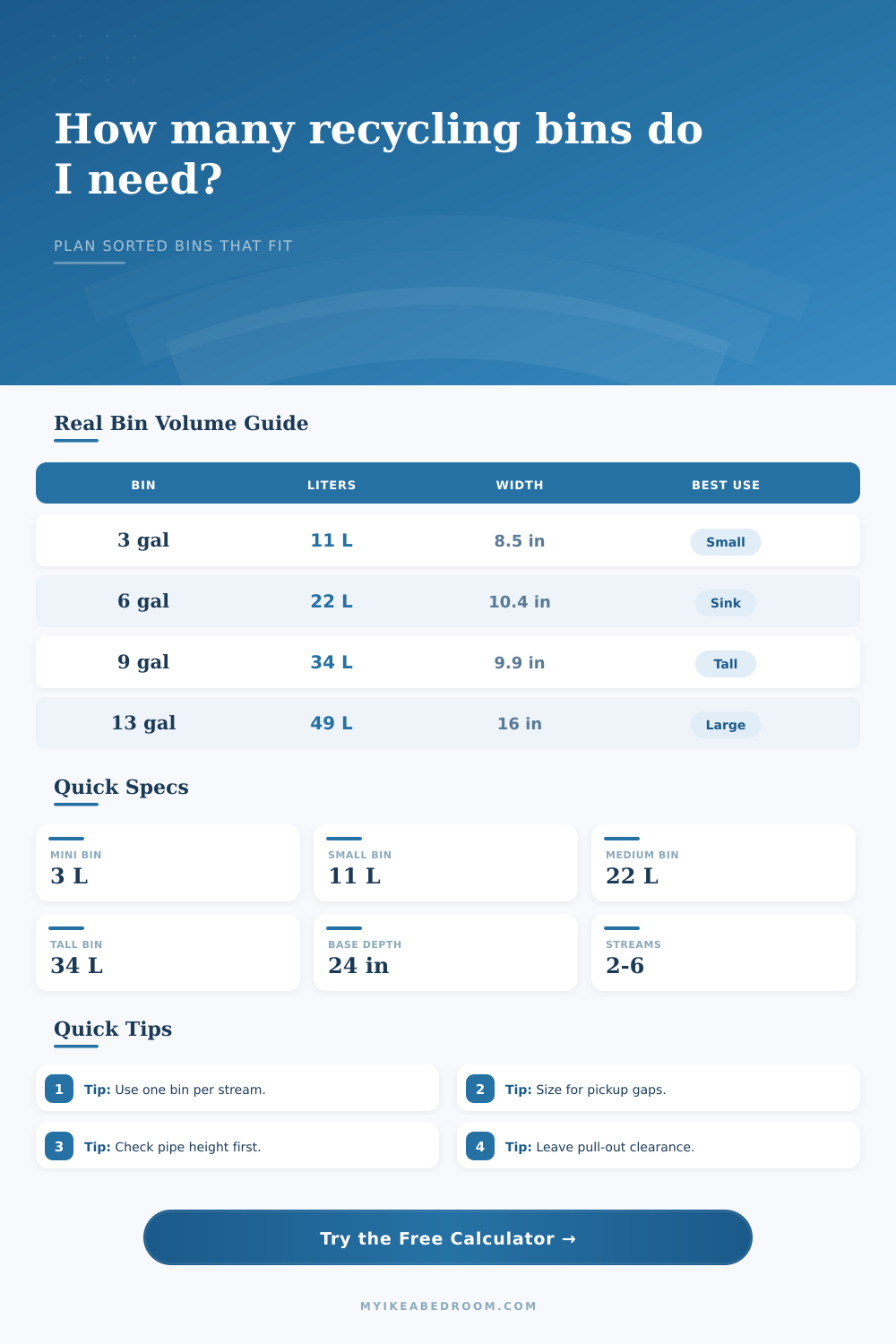
🗂Common bin volumes used by the calculator
📊Reference tables for recycling bin quantity planning
| Bin size reference | Real volume | Typical footprint | Clearance note |
|---|---|---|---|
| Countertop food scrap bin | 3 L / 101 oz | about 6.5 in wide | Fits shelves, carts, or counter corners |
| Small HALLBAR-style lidded bin | 11 L / 3 gal | about 8.5 in wide | Good for glass, cans, or returnables |
| Medium HALLBAR-style lidded bin | 22 L / 6 gal | about 10.4 in wide | Short enough for many under-sink areas |
| Tall HALLBAR-style lidded bin | 34 L / 9 gal | about 9.9 in wide | Needs roughly 22 in vertical clearance |
| Standard tall kitchen bin | 49 L / 13 gal | about 16 in wide | Works better freestanding or in wide pantry bays |
| Utility or laundry sorting bin | 60 L / 16 gal | about 17.5 in wide | Best for bottles, bulky packaging, and laundry rooms |
| Cabinet or station width | Common IKEA depth | Likely bin layout | Planning use |
|---|---|---|---|
| 12 in / 30 cm | 15 or 24 in frame depth | 1 narrow 11 L bin | Small returnables or glass station |
| 15 in / 38 cm | 15 or 24 in frame depth | 1 medium 22 L bin | Single under-sink recycling stream |
| 18 in / 46 cm | 15 or 24 in frame depth | 2 small bins side by side | Paper plus containers in compact kitchens |
| 24 in / 61 cm | 15 or 24 in frame depth | 2 medium or 3 narrow bins | Most mixed household recycling setups |
| 30 in / 76 cm | 15 or 24 in frame depth | 3 medium bins or 2 tall bins | Three-stream sorting with extra headroom |
| 36 in / 91 cm | 15 or 24 in frame depth | 4 narrow or 3 medium bins | Detailed sorting station or shared home |
| Sorting stream count | Typical streams | Minimum bins | When to add extras |
|---|---|---|---|
| 2 streams | Trash and mixed recycling | 2 bins | Add one if mixed recycling fills first |
| 3 streams | Paper, containers, returnables | 3 bins | Add cardboard overflow for parcel-heavy homes |
| 4 streams | Paper, plastic, metal, glass | 4 bins | Add a tall bin for bottles or cartons |
| 5 streams | Paper, plastic, metal, glass, organics | 5 bins | Add a small daily caddy for organics |
| 6 streams | Paper, card, plastic, metal, glass, organics | 6 bins | Add overflow if pickup is every two weeks |
| Placement zone | Usable clearance | Practical bin size | Fit note |
|---|---|---|---|
| Under-sink with disposal | 12-18 in high | 3 L to 22 L | Measure below pipes, trap, and disposal body |
| Under-sink without disposal | 18-25 in high | 11 L to 34 L | Shallow drawers can preserve pipe clearance |
| Base cabinet pull-out | 22-30 in high | 22 L to 34 L | Allow slide movement and lid lift room |
| Laundry room corner | 28-36 in high | 34 L to 60 L | Better for bottles, detergent jugs, and cartons |
| Pantry or utility bay | 30-60 in high | 49 L to 60 L | Use tall bins or stacked smaller sorting bins |
💡Planning checks
They’re too deep: You purchased new recycling bins (or maybe you bought whatever fits in the space that you have). But they don’t go underneath the sink. They is too deep for under-sink storage, and their lids bump into your pipes.
This is another frequent mistake. When you bought those bins, you probably only looked at volume, ignoring the actual cabinet. Measuring by liters isn’t the point. You need to measure how far apart your hinges are. You also need to know how high it must be to clear the trap and when your garbage gets pick up.
How to Measure for Under-Sink Recycling Bins
Your recycle system is treated like a system in the calculator. First, you define your household load. How frequently do you take recycling out? If you take recycling out once a week, you need less storage space than if you wait two weeks to drop it off at the curb. The tool accounts for this frequency. It gives you enough room to avoid jamming wet cardboard into an already-full bin. That causes a mess. Lids can’t hold compression.
How many streams? That’s the number-one thing that matters when you sort trash. Why? Because most towns have different recycling bins for things like glass, metal, plastic, and paper. Each must go into its own bin. And the calculator makes you account for this up front. If it has four streams, then it needs four individual volume. No big bins with dividers: they slide around and everything mixes. Individual bins maintains honesty.
Most plans fail at cabinet fit. Standard cabinet sizes don’t work; measure clear width. That twenty-four inch cabinet might be down to just twenty two inches of usable space. Why? Because of hinges on doors and sides. The tool adds a bit of extra space for all that. It then allows you to realistically determine how many bin will fit side-by-side.
And it tests vertical clearance. Sure, a tall bin might look great but what about the P-trap or the garbage disposal? Those can eats up some height. They’ll sometimes only leave enough for shorter, wider containers.
An overflow buffer is a big deal because adding 10 percent more capacity for overflow from guests or larger packages means there is no need to mash the lid down. No mashing means no crushing of paper and a good seal between lid and canister. And that’s important for cleanliness and smell.
You should of run the numbers to see if the math shows your set-up will fit the bins. There are only two options here: Combine like materials to simplify the streams. You can also relocate a bin into another area, such as the laundry room or pantry. Plumbing be darned; recycling doesn’t need to take place beneath the sink.
The point of planning out your station is that you fit the correct amount of bins to fill up the space you have. You match size of the cabinets to the amount of material you need to hold on each pickup schedule. It’s a quiet system designed to work for you. No more mixed materials, no more fumbling with lids. Just open the door, throw it in and shut the door.