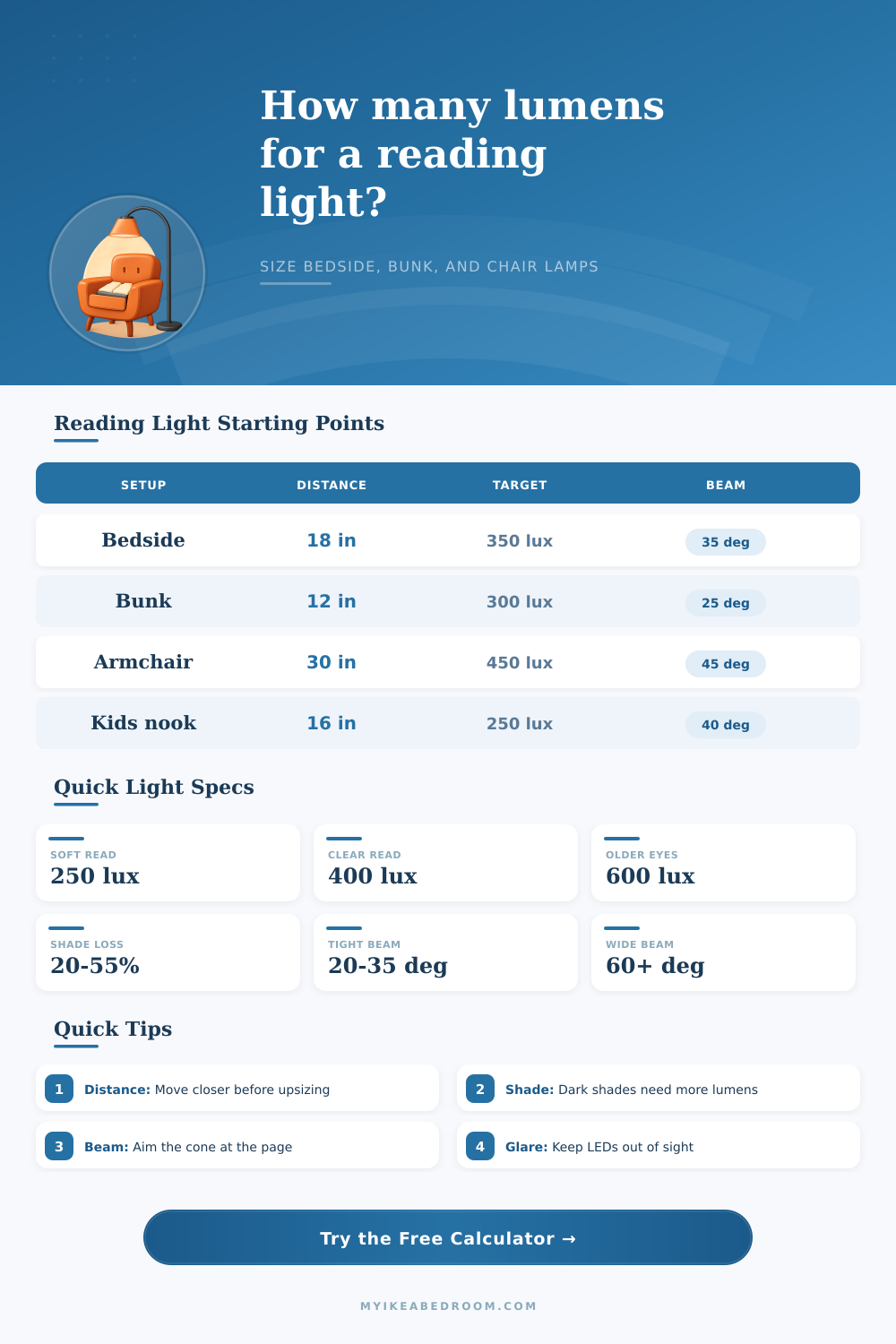
Bedside, bunk, and reading chair light planner
Reading Light Lumens Calculator
Estimate target page lux, lumens reaching the page, beam footprint, contrast score, glare risk, and required fixture lumens for sconces, clip-on lights, wall lamps, nightstand lamps, and floor lamps.
A smaller beam or shorter distance can raise page lux without installing a brighter bulb. The glare score checks whether that concentration is likely to feel harsh.
| Reader and print | Starting target | Vision factor | Typical use |
|---|---|---|---|
| Young reader, easy print | 220 to 300 lux | 0.9x | Kids books, large print, short sessions. |
| Adult, normal print | 300 to 450 lux | 1.0x | Most paperback and hardcover reading. |
| 40+ or smaller print | 400 to 600 lux | 1.18x | Compact novels, notes, study pages. |
| 60+ or tired eyes | 550 to 800 lux | 1.45x | Long sessions and lower contrast paper. |
| Low vision support | 750 to 1200 lux | 1.8x | High contrast reading with careful glare control. |
| Page preset | Approx size | Area | Calculator note |
|---|---|---|---|
| Paperback novel | 5.5 × 8.2 in | 0.029 m² | Common bedtime reading page. |
| Hardcover book | 6.4 × 9.4 in | 0.039 m² | Needs slightly wider coverage. |
| Magazine or workbook | 8.5 × 11 in | 0.060 m² | Wide beam or more lumens helps. |
| Tablet or e-reader | 5.3 × 7.8 in | 0.027 m² | Lower paper reflectance may not apply. |
| Kids picture book | 8 × 10 in | 0.052 m² | Broader page with lower target lux. |
| Beam angle | Reading behavior | Best distance | Glare note |
|---|---|---|---|
| 15 to 25 degrees | Spot beam, high page lux | 10 to 18 in | Can feel harsh if pointed at eyes. |
| 30 to 45 degrees | Focused reading cone | 14 to 28 in | Best balance for bedside sconces. |
| 50 to 70 degrees | Soft task spread | 18 to 34 in | Needs more lumens but less hotspot. |
| 80+ degrees | Roomy ambient wash | Close pages only | Good comfort, weaker page contrast. |
| Mounting style | Typical height | Distance issue | Planning check |
|---|---|---|---|
| Clip-on bunk light | 6 to 12 in above page | Very short reach | Use low lumens and shield the LED. |
| Headboard or wall lamp | 14 to 24 in above page | Moderate diagonal distance | Aim below eye level and across the page. |
| Nightstand lamp | 16 to 28 in above page | Shade loss is common | Raise or angle the shade toward the book. |
| Floor reading lamp | 28 to 48 in above page | Longer throw | Needs a stronger bulb or narrower head. |
When you buy a lamp, there’s nothing more frustrating than discovering that something doesn’t seem quite right. Maybe you’re using a dim bulb, so you upgrade to a brighter one, but even then, after twenty minutes under the lamp, your eyes starts straining. Wattage isn’t everything; neither are lumens. Raw numbers don’t matter. What matters is how much light hit your page. It also matters where that light ends up when it hits shade or when some of it scatters in the air.
With the calculator, you feed it some information about your set-up, and it crunches hard math for you. No need to guess at coefficients, letting you focus on comfort.
How to Choose the Right Light for Your Eyes
Light gets very weak over distance. Twice the distance means one-fourth the light, because light diffuses into space. That means that a lamp on the floor six feet away has to be many times brighter than clip-on reading light 12 inches from your page. People usually purchase their lamp by total lumens without thinking about geometry of the room, which can eat up a good chunk of those lumens before they ever touch the paper. Before purchasing a higher-lumen bulb, scoot your seat more nearer the book. Often that solves it. It requires less effort, creates less glare for everyone else in the room and uses less electricity.
There is less available light because shades block some of it. A nice-looking cotton or linen shade soaks up light like a sponge. Even thicker shades, or darker ones, can blocks half the light before it escapes lamp. The tool figures in this loss to light transmission. It displays how much more light you’re buying (and overpaying for) with a clear task head compared too one covered with a decorative shade trapping most of the light. Instead of lighting your book, you’re heating up interior of the lamp.
The rest of the light depends on beam angle. Narrow beams make a tight little circle of high-intensity, good for highlighting your text. Soften the beam to wide, and everything’s more diffused but also less bright on page. That’s what people with older eyes or who want to read smaller print require: that concentration. How much do you need? The reference table show the target lux by age and print size. Is it time for a soft mood light, or is it a spotlight you want?
Even with enough light, glare makes it hard to relax. If you have a lamp where all you see is naked LED chip in your face, you’re going to hate it. It is fighting against itself. Your eyes try to adapt to the brightness but no matter how easy the words look on the screen, it still tires your eye. A good reading light either aims the light down or shields source from view, so you are seeing the light reflected off the page, not directly into your retina. Out of sight, out of mind, keep those LEDs away from your line of sight and let the page reflect the light.
Beyond most people’s expectations, as they get older, their lighting requirements rises. Pupils narrow and lenses turn yellow, so what used to need three hundred lux may now require six hundred. And it isn’t vanity, this is biology. To fit that, the calculator takes into consideration a vision factor. That way, the default recommendation doesn’t take into account your unique eyesight, and you’re not pulling at the strain of poor lighting.
To be cozy, the light must be clear but not spill over too much, enough light to read by without reading a book in the dark. You should of used a directed beam of light that is good for your eyes and environment. Adjusting distance, adjusting the shade, making sure it’s transparent enough… respect the angle of the light beam and you’ve got yourself a tool for comfort. Less eye strain.
You will trust the brightness number on the package less and understand what it realy means more.