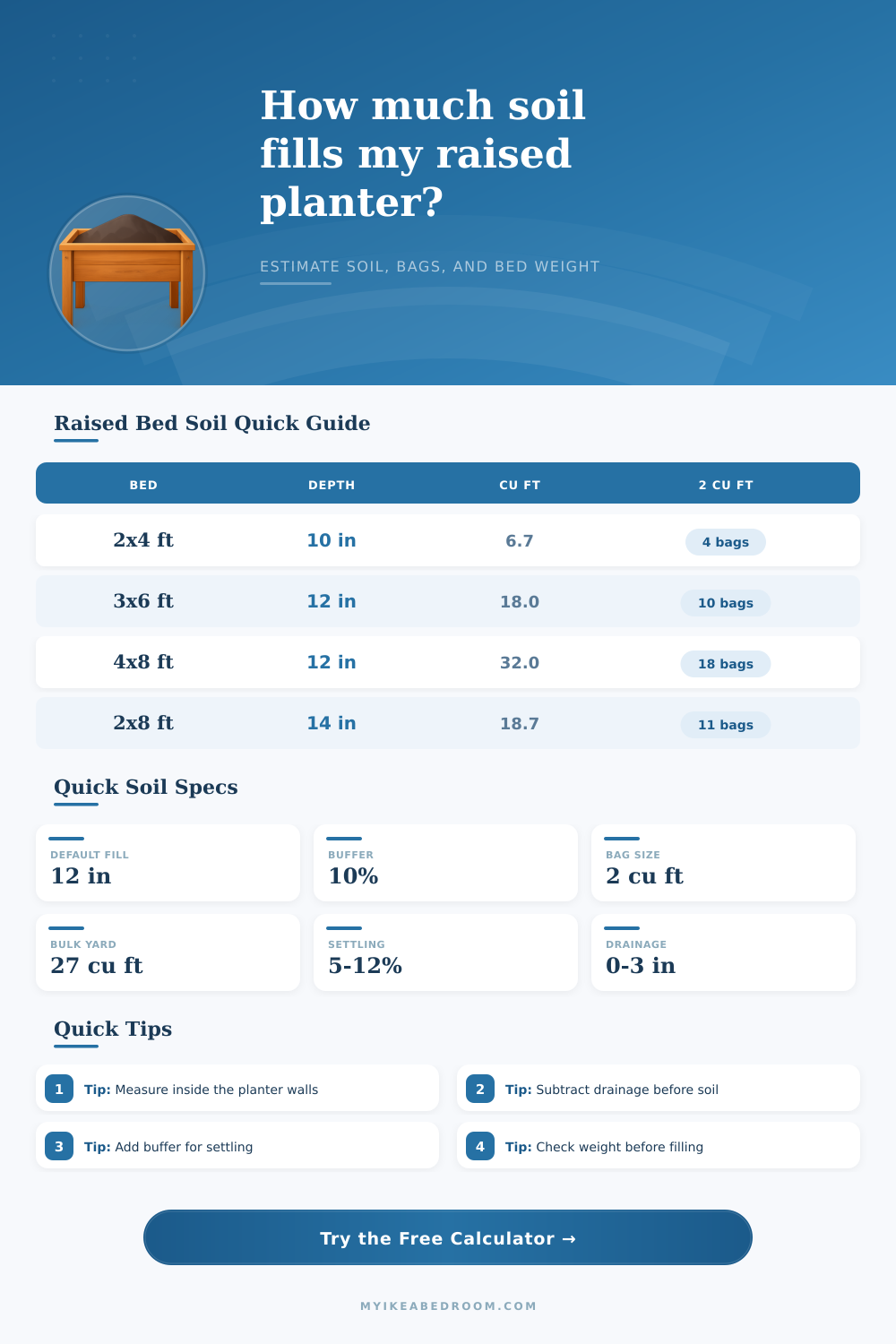
Soil Quantity for Raised Planter Box Calculator
Estimate raised planter soil volume, drainage displacement, settling buffer, bag counts, bulk cubic yards, and filled bed weight from the dimensions inside your planter box.
Start with a common planter box size, then adjust the inside dimensions, fill depth, drainage layer, soil blend, bag size, and settling buffer.
| Soil depth | Sq ft per cu yd | Sq ft per 2 cu ft bag | Metric depth |
|---|---|---|---|
| 6 inches | 54 sq ft | 4.0 sq ft | 15.2 cm |
| 8 inches | 40.5 sq ft | 3.0 sq ft | 20.3 cm |
| 10 inches | 32.4 sq ft | 2.4 sq ft | 25.4 cm |
| 12 inches | 27 sq ft | 2.0 sq ft | 30.5 cm |
| 18 inches | 18 sq ft | 1.3 sq ft | 45.7 cm |
| Container | Volume | Bags per yard | 12 in coverage |
|---|---|---|---|
| Small bag | 1 cu ft | 27 bags | 1 sq ft |
| Medium bag | 1.5 cu ft | 18 bags | 1.5 sq ft |
| Large bag | 2 cu ft | 13.5 bags | 2 sq ft |
| Jumbo bag | 3 cu ft | 9 bags | 3 sq ft |
| Bulk yard | 27 cu ft | 1 yard | 27 sq ft |
| Planter | Inside area | 12 in soil | 2 cu ft bags plus 10% |
|---|---|---|---|
| 2 x 4 ft herb box | 8 sq ft | 8 cu ft | 5 bags |
| 3 x 6 ft vegetable bed | 18 sq ft | 18 cu ft | 10 bags |
| 4 x 4 ft square bed | 16 sq ft | 16 cu ft | 9 bags |
| 4 x 8 ft raised bed | 32 sq ft | 32 cu ft | 18 bags |
| 2 x 8 ft narrow bed | 16 sq ft | 16 cu ft | 9 bags |
| Mix type | Typical lb/cu yd | Settling | Best use |
|---|---|---|---|
| Light potting mix | 450-650 | Low | Deck boxes |
| Raised bed mix | 750-950 | Medium | Vegetables |
| Compost blend | 850-1150 | Medium-high | Food beds |
| Screened topsoil | 1200-1700 | High | Ground beds |
| Sandy herb mix | 1000-1350 | Medium | Dry herbs |
Raised planter boards, liners, and corner posts can shrink the fill area enough to change the bag count, especially on narrow balcony boxes.
If a planter has a false bottom, reservoir, gravel layer, or wood-core filler, subtract that layer before estimating the actual soil volume.
Bagged soil is sold by loose volume, and fresh fills settle after watering. A 5% to 15% buffer keeps the finished surface closer to the planned depth.
Wet soil, planter walls, water reservoirs, and mature plants all add weight. Use the filled weight estimate as a planning checkpoint before loading elevated areas.
Calculating the amount of soil that is needed for a raised planter box is a necesary task before adding plants to the boxes. The amount of soil that the user will use determine whether the plants will grow good in the boxes or if they will struggle to grow. If there is too little soil, the roots of the plants will either hit the bottom of the boxes or the roots will dry out quick.
If there is too much soil, the boxes may be too heavy for decks or balconies. One way to calculate the amount of soil that will be needed for an planter box is to utilize a soil calculator. Soil calculators is available online and can assist with the calculation of soil needs for raised boxes.
How to figure out how much soil you need for a raised planter box
To use the soil calculator, the individual must first measure the inside dimension of the boxes. Many boxes contain measurements of the outside of the boxes. Using these outside measurements will lead to ordering too much soil for the boxes.
The area that must be measured are the open areas of the planter boxes, as these are the areas in which the soil will grow. The soil calculator can convert this area into volume of soil, which is the measurement that the individual will use for soil ordering. In addition to calculating the area of the boxes for soil volume, the individual should deduct the depth of drainage layers for the boxes from the total depth of the planter box.
Soil drainage layers use space within the boxes for roots to drain excess water. These plans use space that would otherwise be used for soil. Therefore, the individual can deduct the depth of drainage layers from the total depth to determine how much soil will be needed.
In some cases, the boxes may already contain some soil. In these instances, the individual should enter the volume of the existing soil into the soil calculator so that the tool can calculate the amount of soil that is still needed to fill the boxes to the desired depth. There are different type of soil that may be used within the boxes.
Soil mixes contain different amounts of compost, for instance. Soil mixes that is rich in compost will hold more water within the soil. Soil mixes that are rich in compost will also weigh more when wetted with water.
Most soil calculators allow individuals to select the type soil that will be used within the boxes; the calculator will use the density of each type of soil to calculate the total weight that the raised garden will use. The weight of the soil that is calculated is another important measurement because the balcony (or structure) on which the boxes will sit may have a weight limitation. In addition to the measurements of the raised boxes, the settling of the soil is another factor that should be considered prior to soil ordering.
Soil settling is a process in which the soil compresses after watering. Deep boxes may experience soil that settles by more than ten percent. This settling of soil can be accounted for within the soil calculator.
By accounting for soil settling within the soil calculator, the individual wont have to add soil later to the boxes after the soil has settled to the point of no longer being filled to the rim of the boxes. Soil calculators allow individuals to set a percentage for soil settling in relation to the depth of the boxes. The volume of the soil will determine the number of bags of soil that will be needed to completely fill the boxes.
The individual should round the number of bags up to the nearest whole number to ensure that there is enough soil for the boxes. Bulk soil comes in cubic yard measurements. The soil calculator allows the individual to compare the cubic yard of bulk soil to the number of bags of soil that are needed.
The weight of the soil is another critical measurement for determining how many bags of soil should be ordered. The weight of the soil when wet is greater than the weight of the dry soil. The deeper the boxes are, the more the weight of the wet soil will be.
The amount of compost within the soil will also impact the weight of the soil. The soil calculator will calculate the total weight of the soil within the boxes. It will be up to the individual to ensure that the calculated weight of the soil and boxes does not exceed the capacity of the structure upon which the boxes will sit.
Even if the boxes will remain on the ground, the individual will need to calculate the weight of the soil so that the individual is aware of how much soil will be needed to order for the raised boxes. Through using the soil calculator and accounting for the inside measurements of the boxes, the depth of drainage layers within the boxes, and providing a buffer for soil settling, individuals can ensure that the soil that will be ordered will be the amount of soil that will be contained within the boxes. These three measurement will ensure that the amount of soil that is calculated will be the amount of soil that will be able to be contained within the boxes.
By entering these three measurements into the soil calculator, the soil calculator will indicate the amount of soil that should of been ordered for the planter boxes.