Charm Pack Quilt Calculator
Plan a charm pack quilt from 5-inch squares with rows, columns, finished top size, sashing, borders, backing yardage, binding strips, spare squares, and pack count in one worksheet.
Choose a common charm-square project, then adjust the square size, seam allowance, borders, sashing, backing width, binding width, and spare-square allowance.
| Cut square | Seam allowance | Finished unit | Planning note |
|---|---|---|---|
| 5 in charm | 1/4 in each side | 4.5 in | Standard charm-pack quilt math. |
| 5 in charm | 3/8 in each side | 4.25 in | Useful for bulky flannel seams. |
| 2.5 in mini charm | 1/4 in each side | 2 in | Best for small projects and borders. |
| 10 in layer square | 1/4 in each side | 9.5 in | Use the same formulas at larger scale. |
| Finished top goal | Plain 4.5 in grid | Base squares | Typical packs |
|---|---|---|---|
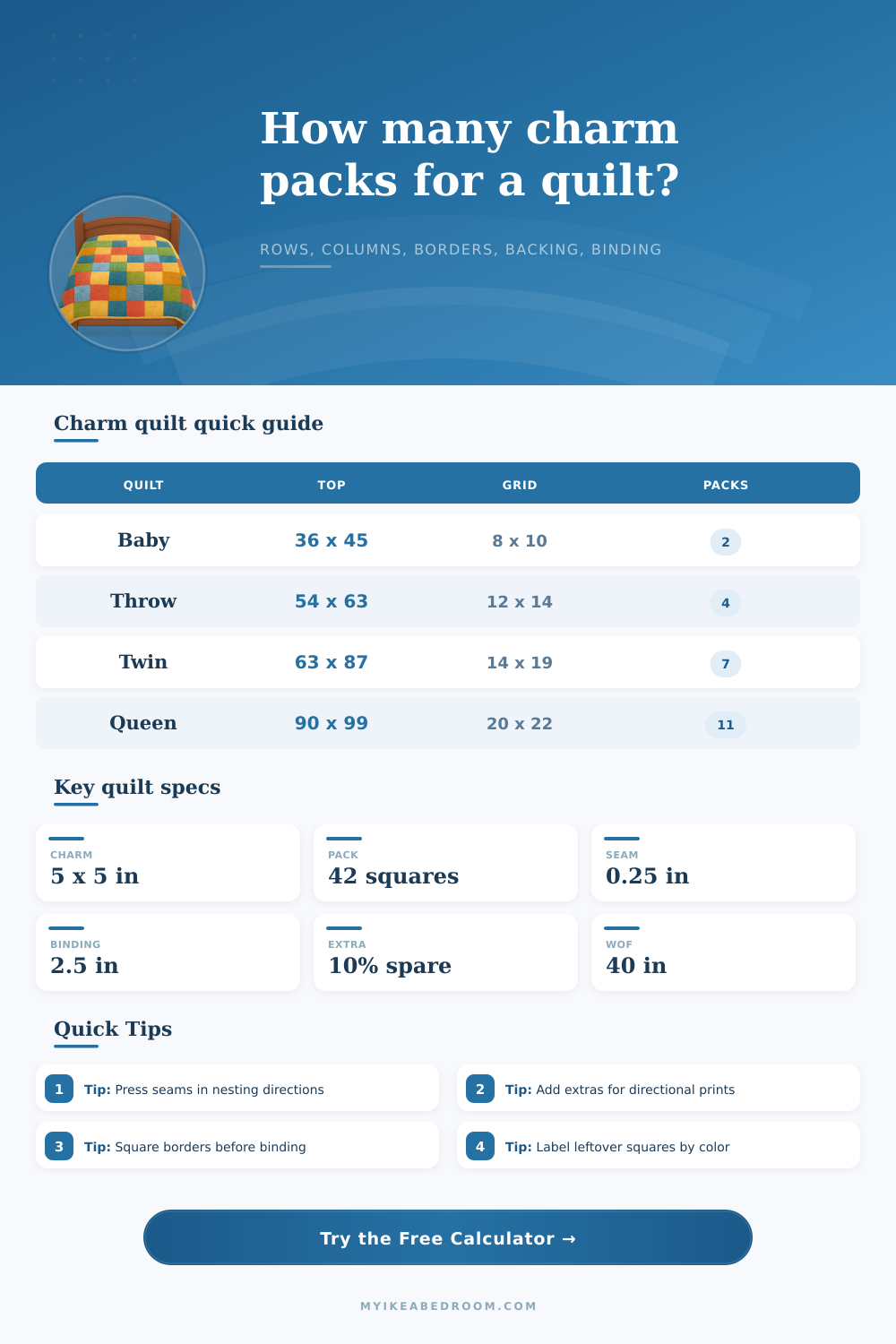
| 36 x 45 in baby quilt | 8 columns x 10 rows | 80 squares | 2 packs, little spare |
| 45 x 54 in lap quilt | 10 columns x 12 rows | 120 squares | 3 packs, modest spare |
| 54 x 63 in throw quilt | 12 columns x 14 rows | 168 squares | 4 packs, exact with 42s |
| 63 x 87 in twin quilt | 14 columns x 19 rows | 266 squares | 7 packs with extras |
| 90 x 99 in queen quilt | 20 columns x 22 rows | 440 squares | 11 packs with extras |
| Fabric choice | Usable width | When it works | Calculator treatment |
|---|---|---|---|
| Quilting cotton | 40 to 44 in | Small quilts or pieced backs | Calculates multiple backing panels. |
| Wide backing | 90 in | Throws, twins, many full quilts | Often one backing width for throws. |
| Extra-wide backing | 108 to 118 in | Queen and king backs | Reduces seams in large quilts. |
| Binding strips | 40 in WOF | Most double-fold binding | Adds 12 in joining and corner allowance. |
After calculating, these cards compare the square plan, backing plan, border fabric, and binding plan for the current quilt.
Awaiting input
Calculate to compare packs and leftovers.
Awaiting input
Calculate to compare grid and borders.
Awaiting input
Calculate to compare panels and yardage.
Awaiting input
Calculate to compare strip count.
Tip 1: If the charm pack has a few repeated prints, use the spare-square allowance for color balancing instead of planning an exact no-leftover grid.
Tip 2: For directional fabric, lay out rows before sewing and rotate squares intentionally. The calculator can add extra squares for orientation mistakes and trimming.
Quilt planners who use charm packs has a different process than those who plan for cutting they own squares of fabric. Charm packs arrive in bundles of five-inch squares of fabric. Many choose to use charm packs because they provide a color-coordinated stories for the quilt top.
However, the math behind creating a quilt from charm packs can be challenging for some quilters. The finished size of a quilt will often be more different from the initial measurements of the charm packs due to borders and seam allowances. A quilt calculator software can help you to avoid such error in the finished quilt.
How to Use a Quilt Calculator for Charm Packs
A quilt calculator will take your desired dimension of your quilt and the dimensions of your charm packs to create a plan for your quilt that includes the number of rows, columns, borders, and the amount of fabric needed for the binding of the quilt. Each input field in the calculator software will have specific measurement for the characteristics of your quilt. The target width and length of the quilt will be the final size that your quilt reach after you sew on the border.
The size of the charm squares will be the size of the squares within the charm packs, typically five inch. Seam allowances will determine how many charm pack squares will fit into your quilt top according to the size of your quilt. You will also enter the sashing and border widths into the software, and they will be the finished measurements of these elements of your quilt.
The spare-square percentage will allow you to purchase extra fabric to account for any cutting mistake or fussy cutting of the fabric of your quilt. The backing measurements will allow you to determine the width of the backing fabric that you will need to purchase for your quilt top, and the overhang measurements will allow you to determine how much extra fabric you will need if you plan to use longarm quilting services. Quilt calculator software will provide you with several differently outputs of your quilt plan.
Each output will provide you with further information regarding your project. The grid layout will provide you with the number of charm squares that you will need for each row and each column of your quilt. This can help you to determine how many charm pack you will need to purchase.
The output that measures backing and binding will allow you to determine how much total yardage of fabric you will need to purchase for your quilt. The washed-size estimate will allow you to determine the size of the quilt after it is washed. Fabric often shrink after it is washed, so this allows you to plan for that and ensure that your quilt will still fit the bed or lap upon which you will lay it to sleep.
These different outputs of quilt calculator software will allow you to create a complete list of the fabric that you will need to purchase for your quilt. Often, the number of squares that you need for a quilt can quickly reach hundreds of squares if you plan on including sashing and borders around your quilt. This is why the spare-square percentage is an important setting within the software.
Using this percentage will provide you with extra fabric to account for directional prints of the fabric or to test the arrangement of your fabric squares on a design wall prior to sewing your quilt. Using a higher spare square percentage will provide you with more fabric than you need. However, if you would like to use less fabric than your quilt design require, you can lower this percentage.
However, if you do, you risk becoming out of fabric prior to completing your quilt. The choices for the backing for your quilt will also have an effect on how the quilt will be constructed. If the backing is narrow, you will have to purchase additional pieces of backing fabric to sew together into your quilt.
However, if the backing is wide enough of a fabric width, you will only need to purchase a single piece of backing. The overhang of your quilt will allow you to specify how much extra fabric you would like for basting the quilt or for longarm quilt services. The binding for your quilt will have to be long enough to cover the perimeter of the quilt top.
The yardage for the binding will also include extra length for the corners and to join the binding strips together. The binding yardage will only be accurate if you enter the width of your quilt and if you specify that you would like your binding to be cut on the straight grain of the fabric. The layout for the quilt is another variable that you will need to decide before you cut your squares of charm pack fabric.
One of the most efficient method of layout is the straight-set grid layout. This allows your squares to sit within a grid fashion. However, an offset layout or an on-point layout can make your quilt appear to be much larger.
The calculator will include a cushion within these layouts for the triangles that you will cut to make your desired layout. However, the arithmetic within the program will ensure that you do not end up with a lack of fabric after cutting these triangles according to your chosen layout. Finally, there are a few common mistakes that will occur if you do not take the time to read the specifications of the quilt calculator.
For example, one common mistake will be to accidentally add too much fabric to your quilt because you may not remember to account for seam allowances when you sew your quilt. Additionally, you may also run out of fabric if you do not account for the need for extra fabric for directional prints within your charm packs. However, you can easily avoid these mistakes if you use the calculator to review your desired number of squares and yardage requirement for your quilt at the same time.
Finally, within the quilt calculator software, there are reference tables that will help you to make your decisions for your quilt design. These reference tables will allow you to see how the size of your quilt will change with a change in the width of the seam allowance. You can also use these tables to see the common sizes of quilts and how many squares of charm pack fabric is required to create those sizes.
These tables can help ensure that you have a realistic plan for your quilt. Furthermore, they will provide you with insight into the reason that some sizes of quilts are common in quilting designs. Using charm packs is convenient for quilters because they come with a coordinated color story.
However, the convenience of charm packs is only helpful if the quilt that you end up with reaches the dimension that you desire for your quilt. Thus, using a quilt calculator will ensure that your measurements at the end of the quilting process match your original vision for your quilt.