Quilt Sashing Calculator
Estimate sashing strip counts, cornerstone squares, border strips, finished quilt size, yardage, binding length, backing size, and strip cutting from your block layout and seam allowance.
Choose a close starting layout, then adjust block count, block size, sashing, borders, fabric width, and waste allowance.
| Grid style | Vertical strip pieces | Horizontal strip pieces | Cornerstone count |
|---|---|---|---|
| Full block-by-block sashing | (columns - 1) x rows | (rows - 1) x columns | (columns - 1) x (rows - 1) |
| Vertical sashing only | (columns - 1) x rows | 0 | 0 |
| Horizontal sashing only | 0 | (rows - 1) x columns | 0 |
| Long row sashing | 0 | rows - 1 full-width rows | 0 |
| Finished sash | Cut strip width | Best visual use | Cornerstone cut |
|---|---|---|---|
| 1 in | 1.5 in | Mini quilts and small blocks | 1.5 x 1.5 in |
| 1.5 in | 2 in | Charm squares and row quilts | 2 x 2 in |
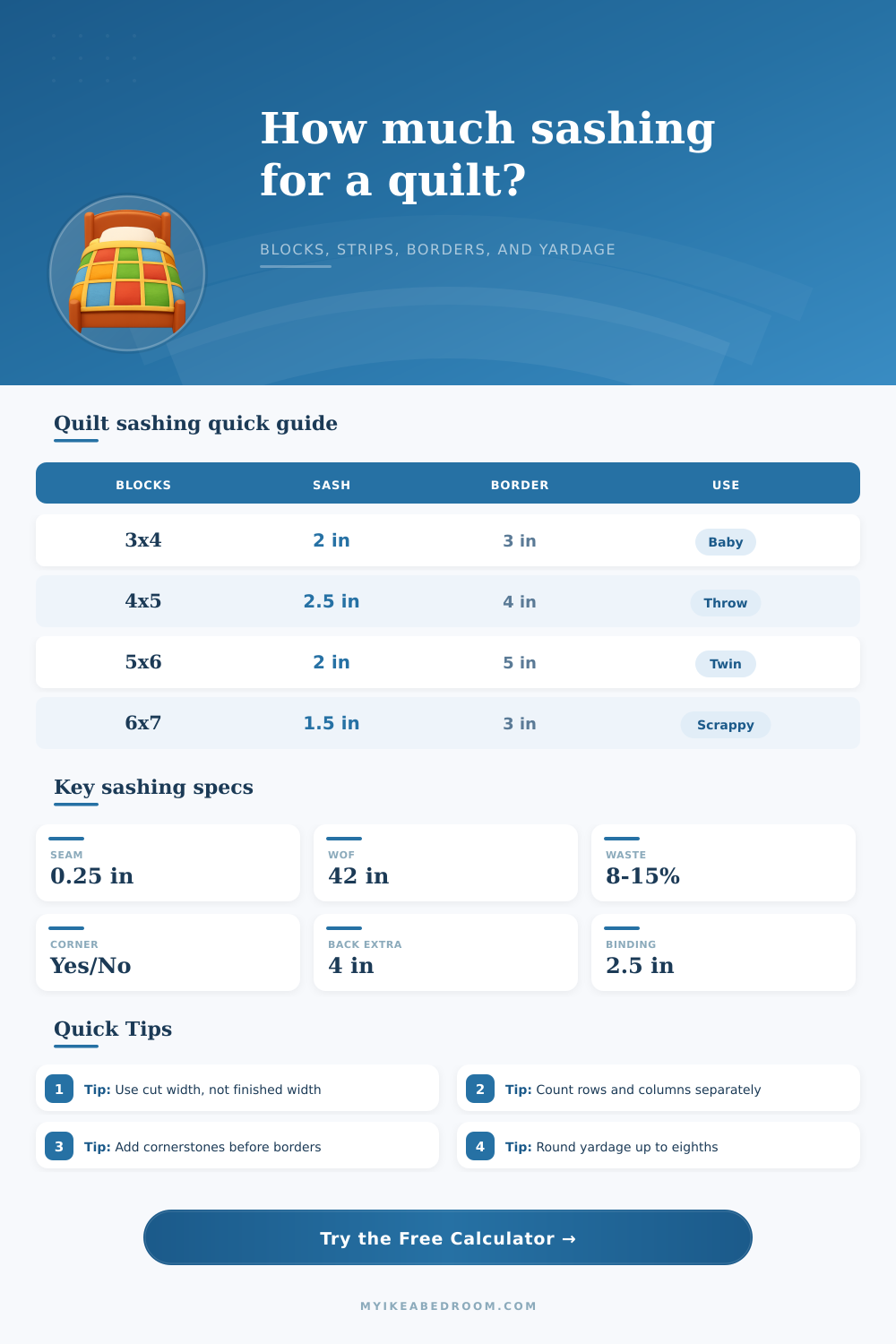
| 2 in | 2.5 in | Sampler quilts and throws | 2.5 x 2.5 in |
| 3 in | 3.5 in | T-shirt quilts and bold blocks | 3.5 x 3.5 in |
| Project | Common grid | Block size | Finished range with sash |
|---|---|---|---|
| Baby quilt | 3 x 4 or 4 x 4 | 8 to 10 in | 34 x 44 to 48 x 48 in |
| Throw quilt | 4 x 5 or 5 x 6 | 10 to 12 in | 50 x 62 to 68 x 80 in |
| Twin quilt | 5 x 7 or 6 x 8 | 10 to 12 in | 64 x 88 to 82 x 104 in |
| Queen top | 6 x 7 or 7 x 8 | 12 to 14 in | 88 x 102 to 116 x 132 in |
| Planning item | Formula | Metric equivalent | Rounding note |
|---|---|---|---|
| Sashing yardage | Cut area divided by usable WOF | 1 yard = 0.9144 m | Round up to nearest 1/8 yard |
| Strip count | Total cut length divided by WOF | 42 in = 106.7 cm | Round up to a whole strip |
| Backing size | Quilt size plus overhang both sides | 4 in = 10.2 cm | Add more for longarm quilting |
| Binding length | Perimeter plus 12 in joining tail | 12 in = 30.5 cm | Round strips up, never down |
Use: every block is framed.
Best for sampler blocks that need visual separation and consistent spacing.
Use: column separation.
Good when rows already have pieced separators or directional block rows.
Use: row separation.
Works for row quilts, strip quilts, and blocks that touch well side by side.
Use: crisp intersections.
Corner squares reduce long seam matching and add a planned accent rhythm.
Cut width includes seam allowance. A 2 inch finished sash with quarter-inch seams should be cut 2.5 inches wide, so the calculator separates finished width from rotary-cut width.
Plan row assembly before cutting. Full grids use short vertical and horizontal pieces, while long row sashing can use fewer seams but needs longer joined strips.
Quilt sashing is a strip of fabrics that is place between the quilt blocks to separate each of the blocks from one another. If there is no quilt sashing, an individual’s eyes will quickly move from one block to the next block within the quilt top, and the quilt will appear crowded due to the lack of space between the blocks. If there is quilt sashing include in the quilt top, though, the quilt sashing will provide space for each of the blocks, as well as create the illusion of a quilt top that is of a larger size than the individual blocks suggests.
The width of the sashing strips that will be use within a quilt must be determine before any fabric is cut. If the strips are narrow, they will allow for the individual blocks to become the focus of the quilt. If, however, the strips are wide, they may even change the balance of the quilt as created by each of the individual blocks.
How to Measure Sashing and Borders for a Quilt
Wide strips may allow for busy blocks to be view as one large block, but narrow strips may even make simple blocks appear formal. Thus, prior to cutting any strips of sashing fabric, an individual must decide the purpose for which the sashing will be use within the quilt. Within the calculation of the width of the quilt sashing, there is one particular measurement that is use: the seam allowance.
The finished width of the sashing strips will not be the same as the width of the strips of fabric that will be cut. The seam allowance will be one-quarter of an inch in width, and you will add it to each side of the sashing strips. Thus, the cut strips of sashing fabric will need to be wider than the finished width of the sashing.
Furthermore, this allowance will impact the yardage of fabric that will be purchase for the quilt; any errors in width measurement will have a corresponding impact on the total yardage of fabric that is required. Within the quilt, there are also small square of fabric that are add to the intersection at which each of the sashing strips meet. These squares of fabric are referred to as cornerstones.
The addition of cornerstones will break up the long seam of the quilt top, and allows for a third type of fabric to be use within the quilt top. While many people choose to use cornerstones within their quilts, others choose to omit these strips of fabric altogether in order to maintain the simplicity of the quilt design. Thus, individuals should always consider the use of cornerstones, since the fabric for these cornerstones cannot be use for the sashing strips.
Borders are strip of fabric that are attach to the edge of the quilt top. The same logic that governs the placement of sashing within the quilt also apply to the addition of borders to the quilts top layer. Each border can finish one edge of the quilt, or several border may be used to create a frame around the quilt.
Furthermore, the width of the outer border may differ from the width of the border strip once the strip is attach to the quilt’s top layer. Thus, individuals may wish to test the border strip against the quilt top prior to purchasing the required amount of fabric for the borders. In addition to the top layer of a quilt, there are two other component to a quilt: the backing and the binding.
The backing for the quilt must be large enough to cover the quilt top, and the binding for the quilt must be of a length that ensure that it will cover the top layer of the quilt, as well as any additional border that may be add to the quilt’s top layer. Thus, these two component of a quilt also rely upon the size of the top of the quilt. Consequently, the backing and binding also rely upon the sashing and the borders of the quilt.
Between the various component of a quilt, it is necessary to perform a few specific measurement prior to employing a calculator to determine the amount of fabric that will be require for the quilt. The grid of the blocks, the size of each of the blocks, the allowance of the seams, as well as the whether the sashing strips will be cut crosswise or lengthwise must be determine prior to the calculation process. Once these measurement have been gather, though, the calculations will be straightforward, and the calculator can assist the individual in performing these calculation.
In determining how much fabric will be require for the quilt, an allowance for error will be made. Some fabric will fray in ways that other fabric, as well as some cutting of the fabric strip will leave behind small strip of fabric that cannot be utilize for sashing. Thus, an allowance for error in the cutting and fraying of the sashing strips will be made in the purchase of the fabric for the quilt.
The allowance is made necessary because the fabric will behave differently on the cutting mat than it will when the quilt is assemble from the various component. There are some common mistake that many individuals tend to make when sewing quilts. One mistake is the use of both finished and cut measurement.
Another mistake is the forgetting to account for the fabric that will be use for cornerstones or borders. Another potential mistake is the assumption that all strip of sashing can be cut from a width of fabric; wider quilts may require join for the sashing strips of fabric. Thus, individuals should account for these potential mistake at the initial planning stage for the quilt.
Another element of quilting is the size of each of the blocks to the width of the sashing. Small block may become too small within the quilt if wide sashing is use, as may large block with narrow sashing. Thus, prior to sewing the block of fabric together, the sashing should be test against the quilt block to determine whether they will be too wide or too narrow relative to the individual block.
This test will save individual from wasting the fabric that would of be require to create the sashing. Finally, quilt sashing is a matter of proportion. The proportion of the sashing strips will be base upon the block of the quilt and the space that each of those block require within the quilt.
Thus, once the proportion of sashing are determine, the calculator will indicate the amount of fabric that will be require to create those strip. Using the correct proportion will make for the easiest math for the individual creating the quilt, but incorrect proportion will require increased amount of fabric of the same type to fix the error in the sashing strips. Thus, the calculator removes the math from the individual, and allow the individual to focus upon the design of the quilt altogether.