Quilt Fabric Yardage Calculator
Estimate quilt top yardage, backing yardage, binding strips, border fabric, block count, and cut pieces from finished quilt dimensions, fabric width, seam allowance, shrinkage, pattern repeat, and piecing complexity.
Start with a common quilt format, then adjust fabric width, borders, seam allowance, backing overage, shrinkage, repeat, and piecing style for your actual plan.
Calculation breakdown
| Quilt type | Typical finished size | Common block size | Backing overage |
|---|---|---|---|
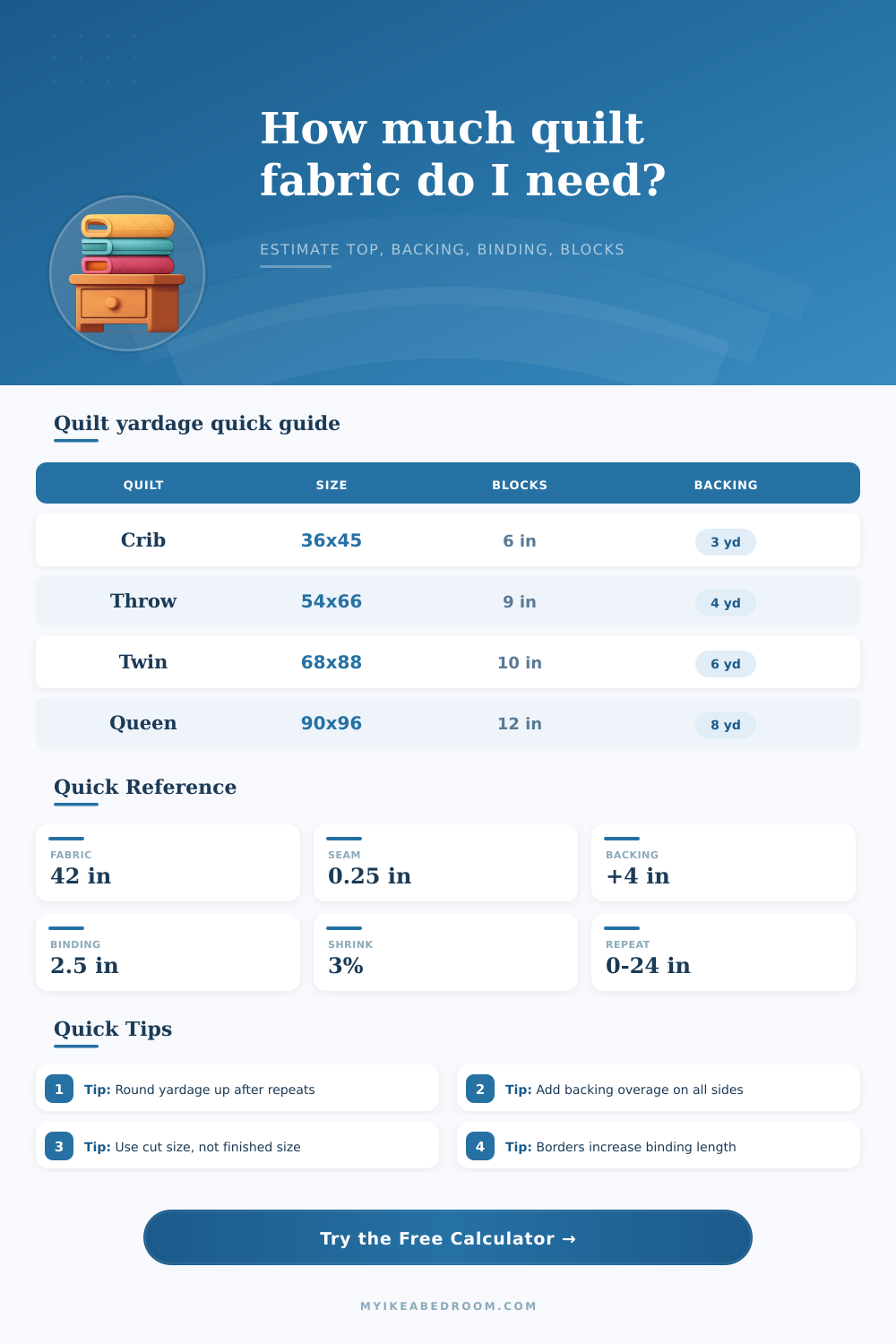
| Crib quilt | 36 in × 45 in | 6 in or 9 in | 3 in to 4 in per side |
| Throw quilt | 54 in × 66 in | 9 in or 11 in | 4 in per side |
| Twin bed quilt | 68 in × 88 in | 8 in to 12 in | 4 in to 6 in per side |
| Queen quilt | 90 in × 96 in | 10 in to 12 in | 6 in per side |
| King quilt | 108 in × 108 in | 12 in to 18 in | 6 in to 8 in per side |
| Piecing style | Piece count per block | Top allowance | Best use |
|---|---|---|---|
| Whole cloth or large panels | 1 piece | 1.02x area | Panel quilts, strip quilts, fast backs |
| Simple block quilt | 1 to 2 pieces | 1.08x area | Squares, rectangles, simple blocks |
| Four patch blocks | 4 pieces | 1.14x area | Classic patchwork and checker layouts |
| Nine patch blocks | 9 pieces | 1.20x area | Small squares and grid-based blocks |
| Sampler or scrappy quilt | 12 to 16 pieces | 1.28x to 1.36x | Mixed blocks, triangles, narrow cuts |
| Fabric width | Usual purpose | Yardage behavior | Layout note |
|---|---|---|---|
| 40 in to 42 in | Quilt top cotton | More seams on wide projects | Use after trimming selvedges |
| 44 in to 45 in | Standard cotton bolts | Good for tops and borders | Enter usable width, not printed width |
| 54 in to 60 in | Home fabric and flannel | Can reduce panel joins | Check grain and shrinkage first |
| 90 in to 108 in | Wide quilt backing | Often uses one backing panel | Still add overage for quilting |
| Input | What it changes | Low setting | High setting |
|---|---|---|---|
| Shrinkage | Raises all fabric estimates | 0% for tested fabric | 5% to 8% for flannel |
| Pattern repeat | Rounds cut length upward | 0 in for solids | 12 in to 24 in prints |
| Border count | Adds top area and binding length | 0 for edge-to-edge blocks | 3 to 4 for medallion quilts |
| Backing overage | Expands backing panel size | 3 in per side | 6 in to 8 in per side |
Minimal top
Best for: whole cloth, panel quilts, or broad strip layouts.
Uses the least piecing allowance, so pattern repeat and shrinkage drive the result.
Patchwork top
Best for: squares, four patches, and nine patches.
More seams mean more cut edges, so the calculator raises the top fabric allowance.
Bordered quilt
Best for: framed centers, medallions, and size adjustments.
Each border increases top yardage, final quilt size, backing area, and binding length.
Wide backing
Best for: reducing backing seams on larger quilts.
Change fabric width to 90 in, 104 in, or 108 in to compare backing panels.
To estimate the yardages of fabric that will be needed to create a quilt, you must take a careful approach to the estimation process. It is possible that, once you cut the fabric for the quilt blocks, there wont be enough fabric to complete the quilt. If you dont account for various factors that may affect the yardage of fabric that is needed for a quilt, you will end up out of fabric before you are able to complete your projects.
One of the factors that you must consider in estimating the yardage of fabric is the complexity of each block of the quilt. Each time that you sew pieces of fabric together, there is a requirement for seam allowances. Seam allowances consumes some of the yardage of the fabric.
How Much Fabric You Need for a Quilt
Each time that you join two pieces of fabric together, there is a loss of a quarter inch of that fabric. Quilt blocks that have many separate pieces, such as four-patch and nine-patch blocks require a great deal of fabric to be lost to these seam allowances. To account for this lost fabric, you should of use a calculator or formula to account for the complexity of the quilt blocks in estimating the total yardage of fabric that are required.
Another factor to consider is the usable width of the fabric. Fabric come in bolts that have a selvedge along one edge of the fabric. The selvedge prevents the fabric from unraveling, but it isnt usable for quilting projects.
If you do not subtract the width of the selvedge from the total width of the bolt of fabric when calculating how much fabric is needed for a quilt, the resulting block will be too small. To account for this lost width of fabric, the quilter must use the usable width in calculating the yardage requirements of the quilt. Another consideration is the pattern repeats that are often found in many quilts.
If the pattern feature large floral motifs or directional stripes, there will be gaps in the fabric that is wasted when attempting to align those repeating patterns. These gaps in the fabric require additional yardage of fabric to be purchased in order to account for these lost portions of the fabric. If you do not account for the pattern when purchasing the fabric, the resulting quilt may have patterns that is upside down or located incorrect relative to the other patches of the quilt.
Another consideration that may factor into the calculation of the yardage of fabric that is required to create a quilt is the shrinkage of the fabric prior to use. Many quilters pre-wash quilts to account for shrinkage that will occur after the quilt is completed. However, pre-washing the fabric will cause the fabric to shrink.
For instance, flannel fabrics may shrink by as much as eight percent when pre-washed. If only the amount of fabric that is required to complete the quilt is purchased, but you pre-wash the fabric prior to quilting, there may not be enough fabric to complete the quilt. It is necessary, then, to purchase additional yardage to account for shrinkage.
Backing fabric will require additional yardage beyond the size of the quilt top. The backing fabric cannot be of the same size as the quilt top. During the quilting process, the backing fabric may shift relative to the quilt top.
If you do not increase the size of the backing fabric beyond the top of the quilt, the backing fabric may show around the edges of the quilt. In order to avoid this issue, the backing must have an overage of four to six inches in each of the side of the quilt top. This overage will ensure that the backing fabric will not shift during the quilting process.
The last factor in the computation of yardage of fabric includes the amount of fabric that will be used to create the binding of the quilt. The binding consist of long strips of fabric that are sewn along the perimeter of the quilt. If any borders are included to the quilt, the perimeter will be increased.
An increased perimeter will require additional binding of fabric to cover the increased perimeter of the quilt. It is necessary to account for binding fabric in the estimation of the total yardage of fabric that will be needed for a quilt. By accounting for each of these factors (seam allowances, usable width of fabric, pattern repeats, shrinkage, backing overage, and binding), it is possible to accurately calculate the yardage of fabric that will be required to create a quilt.
If the yardage is accurately calculate, there will be sufficient fabric to complete the project.