Trim planning and room retrofit
Quarter Round Calculator
Estimate quarter round footage, stick count, miter cuts, scarf joints, and profile coverage when you need to close flooring gaps around doors, corners, and uneven wall runs.
Quarter round trim are used to cover the gaps that exist between the floor and the baseboards. There is a variety of reason for which an individual may choose to use quarter round trim in there floors. For instance, such gaps may accumulate dust within the gaps, or the subfloor may be visible through the gaps when looking at the floor.
Thus, using quarter round trim help to cover those gaps and makes the room and its flooring appear finished. Prior to purchase of a quarter round trim is required to ensure that there is enough trim to complete the project. To determine an amount of quarter round trim that is necessary to complete a project, the individual must measure the entire path that the quarter round trim will take around the room.
How to Measure and Install Quarter Round Trim
The trim will follow the path of the floor around each corner. Thus, it is possible to ignore the length of the walls alone in measuring the amount of trim necessary. Instead, it is necessary to measure around each corner.
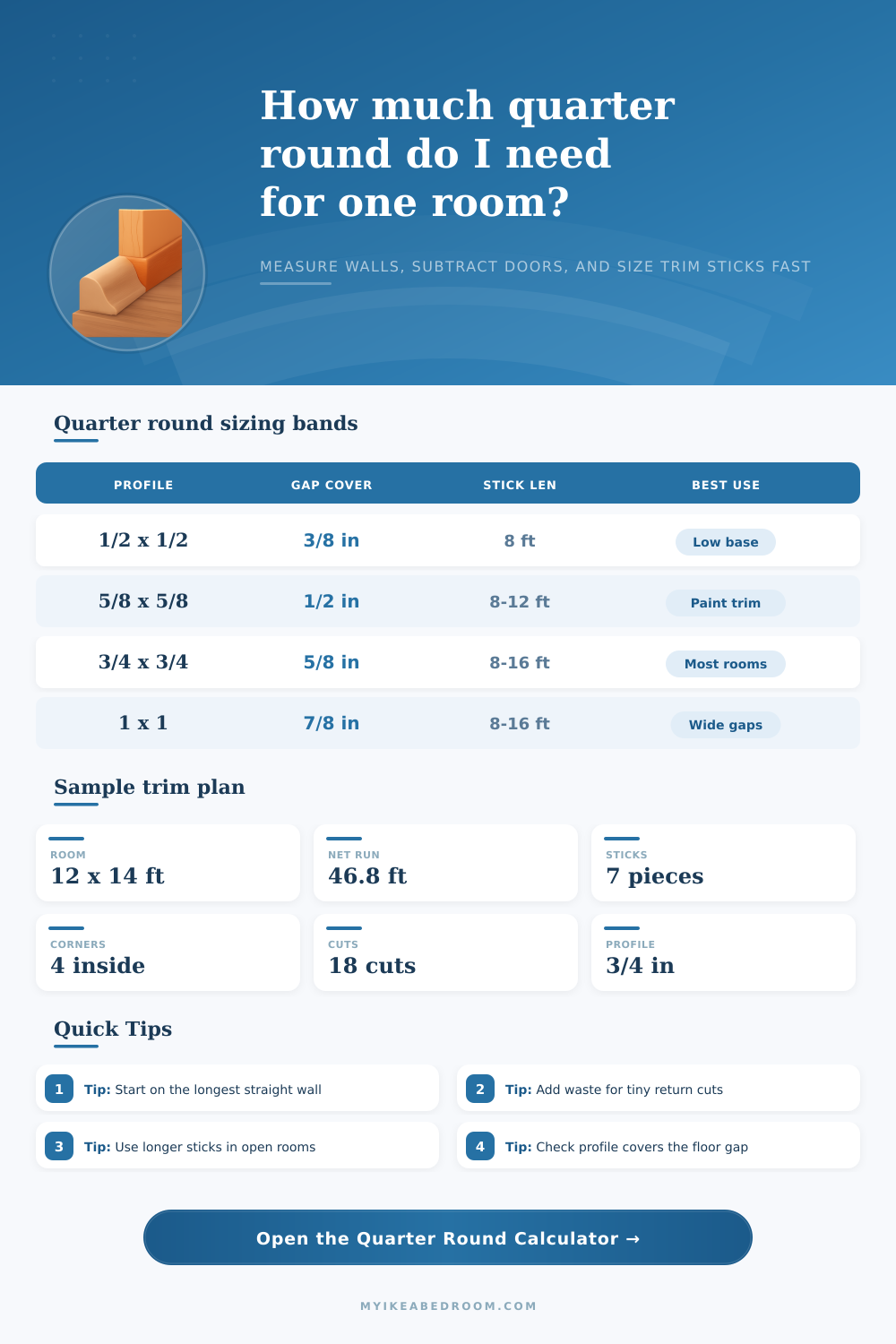
Any measurements of the width of the door casings should be subtracted from the total measurement to be taken, as the trim will not be install along those casings. Additionally, each corner will require an extra portion of trim to account for the miter cut that will be made at that corner; the amount of trim consume by these miters at each corner will add up to a quantity of trim that must be accounted for. The size of the quarter round trim must match the size of the gap in the floor.
For instance, 3/4-inch quarter round trim is often used along floating floors. Smaller quarter round trim may be used along baseboards that are relatively tightly in their measurements, while 1-inch quarter round trim may be used for floors that has settled with unevenness in their heights. The width of the face of the quarter round trim will determine how far the trim extend into the gap in the floor; the two dimensions must be matched in size to the gap to be properly fitted.
The materials of the quarter round trim may affect how well the trim perform within the environment in which it is to be installed. For instance, quarter round trim made of pine or MDF will allow the trim to be painted, but it may shrink if it become exposed to moisture in the environment. PVC trim is an option for bathrooms, for instance, because the PVC will not react to water that may splash on the trim.
Oak trim will provide an appearance of staining of the trim; however, the angles of the corners of the trim must be precise. The length of the sticks of trim that are to be purchased will impact the number of joint that must be created when installing the trim. Longer sticks of trim reduce the number of joints that must be created; eight-foot sticks are a common length of trim.
Allow for ten percent waste for any trim that may be need to accommodate for door returns or the trim that may be lost to miter cuts. When installing quarter round trim, it is recommended to begin with the longest straight wall in the room, and to install the trim towards closets or areas behind furniture that will hide any scarf joint. Prior to installing quarter round trim on the floor, it is recommended to test any miter cuts on scrap pieces of quarter round trim.
The curve on the quarter round trim can make the miter cuts look incorrectly when viewing the trim with the eye; thus, it is necessary to test these cuts. The quarter round trim should be glued to the floor, and it should be nailed every six inch along the length of the trim. After the trim is installed, caulk should be applied to the top edge of the trim, and the trim should be painted to blend in with the remainder of the room.
When installing quarter round trim, there are some mistake that should be avoided. For instance, it is possible to overlook any additional segment within the room beyond the main area of the floor; ignoring these segments will lead to shortages in the amount of trim that is purchased. It is necessary to acclimate the quarter round trim to the humidity of the room for which it will be install for one week.
Otherwise, the trim may develop gaps in the floor or bow after installation. If pine trim is to be used in a wet area of the room, the trim may warp due to the reaction of the pine to moisture in the area. Thus, PVC trim should be used in wet areas of the room.