Primer planning by substrate
Primer Coverage Calculator
Estimate primer volume for drywall, plaster, raw wood, masonry, metal, and repaints by factoring in porosity, texture profile, application loss, and spot-priming work.
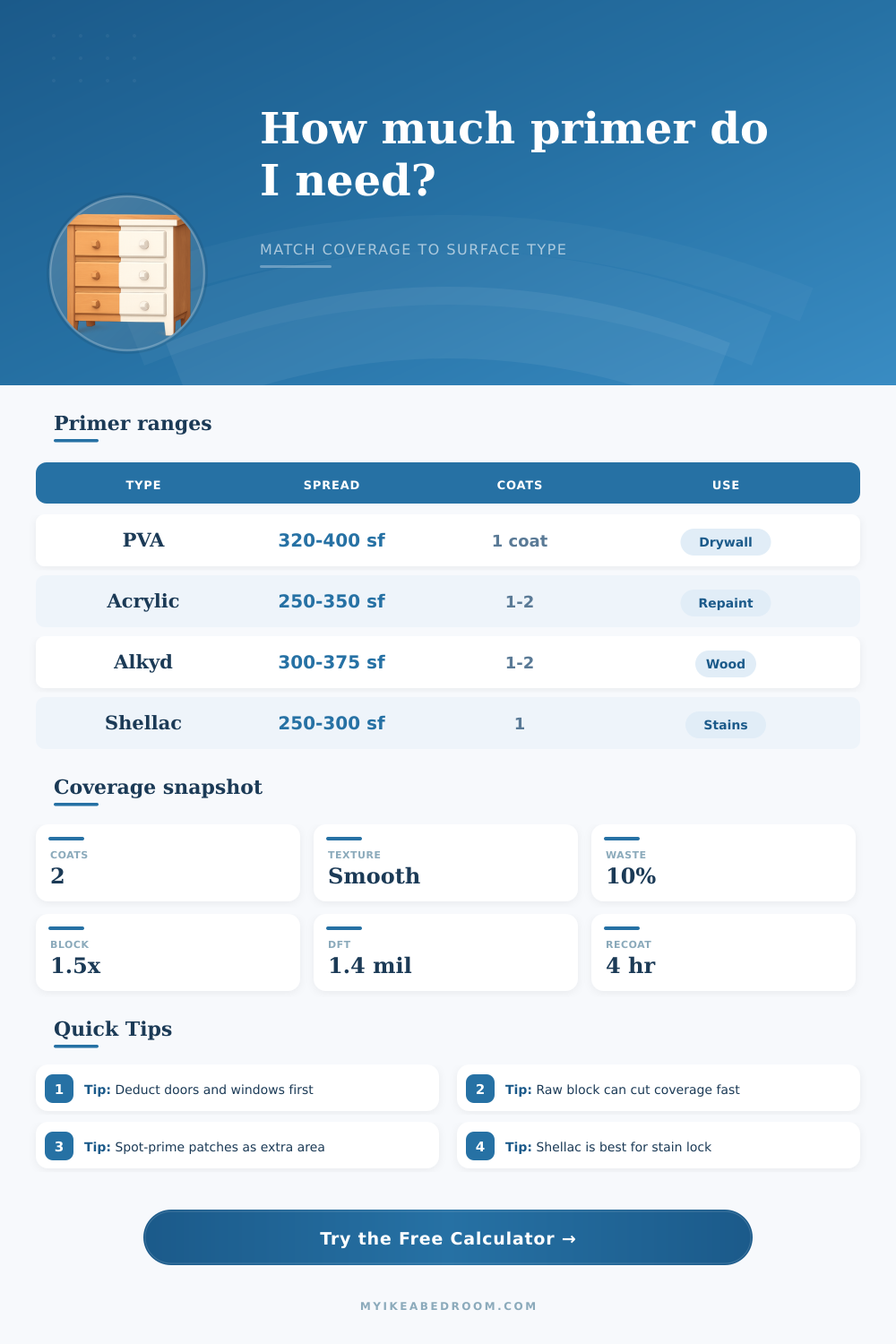
Typical field-planning ranges for interior and exterior primers. Always compare with the product data sheet on the can you will actually use.
Use the grid below when you need to match adhesion, sealing strength, and surface porosity to the right primer family before estimating coverage.
Primer is a substance that are applied to the walls before the application of paint. However, many peoples believe that they can calculate the amount of primer needed by looking at the spread rate of the primer on the primer can and multiplying that number by the total square footages that will be painted. However, this will lead to a shortage of primer because different surface will absorb the primer at different rates.
Therefore, besides the area that must be covered with primer, a person must also consider other factors that will affect the amount of primer needed. The porosity of the surface will affect the amount of primer that that surface absorbs. For example, one of the most porous surfaces is drywall.
Things That Affect How Much Primer You Need
This is because drywall contain paper and joint compound that is both highly porous to the liquid primer. Therefore, primer will dissapear quick on a drywall surface as compared to a drywall surface that has already been painted. Another example of a highly porous surface is cedar wood.
Therefore, people will need more primer to treat cedar wood than drywall. A person must take this into consideration when estimating the amount of primer that will be needed for a project. Another factor that will affect the amount of primer that a person must use is the primer application method.
Using a short nap roller will place a thin and even layer of primer on the wall. However, using a thick nap roller will allow for more primer to be placed onto the wall. Using a spray method will waste some of the primer as it may not be able to be sprayed onto the wall.
Some of the primer will also be lost in the paint tray or the roller sleeve. Therefore, a person must account for this when calculating the amount of primer needed. Adding 10% to the total amount is a common technique used.
The different types of primer will have different spread rates. For example, people use PVA primer to seal drywall, and most people use PVA primer because it is inexpensive. However, if the paint to be applied to the walls is glossy, then an acrylic primer will be used to provide better adhesion between the paint and the wall.
Additionally, if the walls will be treated with wood that contains tannins, an alkyd primer should be used to seal the tannins. The chemical composition of the primer will impact the spread rate of the product. Therefore, people must choose the correct type of primer for the given project.
Finally, the texture of the wall will impact the amount of primer that will be needed for the project. For example, if the walls have an orange peel texture or a stipple texture, the texture will contain more area than a flat painted wall. Therefore, more primer will be needed to ensure the entire area is covered by primer.
Split face block has many small crevices in the cement. Therefore, split face block will take more primer than a smooth cement wall. A person must consider the texture when choosing the amount of primer to buy for the project.
To determine the amount of primer needed, a person can use the following steps. First, calculate the total square footage of the walls that will be treated and subtract the area that will not be treated. Then, account for the porosity of the surface and the texture of the area.
Next, account for the primer waste that may be lost during application. Finally, refer to the technical data sheet on the primer can to determine the spread rate of the primer. By using these steps, a person will have enough primer to complete the project but will not have so much primer that it will go to waste.