Pool Cover Size Calculator
Calculate rectangle, oval, or round pool cover dimensions with overlap allowance, finished area, square meter conversion, water bag count, and anchor count.
Choose a common pool size, then adjust the overlap, cover type, spacing, and rounding rule for the actual cover plan.
Enter the waterline pool size. The calculator adds overlap to every edge, rounds the order size upward, and shows both square feet and square meters.
Cover size result
Order cover size
19x35 ft 5.79x10.67 mCover area
665 sq ft 61.8 m²Pool area
512 sq ft 47.6 m²Bags / anchors
27 / 36 water bags / anchors| Pool example | Shape | Overlap | Rounded cover size | Cover area |
|---|---|---|---|---|
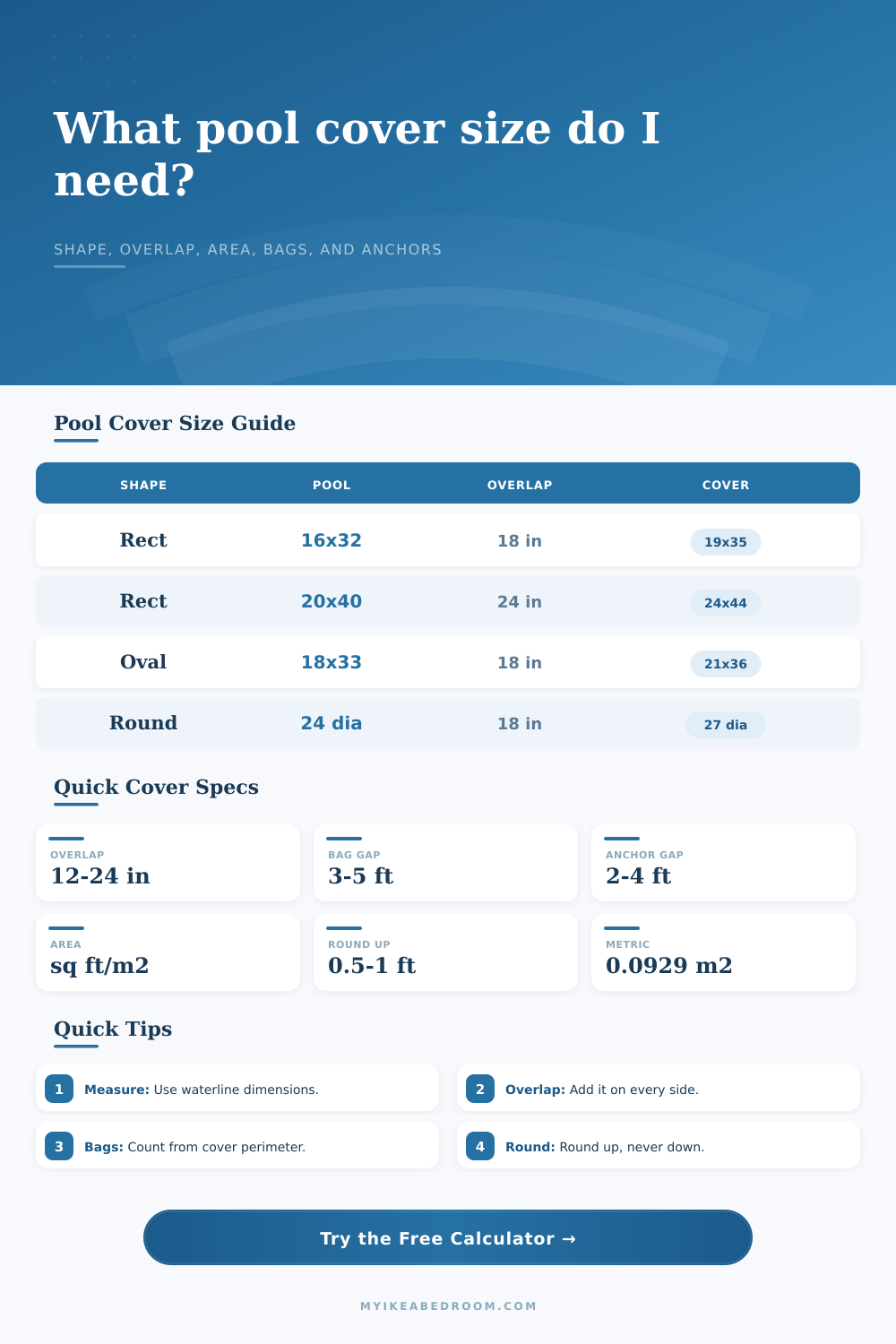
| 12x24 ft lap pool | Rectangle | 18 in each side | 15x27 ft | 405 sq ft / 37.6 m² |
| 16x32 ft backyard pool | Rectangle | 18 in each side | 19x35 ft | 665 sq ft / 61.8 m² |
| 20x40 ft large pool | Rectangle | 24 in each side | 24x44 ft | 1056 sq ft / 98.1 m² |
| 15x30 ft oval pool | Oval | 18 in each side | 18x33 ft | 594 sq ft / 55.2 m² |
| 18x33 ft oval pool | Oval | 18 in each side | 21x36 ft | 756 sq ft / 70.2 m² |
| 24 ft round pool | Round | 18 in each side | 27 ft diameter | 573 sq ft / 53.2 m² |
| Overlap each side | Total added to length | Total added to width | Best used for |
|---|---|---|---|
| 12 in / 30 cm | 2 ft / 0.61 m | 2 ft / 0.61 m | Trim-style solar blankets or very controlled edge layouts. |
| 15 in / 38 cm | 2.5 ft / 0.76 m | 2.5 ft / 0.76 m | Compact above-ground pools with a modest edge allowance. |
| 18 in / 46 cm | 3 ft / 0.91 m | 3 ft / 0.91 m | Common winter covers where water bags sit beyond the pool edge. |
| 21 in / 53 cm | 3.5 ft / 1.07 m | 3.5 ft / 1.07 m | Pools with coping, step areas, or a less even perimeter edge. |
| 24 in / 61 cm | 4 ft / 1.22 m | 4 ft / 1.22 m | Large winter covers, higher wind exposure, or deeper bag placement. |
| Edge support | Typical spacing | Count formula | Measurement basis |
|---|---|---|---|
| Water bags | 3 to 5 ft apart | Cover perimeter divided by spacing, rounded up | Use the finished cover perimeter, not the waterline perimeter. |
| Safety anchors | 2 to 4 ft apart | Cover perimeter divided by spacing, rounded up | Closer spacing is common near corners, steps, and raised obstructions. |
| Round cover cable | Follow full circumference | Finished diameter times pi | Round pools use circumference for bag and anchor counts. |
| Oval cover edge | Use estimated oval perimeter | Ramanujan oval perimeter approximation | Useful for support count; order size still uses length by width. |
| Rectangle corners | Add one support at corners | Rounded count plus corner check | The calculator rounds up, but corners may need deliberate placement. |
| Shape | Pool area formula | Cover dimension formula | Perimeter formula |
|---|---|---|---|
| Rectangle | Length x width | (L + 2 overlap) by (W + 2 overlap) | 2 x cover length + 2 x cover width |
| Oval | Pi x length x width / 4 | (L + 2 overlap) by (W + 2 overlap) | Ramanujan estimate from cover axes |
| Round | Pi x radius squared | Diameter + 2 overlap | Pi x finished cover diameter |
| Metric area | Square feet x 0.092903 | Feet x 0.3048 = meters | Feet x 0.3048 = meters |
Measuring your pool might seem easy, right? But wait, now you are not just measuring water. You are also measuring how high the water is from the ground, how much your deck slope, and how much that fabric will blow up in the wind when it is chilly outside.
The reality is: buying a cover identical to your pool measurements will never work. It has to have some overlap. This is the error most people make. And that is exactly why having a specific calculator prevents an expensive mistake.
Why You Need a Pool Cover Calculator
But it’s the inputs that count most of all. You put in your pool length and width, and then you’re talking about base area, sure. But the overlap is what really does it. That’s the stuff beyond the pool perimeter, typically eighteen to twenty-four inches, where you anchor things down or tuck water bag under. If there were no overlap, the cover would be nestled inside the coping and not touching the ground, with spaces for heat loss and space for stuff to creep through.
So we tell it the shape: round or oval or rectangle, and then we give it base using those raw waterline measurements. And it figures out the rest of the geometry, rounding it up so the dimension make sense for delivery and adding in that overlap on each side. Then it calculates total square footage that you’ll get and shows you what you’re buying. It also translates that surface area into square meters. This might make life easier if you like working in metrics or if you has an overseas supplier.
How about the shape of your pool? Easy enough to figure if it’s a rectangle, but what about an oval? When placing your order, the calculator assume the shape is a rectangle based off the footprint of the cover. It then uses a math approximation for the round ends to find the true surface area covered. That matters because you are paying by the rectangle ordered, yet swimming on the oval. The math is explained well in the tool and will show you both pool area and the cover dimensions, so you can visualize how much more goes onto the extra curves of your oval.
It even provides an estimate as to how many anchors or water bags you’ll need, based off the perimeter of the final installed cover, rather than just the pool perimeter. Don’t calculate your hardware based on the waterline, or you’ll run out of bags halfway around the deck.
Covering a pool requires more than math; there’s also a rhythm to how you’ll cover it. You need preparation and timing. Ideally, you’d like to get it covered when most of the leaves fall but not before the first hard frost sets in. Do it too soon, and you’ll find yourself picking out debris from beneath the cover. Too late, and then you’re battling ice. Your brain provides the timetable (it’s your judgment), while the calculator provide the figures.
How will you store the cover during the summer? That’s another consideration, a big safety cover is not only heavy but bulky. It needs someplace dry where you can roll it up and keep it. A lightweight solar blanket isn’t as easy on rough concrete surfaces; it’ll tear if it were dragged around. Those are just some examples that will cause different amounts of anchor spacing or overlap. It all depends on the type of cover, and you can adjust those in the tool. For instance, a mesh-top safety cover need accurate anchor positioning for handling foot traffic, whereas a heavy winter tarp may require more overlap then a solar blanket.
Don’t skimp on rounding up: The calculator might tell you to order a nineteen by thirty-five foot cover, but don’t attempt to trim costs by ordering an eighteen by thirty-four. That little bit less is enough to cause the edges to stretch out as they tighten, pulling against the grommets and creating the possibility of ripping the cover. That little margin can make the difference between a long life of use and short term use.
For more common pool sizes, the reference tables included next to the calculator provide a handy sanity check that your custom measurements are roughly what you’d expect in the industry. Actualy, it should of helped too.
A pool cover is a shield. It is a shield for the ladder, a shield for the chemicals, and a shield for the warm water. And how do we protect our investment? How do we get it right? Get the size correct. You can argue all afternoon with the calculator and the tape measure, or let the tool do most of the work for you while you worry about getting the deck ready. Once you know what to measure, the math is easy.