Pond Liner Size Calculator
Estimate the liner sheet length, width, square footage, roll orientation, seam risk, edge allowance, shelf effect, and material weight for patio ponds, koi ponds, wildlife pools, raised boxes, and irregular garden basins.
Flexible rubber
Best fit: freeform ponds, shelves, rounded corners, and stones.
EPDM and butyl tolerate folds well, so the calculator uses a modest handling buffer.
Reinforced sheets
Best fit: wider spans, boxier basins, and sites where lower weight helps.
RPE has good strength but needs cleaner folds at ledges and corners.
Polyethylene
Best fit: large simple excavations and formal geometry.
LLDPE bends more readily than HDPE; HDPE often needs professional seaming.
PVC sheets
Best fit: small water features with simple edge details.
PVC is light and manageable, but shape buffer matters around curves and shelves.
| Top opening | Depth | Edge each side | Base liner formula |
|---|---|---|---|
| Length by width at rim | 18 in | 12 in | L + 5 ft by W + 5 ft |
| Length by width at rim | 24 in | 15 in | L + 6.5 ft by W + 6.5 ft |
| Length by width at rim | 36 in | 18 in | L + 9 ft by W + 9 ft |
| Length by width at rim | 48 in | 18 in | L + 11 ft by W + 11 ft |
| Edge detail | Dry lip | Anchor fold | Use in calculator |
|---|---|---|---|
| Small patio pond | 4 to 6 in | 6 to 8 in | 10 to 14 in per side |
| Rock coping edge | 6 to 8 in | 8 to 12 in | 14 to 20 in per side |
| Planting shelf edge | 6 to 10 in | 10 to 12 in | 16 to 22 in per side |
| Raised timber box | 3 to 5 in | 4 to 6 in | 7 to 11 in per side |
| Material | Typical widths | Weight basis | Seam note |
|---|---|---|---|
| 45 mil EPDM | 10, 15, 20, 25, 30, 40, 50 ft | 20 oz per sq yd | Often available factory seamed |
| 30 mil PVC | 10, 15, 20, 30 ft | 14 oz per sq yd | Keep seams above simple slopes |
| 30 mil reinforced PE | 12, 15, 20, 24, 30, 40 ft | 12 oz per sq yd | Prefer clean, broad folds |
| 60 mil HDPE | 15, 20, 22.5, 30 ft | 28 oz per sq yd | Usually needs heat welding |
| Pond type | Top opening | Depth | Estimated ordered sheet |
|---|---|---|---|
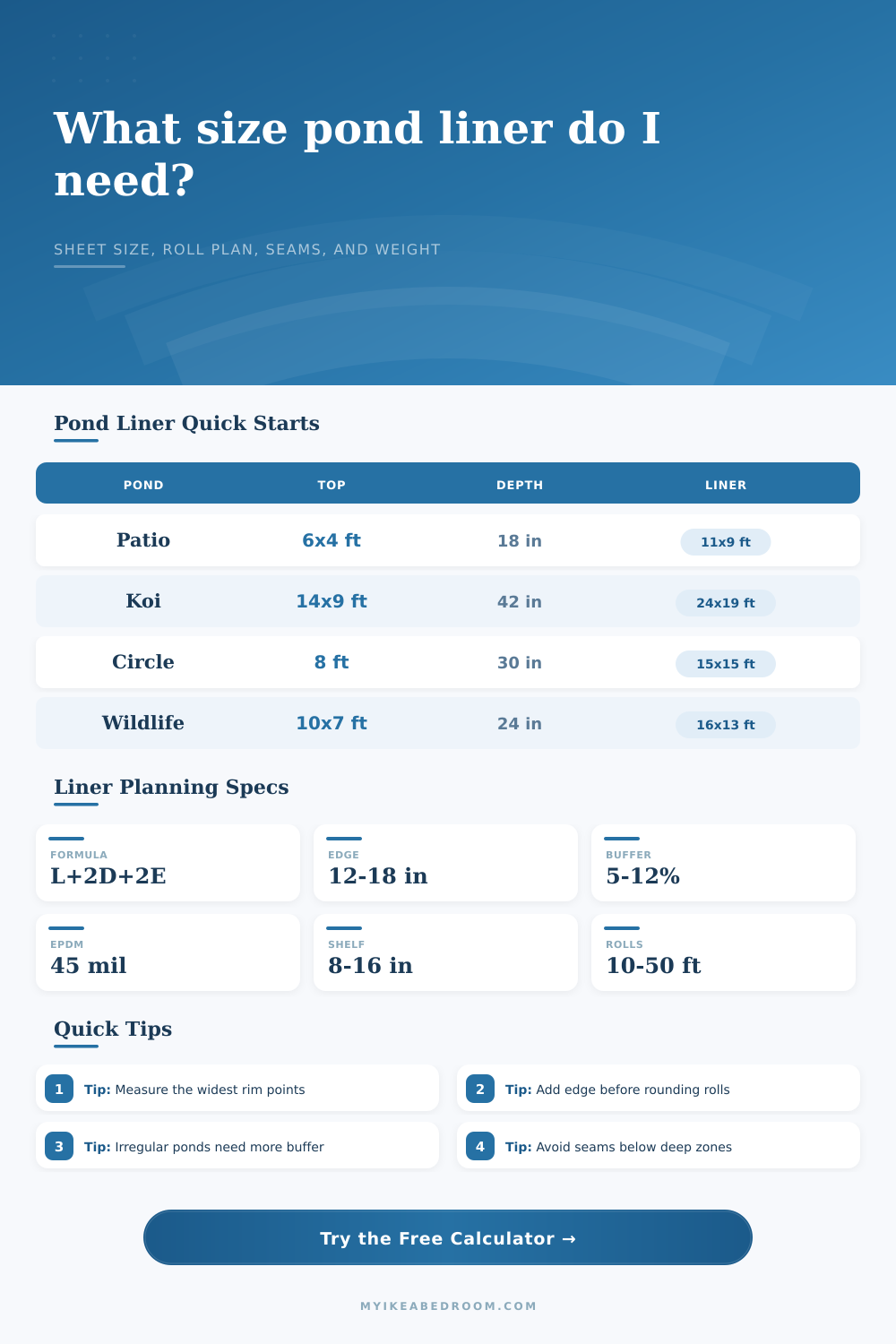
| Patio bowl | 6 by 4 ft | 18 in | 12 by 10 ft |
| Wildlife shelf pond | 10 by 7 ft | 24 in | 18 by 15 ft |
| Small koi pond | 14 by 9 ft | 42 in | 25 by 20 ft |
| Round feature pond | 8 ft diameter | 30 in | 16 by 16 ft |
Measure outside the finished waterline. The sheet formula assumes the entered length and width are the top rim opening, not the smaller flat floor at the bottom.
Keep edge allowance separate from buffer. Edge allowance is physical liner that stays at the rim; buffer is extra area for folds, trimming, and roll availability.
A common mistake most of us make when building ponds is using an undersized liner. Pick out your material, dig your hole and then realize this sheet doesn’t even come close to reaching the anchor trench. It is frustrating. The usual result is either a clumsy seam job or another trip to the store.
Sizing these things isn’t rocket science, but the geometry of your excavation make it easy to screw up. You’re not simply laying down some sort of rectangle on the ground. Instead you’re wrapping something with complex edges, varying slopes and different depths. And it isn’t hard to get the hang of basic concept.
How to Pick the Right Size Pond Liner
Simply measure widest part of the opening of your pond, add twice the maximum depth, and then add on amount of liner needed to cover your buried/anchored edges. In other words: if your pond is 20 feet wide at its widest end but only 3 feet deep anywhere in it, you’re going to need double the width plus the length needed to go all the way across. You also needs some extra room for error.
Then the liner will extend from one rim through the deepest water up to the opposite rim, leaving enough slack to work around pond edges. That’s why the calculator above does the math for you (and even leaves room for the forgotten buffer zone). Because there’s always a buffer. No pond is a perfect rectangle. If yours has an odd kidney shape, a shelf for plants, or a curve somewhere, you will want more material to tuck and fold so you do not stress the seams. That buffer is key.
That buffer gets you thinking different than what material you choose. For instance, why does everyone go with EPDM rubber? Well, it’s tough as nails, flexible, and forgiving; it’ll stretch and bend nicely around shelf edges and rocks without tearing when you need to make a sharp fold. That means you can sometimes get away with a tighter cut because it bends and stretches well.
In contrast, PVC or reinforced polyethylene is more rigid (some might say strong, but not necessarily in all ways) and far less pliable. This rigidity make it hard to fold up on itself and force into tight corners or stepped shelves; you risk tearing those rigid materials if you do. So the tool adjusts how difficult it is to handle and estimates weight based off which material you choose.
And it even checks whether your needed sheet size matches commonly available roll sizes from suppliers. This is a huge practical benefit. If the material won’t be typically made in your needed size (e.g., you require a 25′ by 25′ sheet), knowing this doesn’t help. And if it’s only made in smaller widths, then you’ll have to join two rolls and add another potential source of failure. This alerts the calculator to raise a red flag for you, so that you can specify the proper sizes from the beginning.
The other thing that catches folks off guard is the edge allowance. That is not excess fabric; that’s what’s on top of the water line (and underneath when buried by coping stones or anchored in a trench). Cut it too low and as time goes on, the liner settles down, sliding closer to the bottom. Leaving the rim exposed and subject to crud and algae. A nice big edge provides wiggle room and keeps things in place.
All this comes down to finding the sweet spot between art and science, your pond should look natural, and its liner should fit inside it comfortabley without undue stress. The best size is not only economical but leak-proof and won’t cause you worry (nothing like seeing your water level going down to give you the willies).
Best advice: Go with a bit more than you think you need; you can always cut off excess but you never know if you’ll have too little on fill-in day. You should of gotten a bigger size from the start. It is actualy better to have extra furnitures for the edges.