Plywood Weight Capacity Calculator
Estimate plywood shelf and panel capacity from span, depth, thickness, core type, supports, load pattern, deflection limit, safety factor, stiffeners, and moisture condition.
Pick a common cabinet, closet, bed, drawer, pantry, or workbench setup, then adjust the real dimensions and support details.
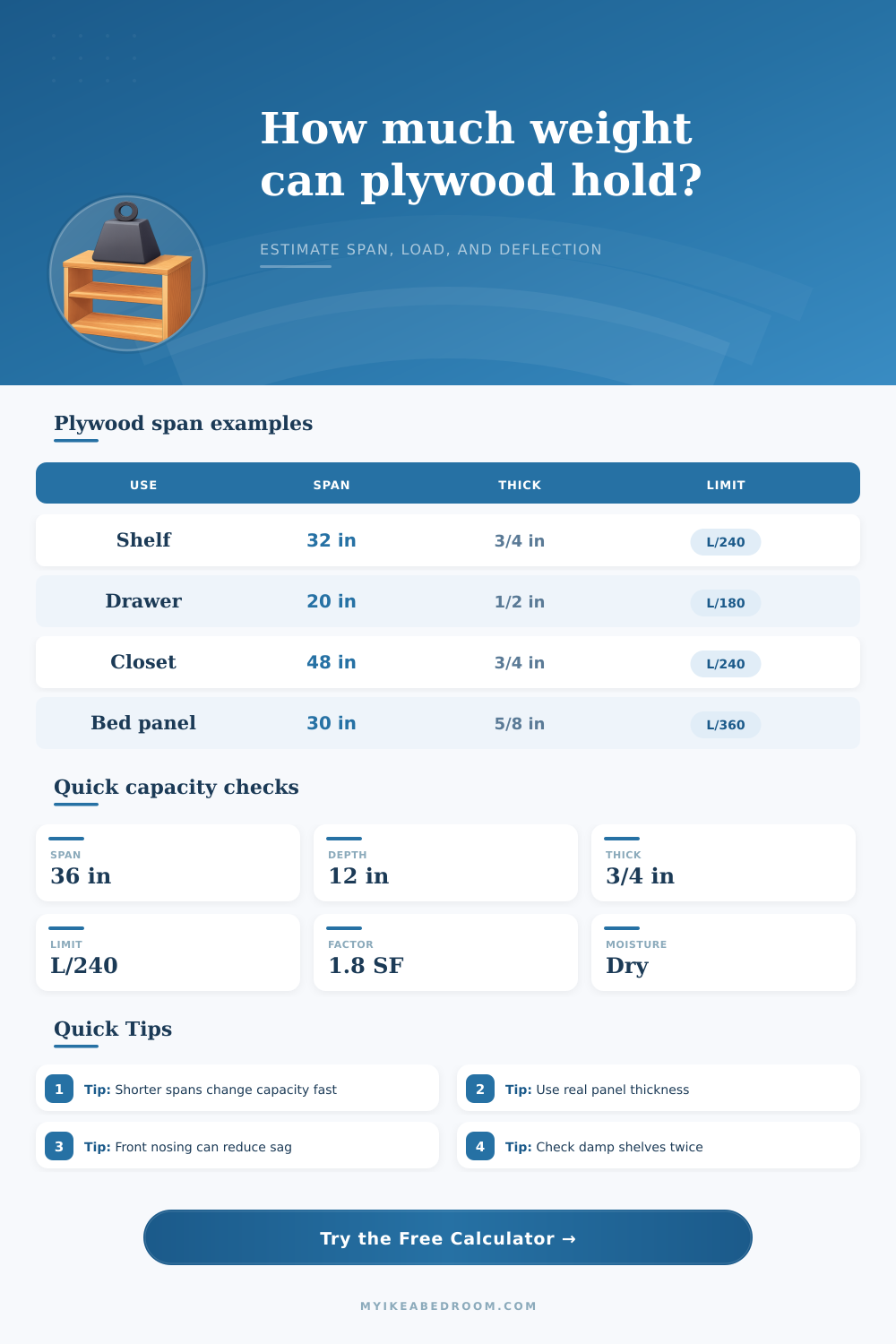
Sag control: Thickness matters more than most users expect because stiffness changes with thickness cubed. A small increase in thickness or a glued hardwood front nosing can reduce visible sag.
Support reality: A shelf sitting loosely on pins behaves differently from a shelf captured in dados or supported by a back cleat. Use the support option that matches the weakest real connection.
Plywood often tends to bend without warning. Plywood sag under the weight of the objects that are placed on the plywood; the weight of the plywood cause the plywood to bow. If the plywood bows, the middle of the plywood shelf will be lower than the ends of the shelf.
This will cause the items that are placed on the plywood shelf to slide towards the center of the shelf. By using a calculator, you can determine the load capacity of the plywood that will be use for the project. The capacity of the plywood depends on several specific factor.
Why Plywood Shelves Sag and How to Make Them Stronger
The factors that relate to the capacity of the plywood are the span of the plywood, the depth of the plywood, the thickness of the plywood, and the support condition of the plywood. The span of the plywood is the distance between the supports for the plywood. The span is one of the critical factor for the capacity of the plywood; increasing the span of the plywood will reduce the capacity of the plywood cubicly.
For example, increasing the span of the plywood by a few inches may reduce the capacity of the plywood to half of it’s initial capacity. The depth of the plywood is another of the critical factors for the plywood; the depth of the plywood is different from the span, however. If the plywood is 16 inches deep as opposed to 10 inches deep, the shelf will be stiff.
The thickness of the plywood is another critical factor; the stiffness of the plywood is related to the cube of the thickness of the plywood. Thus, increasing the thickness of the plywood will have a more greater effect on the stiffness of the plywood than changing the species of plywood that is used. The support conditions for the plywood will also impact the capacity of the plywood.
For example, if the plywood shelf rests on pins at each end of the shelf, the shelf is free to rotate slightly when weight is placed on the shelf. However, if a back cleat is added to the shelf, the rotation of the shelf is restrained. Restraining the rotation of the shelf will increase the bending capacity of the shelf and the amount of weight that the shelf will allow before it begins to sag.
The calculator accounts for these different support conditions. Furthermore, the load that is placed upon the shelf will also impact the capacity of the plywood. For example, if a heavy box is placed in the center of the shelf as opposed to books that are evenly distributed across the shelf, the effect on the plywood will be different.
The distribution setting of the calculator will allow the calculator to take into account the load that will be placed upon the plywood. The moisture content of the plywood will also have an impact upon the load that the plywood can bear. For example, plywood may be manufactured with an 8 percent moisture content.
However, if the plywood is stored in a garage or a laundry area, its moisture content can reach to 14 or 15 percent. An increase in the moisture content of the plywood will reduce both the stiffness and the bending strength of the plywood. These options in the calculator will account for these reduction in strength.
The treatment of the edges of the plywood will impact the stiffness of the plywood. For example, a thin banding on the edge of the plywood will have a minimal impact upon the stiffness of the plywood. However, adding a glued hardwood nosing or a cleat on the front edge of the plywood can increase the stiffness of the plywood by a factor of two or more.
The deflection limits of the plywood are the measurements of how much the plywood can bend. For example, an L/240 deflection limit in the range of 1/8 inch to 1/4 inch in the middle of the shelf for cabinets is common. An L/360 deflection limit in the range of 1/16 inch to 3/16 inch in the middle of the shelf for furniture is more common.
The deflection limit will have an impact upon the load the plywood will bear. For example, it is recommended to use a safety factor of 1.8 in calculating the load of the plywood; it is also recommended to use a safety factor of 2.2 or 2.5 in situations that include the weight of people or that may change in relation to the humidity in the area where the plywood will be used. The actual plywood may not meet the specifications that may be published about the plywood; the actual thickness of the plywood may be thinner than the thickness that is specify, and there can be voids in the plywoods core and variations in the plywoods glue lines.
Furthermore, it is also common for those building the shelf to add supports to the plywood in the middle or at the front of the shelf, even if the calculations indicate that the plywood will be adequate for the task. The tables included on the calculator are for quick reference, and they indicate the spans of the plywood given its thickness, and the effect that different support types will have upon the plywood. Scanning these tables will show that adding a nosing to the plywood or reducing the span between supports will have a greater impact upon the plywood than purchasing a higher grade of plywood.
By running the numbers, it will be possible to determine the weight that will be carried by the plywood shelf. For example, the weight of a closet shelf that is used to store sweaters will have different impact upon the plywood than a shelf that is used to store heavy boxes of books. Thus, the planned load for the plywood shelf can be tested in the calculator.
The same is true of shop projects; for example, a workbench shelf will have a different load specification than a shelf for a desk. Thus, the goal is to reach a result in the calculator that ensures the plywood shelf feels stable once it is built and used with the specified load. Thus, the calculator has removed the guesswork regarding the strength of plywood, and allows for decisions to be made with clear information about that strength.