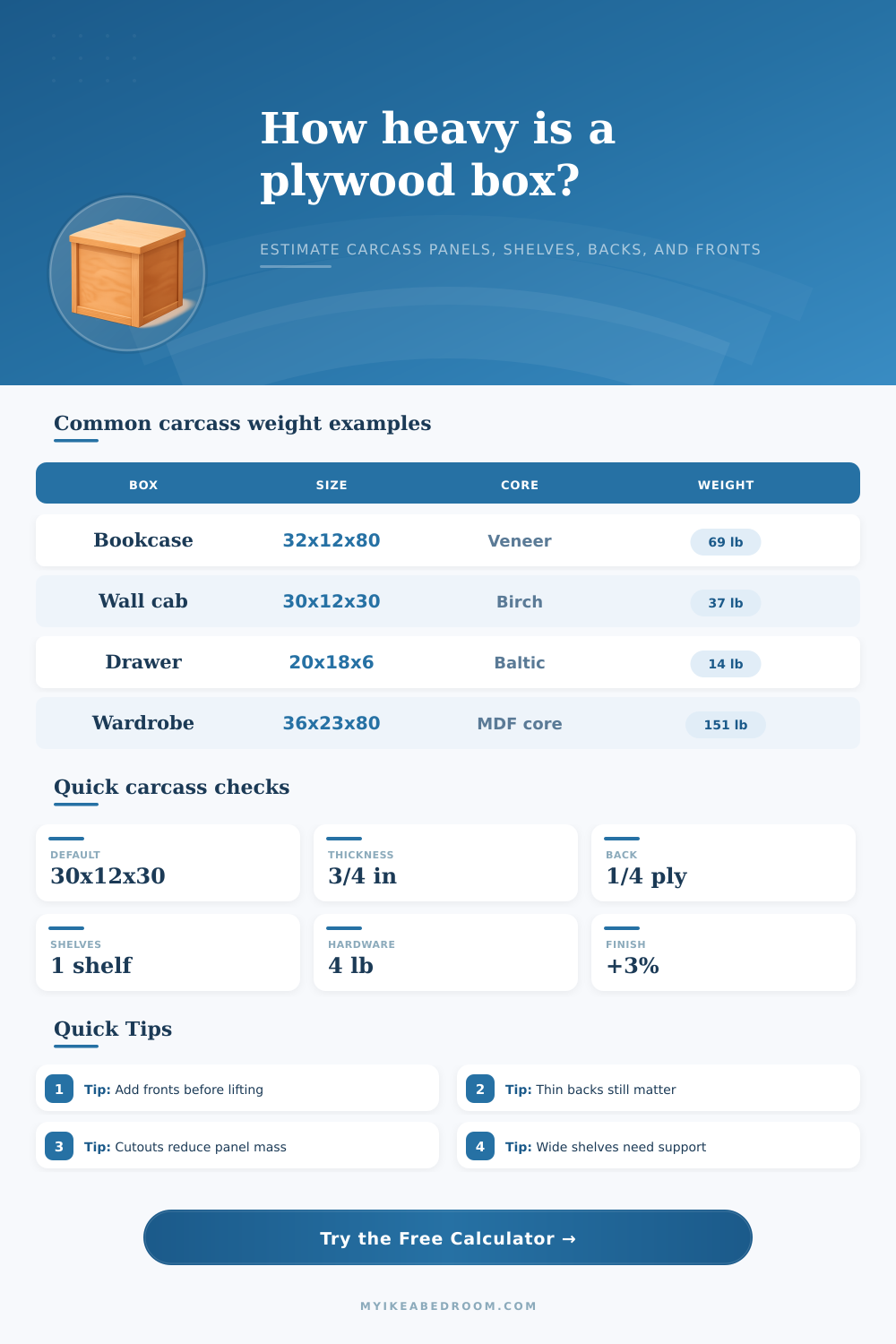
Cabinet carcass weight planner
Plywood Box Weight Calculator
Estimate a plywood cabinet box from outside width, depth, height, panel thickness, core density, back panel, shelves, fronts, openings, hardware, finish, and moisture allowance.
Choose a common cabinet, storage, or furniture box, then adjust panel thickness, back style, shelves, fronts, cutouts, hardware, and finish factor.
Weight summary
Panel-by-panel weight
| Core type | Planning density | Metric density | Typical use |
|---|---|---|---|
| Poplar core plywood | 32 lb/ft³ | 513 kg/m³ | Light drawers, small storage boxes |
| Softwood plywood | 34 lb/ft³ | 545 kg/m³ | Shop bins, utility carcasses |
| Veneer-core hardwood | 38 lb/ft³ | 609 kg/m³ | Cabinet boxes and bookcases |
| Birch cabinet plywood | 42 lb/ft³ | 673 kg/m³ | Shelves, casework, visible interiors |
| Baltic birch plywood | 45 lb/ft³ | 721 kg/m³ | Drawer boxes and strong compact cases |
| MDF-core plywood | 48 lb/ft³ | 769 kg/m³ | Flat painted doors and wardrobe panels |
| Back option | Thickness used | Area factor | Weight behavior |
|---|---|---|---|
| Open back | 0 in | 0% | Lightest, least racking resistance |
| 1/8 in hardboard | 0.125 in | 100% | Small weight increase, useful dust back |
| 1/4 in plywood | 0.25 in | 100% | Common cabinet back estimate |
| 1/2 in plywood | 0.50 in | 100% | Noticeable weight, stronger fastening |
| Same as carcass | Main panel | 100% | Heavy case backs and structural boxes |
| Recessed back | 1/4 in | 90% | Allows rabbet lips and clearances |
| Preset | Nominal size | Added parts | Use the result for |
|---|---|---|---|
| BILLY-style bookcase | 31.5 x 11 x 79.5 in | 5 shelves, hardboard back | Room carry and anchoring plan |
| Wall cabinet carcass | 30 x 12 x 30 in | 1 shelf, pair doors | French cleat or rail load check |
| Drawer box | 20 x 18 x 6 in | One front, open back | Slide rating and removable drawer weight |
| Wardrobe cabinet | 36 x 23 x 80 in | 3 shelves, pair doors | Two-person handling and tip risk |
| Under-bed box | 38 x 24 x 7 in | Open top style estimate | Rolling storage and lift weight |
| Shelf span | 3/4 veneer ply | 3/4 birch ply | Planning note |
|---|---|---|---|
| 18 in | 60 lb | 70 lb | Short cubbies can carry dense stacks |
| 24 in | 45 lb | 52 lb | Good general cabinet shelf range |
| 30 in | 35 lb | 41 lb | Use for books only with care |
| 36 in | 28 lb | 33 lb | Add edging, pins, or center support |
| 48 in | 21 lb | 25 lb | Long shelves need a design check |
Open back
Lowest weight but the center of mass stays near the middle depth. Add a back if the box needs racking resistance.
Full slab fronts
Front-heavy boxes feel different during installation because the center of mass moves toward the door plane.
Dense cores
MDF-core and particle-core panels can add surprising weight to tall wardrobes and wide painted doors.
Many shelves
Shelf count often weighs more than the back panel in bookcases, media towers, and pantry cabinets.
Handling tip: Calculate once with fronts installed and once with fronts removed. The total may be close, but the center-of-mass note can change the way the box wants to tip during lifting.
Shelf tip: Treat the shelf load result as a planning estimate, not an engineering rating. Long spans, weak shelf pins, heavy books, and missing front edging can reduce usable load quickly.
Plywood cabinets and plywood boxes are essential component of many woodworking projects. The weight of plywood cabinets and plywood boxes must be considered prior to finishing the project. Although plywood cabinets may feel very lightly while working on the project in the shop, they may be too heavy to move once finished and hung on a wall by two people on a ladder.
The weight of plywood cabinets change due to the materials selected to make the cabinets, spesifically in relation to the choice of backs, shelves, and hardware. The calculator included with this article will allow you to calculate the weight of your plywood cabinets after entering the dimensions of the cabinets and the details of the materials to be use in its construction. The thickness of the plywood cabinets is one variable that will impact the weight of the cabinet, but the density of the plywood will also have an impact on the weight.
How Much Do Plywood Cabinets Weigh
Two pieces of plywood may appear to be the same, but they could have different weight based off the type of core in each piece of plywood. For instance, plywood with a Baltic birch plywood core will weigh more than plywood with a poplar core. Additionally, plywood with an MDF core will weigh more than plywood with a Baltic birch plywood core.
The calculator will convert these different densities to weights of the plywood panels so that you dont have to guess at the weight of your tall cabinets or multiple cabinets. The type of back that you will use for the plywood cabinet will impact the weight of the cabinet. Backs for plywood cabinets cover the height and the width of the cabinet.
Using a quarter-inch plywood back will add to the weight of the cabinet. Using an open back will reduce the weight of the cabinet; however, the cabinet may be more prone to racking with an open back. Not only will the type of back impact the weight of the cabinet, the type of back will also impact whether the cabinet stand on its own or whether it relies upon other cabinets for support.
Shelves will impact the weight of the cabinet. Full-depth shelves will add to the area and the weight of the cabinet. The span of the shelves is more important then the weight of the shelves.
If the shelves are going to hold books or dishes, they may sag in the middle. The calculator will provide an estimated load rating for each shelf that will allow you to determine whether it will need a center support or whether it will need thicker shelves. This estimate isnt a guarantee, but it will allow you to have a better understanding of the strength of the shelves.
The type of front door that are to be placed on the plywood cabinet will impact the weight of the cabinet. For instance, if you use slab doors on the cabinet, the doors will add to the weight of the cabinet. Additionally, they will move the center of mass of the cabinet forward, which may cause it to tip when lifted from the sides.
The calculator will include a handling note to alert you to this so that you do not encounter this problem when your hanging the cabinet on the wall. It may be better to remove these doors during the construction of the cabinet and to re-install them after the cabinet has been hung on the wall. Hardware and finishes for plywood cabinets are very small components.
However, they will add to the total weight of the cabinet. For instance, screws, hinges, drawer slides, paint, and laminate will all increase the weight of a plywood cabinet. Additionally, plywood panels that contains moisture will weigh more than dry plywood.
The calculator will account for the moisture content so that the total weight reflects the actual weight of the cabinets. Cutouts for plywood cabinets, such as areas for electrical wires or vent openings, will remove some of the area and mass of the cabinet. The cutout will not remove a significant amount of mass from the cabinet unless it is a very large cutout.
However, the cutout may have an impact on the way in which the cabinet is handle. For instance, removing some of the mass from the back of a wardrobe carcass will make it easier to move. However, it will also reduce its structural strength.
The calculator will account for the area of any cutouts. It is common for people to make mistakes when building plywood cabinets. Many people dont consider the weight of the cabinets until they are finished.
When they add the shelves and doors to the cabinets, they do not calculate the weight that these components will add. If they do not calculate the weight of the cabinets, their plywood cabinet may be too heavy for two people to move. By using this calculator for plywood cabinet weights, it is possible to make trade-offs between the thickness of the backs and the support that they will provide, or the weight of the shelves that are to be incorporated into the cabinets.
Another consideration for plywood cabinet projects is in the way that the plywood cabinet will be moved. A wardrobe carcass that weighs 150 pounds may be easy to move on a dolly. However, it may be difficult to move through a doorway or to lift it over your shoulders.
The handling note and estimation of the cabinets center of mass will allow you to determine whether the cabinet will be easy or difficult to move. It is true that real plywood cabinets will likely not be the same as the boxes drawn out in perfect rectangles. You will make a toe kick and scribe allowances at the bottom and the sides of the cabinets.
These allowances will not significantly change the weight of the cabinets. However, they will make it so that the weight calculations provided by the calculator will only be an estimate. The weight of the cabinet can be measured on a bathroom scale to confirm if the calculations match the actual cabinet.
The weight of the plywood cabinets is an essential factor in plywood cabinet projects. For instance, the weight will influence how the cabinets are joined and where the mounting points will be. Run the calculator prior to cutting the plywood panels for your cabinets.
By doing so, you will be able to make your decisions based on the actual weight of each of the types of plywood panels that are to be use in the project. If you calculate the weight prior to beginning your project, you will be able to understand in what way the cabinets will behave when you lift them.