Plate Capacity Per Cabinet Calculator
Estimate how many plates fit by cabinet interior size, plate diameter, stack height, shelf count, and safe shelf load.
🏠Cabinet Presets
📏Cabinet And Plate Inputs
Cabinet Capacity Result
🧱Plate Material Comparison Grid
📊Reference Tables
| Cabinet style | Common interior size | Best plate fit | Planning note |
|---|---|---|---|
| Narrow wall cabinet | 13.5 x 11.5 in | One dinner stack | Good for 6 to 12 plates per level |
| 24 in wall cabinet | 22.5 x 11.5 in | Two dinner stacks | Often fits service plates for 8 |
| 30 in wall cabinet | 28.5 x 11.5 in | Two dinner or three salad stacks | Watch shelf sag with heavy stoneware |
| 36 in base cabinet | 34.5 x 20.5 in | Six dinner stacks | Deep cabinets can hide rear stacks |
| Glass-door display | 28 x 10.5 in | Low visible stacks | Use lower stack height for tidy sightlines |
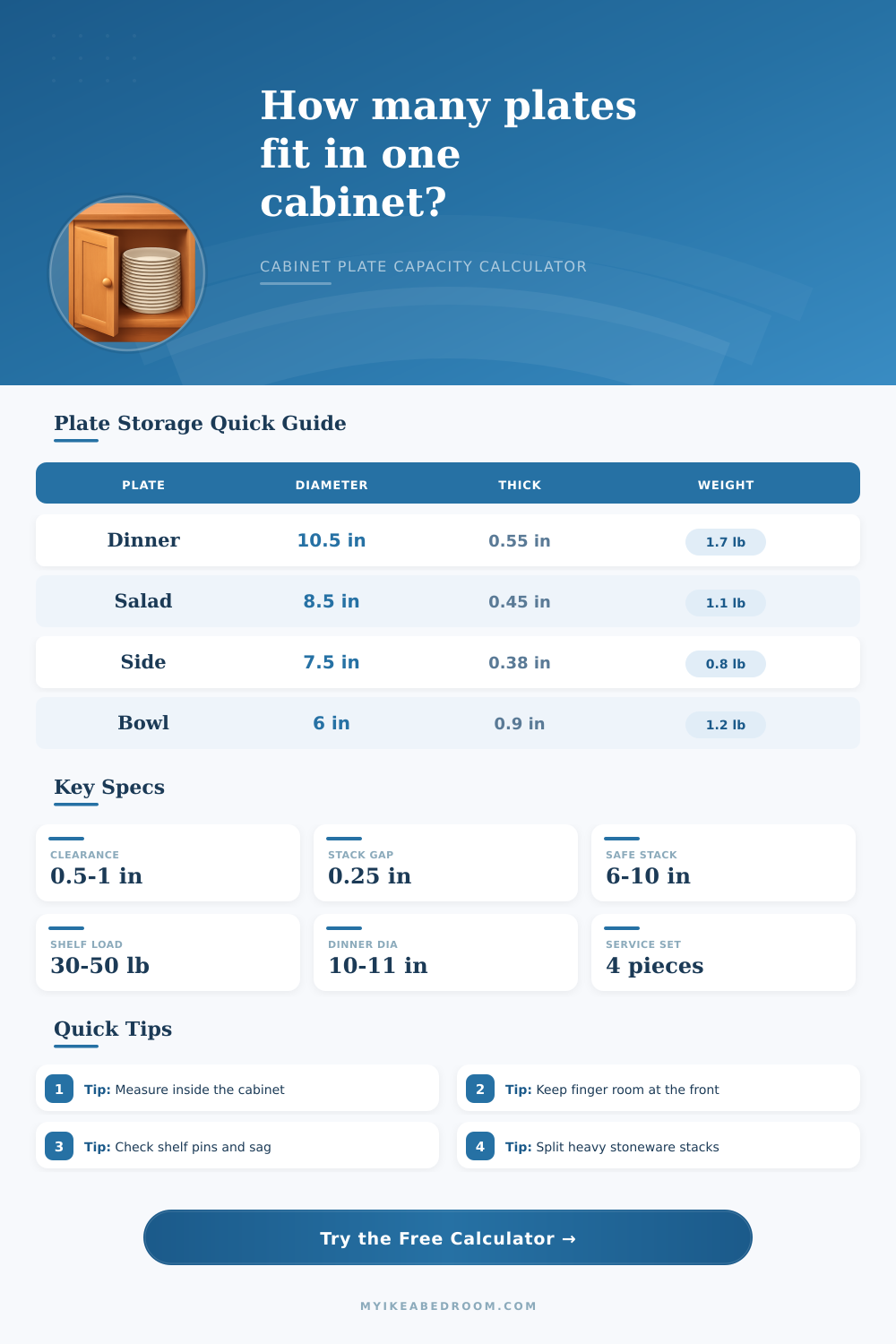
| Plate type | Typical diameter | Average thickness | Typical weight |
|---|---|---|---|
| Dinner plate | 10 to 11 in | 0.45 to 0.65 in | 1.3 to 2.2 lb |
| Salad plate | 8 to 9 in | 0.35 to 0.55 in | 0.8 to 1.3 lb |
| Side plate | 6.5 to 7.75 in | 0.30 to 0.45 in | 0.5 to 0.9 lb |
| Wide rim plate | 11 to 12 in | 0.50 to 0.75 in | 1.8 to 2.6 lb |
| Shallow bowl | 7 to 9 in | 0.80 to 1.20 in | 1.0 to 1.8 lb |
| Shelf load per level | Light plates at 1.0 lb | Porcelain at 1.6 lb | Stoneware at 2.1 lb |
|---|---|---|---|
| 20 lb shelf | 20 plates | 12 plates | 9 plates |
| 30 lb shelf | 30 plates | 18 plates | 14 plates |
| 40 lb shelf | 40 plates | 25 plates | 19 plates |
| 50 lb shelf | 50 plates | 31 plates | 23 plates |
| 75 lb shelf | 75 plates | 46 plates | 35 plates |
| Storage layout | Best use | Capacity effect | Access effect |
|---|---|---|---|
| One low stack | Daily dinner plates | Lower count | Fastest access |
| Two side-by-side stacks | Service for 8 to 12 | Higher count | Easy front access |
| Deep front/back stacks | Base cabinets | Highest count | Rear stack less visible |
| Short display stacks | Glass doors | Moderate count | Neater appearance |
| Split heavy stacks | Stoneware sets | Load balanced | Less shelf stress |
💡Capacity Tips
Cabinet capacity is an important factor to consider when determining how to organize a kitchen. Cabinet capacity is a factor in that it helps to determine how many plates can be stored within the cabinet. Beyond the total number of plates that a person owns, there are various factors relate to the cabinet that can impact it’s capacity.
For instance, if a person places too many plate within a single stack, the plates may become unstable. Similarly, if too many plates is placed upon a shelf within a cabinet, that shelf may sag under the weight of those plates. One of the primary factors that impact cabinet capacity is the size of the plates that are to be stored within the cabinets.
How Many Plates Can a Cabinet Hold
Dinner plates that are large in size will take up additional space on each side of the plate, reducing the number of plates that may be placed within the cabinet. Another of the constraints to cabinet capacity is the depth within the cabinet. The depth of the cabinet may appear to have ample space for the plates to be stored within the cabinets.
However, the depth that the cook can use to place the plates into the cabinet is less than the total depth of the cabinet; the depth of the door take up some of that space, as does the space needed to lift the plates into the cabinet. Height is another of the constraints to cabinet capacity. The height of the plates to be stored within the cabinets will impact the height of the stacks of plates that may be created within the cabinet.
Thicker plates will take up more of the vertical height of the cabinet than thin plates. Thus, fewer stacks can be created with thick plates than with thin plates. Furthermore, the height of the plates also relates to the weight of those plates.
Plates placed within the cabinet will add to the total weight of the cabinet. Each shelf within the cabinet has a load rating; it is the maximum weight that the shelf can hold. For instance, a heavy stoneware plate will weigh more than a lightweight porcelain plate.
Thus, fewer stoneware plates can be placed upon the shelf than porcelain plates. The calculator that is provided helps to mathematically determine the total number of plates that can be stored within a cabinet. The dimensions of the cabinet, the size and weight of the plates, and the load rating of the shelves within the cabinet must each be entered into the calculator.
The calculator will provide a theoretical and a practical number of plates that may be stored within the cabinet. The practical number will be less than the theoretical number; the calculator includes a “handling reserve” within the calculation of the number of plates. This handling reserve is an amount of space that is allowed within the cabinet for the cook to be able to easily access the plates that are stored within the cabinet.
Thus, the plates should not be placed into the cabinet too tight. Another of the factors that will impact cabinet capacity is the materials that are used to produce the plates. For example, stoneware is a heavy material.
Thus, fewer stoneware plates can exist within the cabinets than if the plates were made of a lighter material, such as porcelain or bone china. Similarly, glass and melamine plates are also made of a relatively light material. Thus, there will be more of these types of plates that may be stored within the cabinets prior to reaching the load rating of the shelves within those cabinets.
Many of the mistakes that is made when calculating the cabinet capacity are related to measurement errors. For instance, the measurements that are obtained may be of the outside dimensions of the cabinet, rather than the internal dimensions of the cabinet. The depth that is usable for the cook to place plates into the cabinet is less than the total depth of the cabinet; the door takes up some of that space.
Similarly, some individuals may be focused on the total number of plates that would be stored within the cabinets, but do not consider the weight that each of those plates may add to the cabinets. Again, placing too much weight upon the shelves may result in the shelves sagging. Using a load margin will allow cooks to avoid these types of mistake.
The way within which a person intends to use the cabinets will also impact how the cabinets are organized to maximize their capacity. For instance, a display cabinet that has glass doors may have restrictions upon the heights of the stacks of plates that are placed within the cabinets; the stacks will need to be shorter to appear organized within the display cabinet. In contrast, a deep base cabinet may allow for multiple rows of plates to be stored within that cabinet.
However, the plates that are placed in the second row within such a base cabinet will be more difficult to access than the plates placed in the front row. Thus, the plates that are used the most within a given period of time may be stored in the easily accessible row. Another of the ways within which cabinet capacity may be measured is by measuring the service size of the kitchen.
For instance, one place setting includes a dinner plate, a salad plate, and any other plates that are used in dining. Thus, the total number of plates that are stored within the cabinets may be converted to the estimated number of place setting. This number can help cooks to understand how many individuals can be served using the plates that are stored within the cabinets.
By being able to calculate each of these numbers, an individual can make decisions regarding the organization of there kitchen. For instance, the cook may decide upon adding a new shelf to the cabinets. Or, they may decide to switch to plates that weighs less.
Additionally, the cook may decide to reduce the height of the stacks of plates that are placed within the cabinets. Each of these types of decisions will help to ensure that the cook is able to effectively and efficient store the plates that are used in the kitchen; entering the information regarding both the cabinets and the plates will allow the cook to understand which types of decisions can be made with regard to their kitchen’s organization.